With the 26-man squad to be announced on May 15, Japan heads to North America with an official goal that, for the first time in history, is not “qualify” but “break the quarterfinal ceiling.”
On March 20, 2025, Japan beat Bahrain 2-0 to become the first nation in the world to qualify for the 2026 World Cup. Their final-round qualifying campaign — 6 wins, 2 draws, 1 loss, 19 points from 10 matches — set the record for fewest defeats by an Asian side in a World Cup final qualifying round. A year later, Hajime Moriyasu’s Japan has entered the home straight before the North American tournament.
The opening match is June 11. Japan’s Group F opener is scheduled for June 17, slotted into the bracket immediately after Uruguay vs Sweden. Their group-stage opponents are the Netherlands, Sweden, and Tunisia. A draw Moriyasu publicly called “the group of death.”
May 15 Squad Announcement — 14 Players Effectively Confirmed
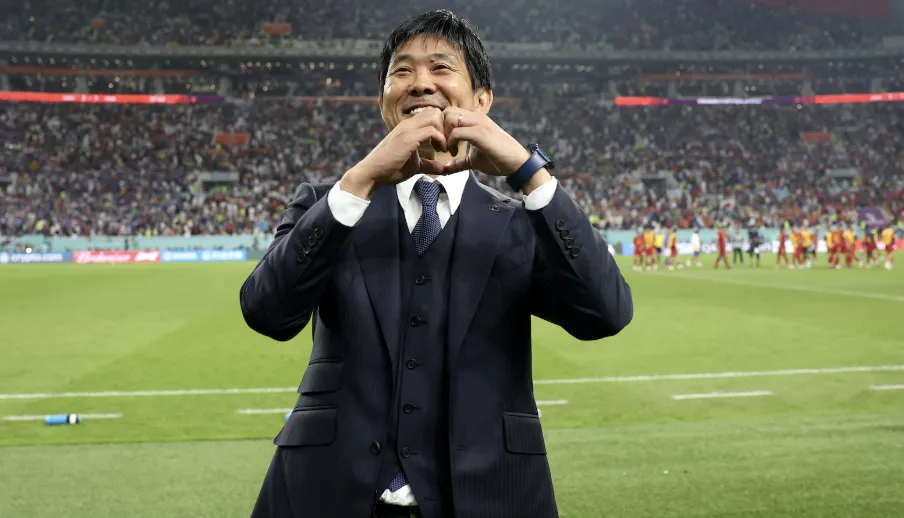
The Japan Football Association announces its 26-man final roster at 14:00 on Friday, May 15, at the Takamado Memorial JFA Yume Field in Tokyo. JFA President Tsuneyasu Miyamoto, National Team Director Masakuni Yamamoto, and head coach Hajime Moriyasu will attend. After the May 31 Kirin Cup match against Iceland at the National Stadium, the squad departs that same night for the pre-tournament training camp in Monterrey, Mexico.
A look at the playing-time rankings under the second Moriyasu regime suggests 14 of the 26 players are effectively locked in.
GK Zion Suzuki (Parma, 1,980 minutes). DF Kō Itakura (Ajax) and Hiroki Itō (Bayern Munich). MF Wataru Endō (Liverpool), Hidemasa Morita (Sporting CP), Ao Tanaka (Leeds United). Wing-backs Kaoru Mitoma (Brighton), Junya Itō (Genk), Keito Nakamura (Stade de Reims). Twin shadow strikers Takumi Minamino, Takefusa Kubo (both Real Sociedad), Daichi Kamada (Crystal Palace). Centre forward Ayase Ueda (Feyenoord). Ritsu Dōan (Eintracht Frankfurt) is in the top five for playing time as well.
The 3-4-2-1 Moriyasu has consistently used is the formation that turned Japan’s victory over Spain at Qatar 2022. Three and a half years later, the spine has not changed. What has changed is the depth. After the Bahrain match, Moriyasu told the press, “There are an absurd number of players I want to call up.” A Japan head coach publicly framing a selection dilemma in those terms is unprecedented.
The remaining 12 spots are contested by players returning from injury. Takehiro Tomiyasu (Ajax, returning to the squad after one year and nine months), Yūto Nagatomo (FC Tokyo, 38), and Seiya Maikuma (AZ) all need their final readiness tests to land before May 15. Soccer Digest’s squad projection has tipped Joel Chima Fujita (St. Pauli) — captain of Japan’s Tokyo Olympics under-23 squad — as the most likely surprise pick.
The Two Matches That Built the “2026 Team”
The 2025-26 Moriyasu Japan campaign produced two matches that will be remembered in Japanese football history.
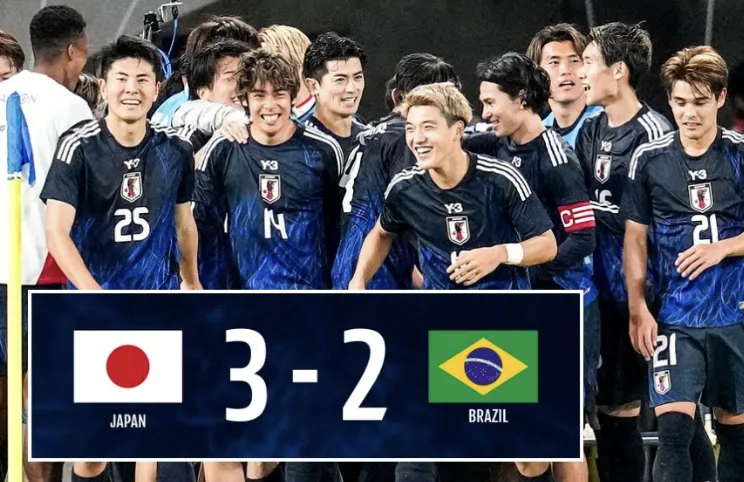
October 14, 2025. Tokyo Stadium. Japan 3-2 Brazil. Japan’s first-ever victory over Brazil’s senior national team. The previous 13 meetings had produced 2 draws, 11 losses, and a goal differential of -38. In the 14th, Japan came back from 0-2 down at halftime to score three second-half goals. The decisive third was scored by Ayase Ueda in stoppage time. After the match, Brazil’s new manager Carlo Ancelotti said: “The moment our shape broke, the Japanese players ran without mercy.”
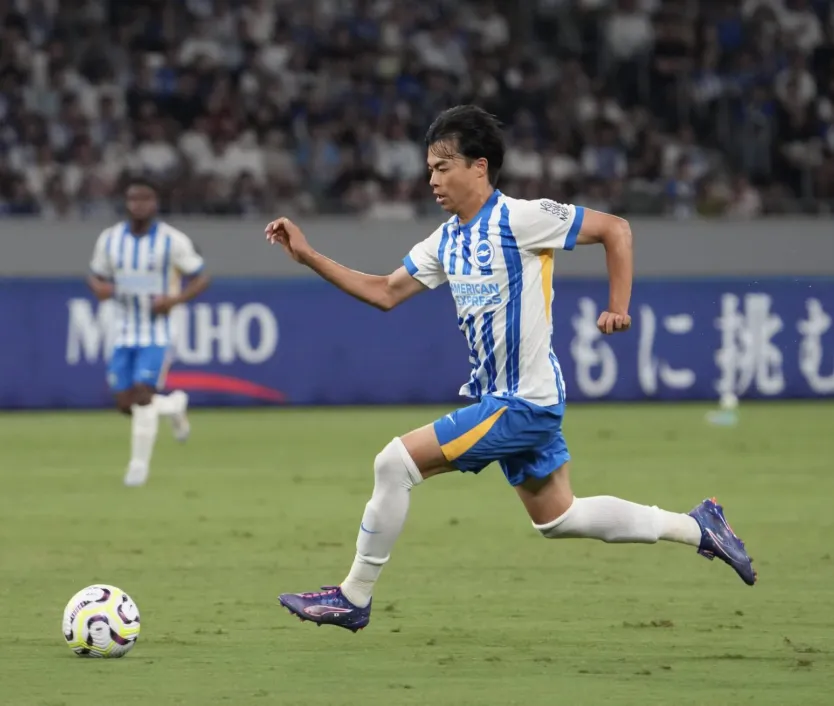
April 1, 2026. Wembley Stadium. Japan 1-0 England. The first time an Asian senior side had beaten England’s senior side at home. The decisive goal came from acting captain Kaoru Mitoma. From the first half, Wembley’s English supporters had booed their own team. Moriyasu’s post-match comment was measured: “England did not field their full strongest squad, but we still gave everything we had.” France’s L’Équipe placed Moriyasu second in its World Cup managers’ rankings the next morning.
The two results carry a common theme. Japan has decisively exited the phase of being merely “good in Asia.” Moriyasu’s Japan is the first Japanese side capable of competing — on individual quality alone — with elite South American or European national teams.
Moriyasu has been making history of his own. On November 18, 2025, the Kirin Challenge Cup match against Bolivia (3-0 win) marked his 100th match in charge of Japan — the first head coach in Japan national-team history to reach that mark. The decision to retain him for a second cycle was unprecedented; the JFA’s bet on Moriyasu is reportedly worth ¥200-300 million per year.
Escaping Group F — “The Group of Death”
Netherlands, Sweden, Tunisia. To finish in Group F’s top two and reach the Round of 32, Japan likely needs at least one win and one draw.
The Netherlands topped European qualifying Group G unbeaten under Ronald Koeman. Memphis Depay (the Dutch all-time top scorer), Virgil van Dijk and Frenkie de Jong form the spine; Xavi Simons, Cody Gakpo and Jeremie Frimpong lead the attack. For Japan, the Netherlands have a place in the team’s history that ranks alongside Johor Bahru and Doha — losses in 1998 (0-1) and 2010 (0-1), and the friendly invitation following the Round of 16 exit at Qatar 2022. Japan has no recorded competitive win over the Netherlands.
Sweden reached the playoffs via the UEFA Nations League back door and secured their World Cup spot from there. Under Jon Dahl Tomasson, with Alexander Isak (Newcastle) leading the line, they head to the tournament at their highest-ever FIFA ranking of 18. Midfielder Viktor Gyökeres (Arsenal) has been a top-five scorer in Europe’s big-five leagues all season.
Tunisia topped African qualifying Group H. Mohamed Ali Ben Romdhane’s dramatic decisive goal sealed their place. Africa Cup of Nations semi-final regulars, Tunisia have never advanced past a World Cup group stage.
In an April press conference, Moriyasu said: “All of our opponents are above us, but we have a chance to beat all of our opponents.” This may be the last season in which a Japan head coach concedes “above us” status to opponents at a press conference.
Four Years Ago — The “Quarterfinal Wall”
At Qatar 2022, Japan beat Germany and Spain to top their group, then met Croatia in the Round of 16. The match ended 1-1 after extra time and Japan lost 1-3 on penalties. It was Japan’s fourth Round of 16 exit (2002, 2010, 2018, 2022). They have never broken through the quarterfinal wall.
Moriyasu later reflected on the 2022 Croatia loss by saying he had “spent too long deciding the order of penalty takers.” For 2026, the JFA has confirmed that set-piece training has been deliberately structured around international-tournament penalty-shootout scenarios as preparation for a Round of 16 exit.
The previous Round of 16 penalty-shootout exits — 2002 vs Turkey 0-1, 2010 vs Paraguay 3-5, 2018 vs Belgium 2-3 (in normal time, the famous comeback loss), 2022 vs Croatia 1-3 on penalties — define the wall Moriyasu’s Japan officially seeks to break.
May 31 vs Iceland — The Meaning of the Send-Off Match
The Kirin Cup against Iceland at the National Stadium is the only test between the May 15 squad announcement and the World Cup itself. In an April 24 interview, Moriyasu confirmed he would call up additional players beyond the 26-man squad for the send-off match — citing schedule conflicts with European top-five league seasons that may force last-minute condition adjustments.
European-based players — Mitoma (Premier League), Kubo (La Liga), Suzuki (Serie A), Itō (Bundesliga) — finish their club seasons May 23-24. Playing on May 31 against Iceland leaves them with no rest before the June 11 World Cup opening; load management for the European contingent is the operational headache.
Immediately after the match, the squad flies to Monterrey, Mexico. The pre-tournament training camp in Monterrey will function as the home base for all Japanese matches at the North American tournament. The Group F venues are split: Japan vs Netherlands (June 17, Lumen Field, Seattle), Japan vs Sweden (June 22, Lincoln Financial Field, Philadelphia), Japan vs Tunisia (June 26, Levi’s Stadium, SF Bay). Japanese supporters will be forced into transcontinental travel.
Where Does Japan Go in 35 Days?
Moriyasu’s Japan does not aim for “the quarterfinals.” Under the North American tournament setup, the JFA has officially declared its goal as “the best result in Japanese football history” — which means the quarterfinals or beyond.
Asian sides that have reached a senior World Cup semi-final number only two: South Korea in 2002 and Morocco in 2022 (Morocco being CAF, of course). If Japan becomes the first AFC nation to reach the quarterfinals on its own merit, it will mark the first achievement in the JFA’s long-stated road map.
The 26-man roster will be announced on May 15. Moriyasu has said in advance that he will publicly explain the reasoning behind every selection at the same press conference. A coach who genuinely says “there are an absurd number of players I want to call up” — what he decides will, in 35 days, define how Japan looks on the field.
“Throughout my career, this is the first time I have managed a squad with this much depth.” That single line, delivered in Moriyasu’s April interview, was almost the only “expression of confidence” the famously humble manager allowed himself in front of the press.
The World Cup begins on June 11. Japan plays the Netherlands on June 17 in Seattle. In 35 days, can Samurai Blue reach the Final stage at MetLife Stadium?