The 2026 World Cup qualifiers finished on March 31 in Zenica, in a cold Bosnian stadium that has never hosted a tournament final of anything.
Italy lost on penalties.
That sentence reads simple. It is not. It is the third consecutive time Italy has failed to reach a World Cup. Before 2018, it had happened exactly once in their history — in 1958. Now it has happened in 2018, 2022, and 2026.
Bosnia and Herzegovina, a country of 3.2 million people ranked 66th by FIFA, is in Group B alongside Canada, Qatar, and Switzerland. Italy, four-time world champions, is at home.
Bosnia-Italy is the headline. But the European qualifiers for 2026 produced a sequence of nights that, taken together, look like the most chaotic qualifying cycle since World War II. Scotland won a match in the 98th minute from the halfway line. Czechia eliminated Denmark on penalties in Prague. Sweden scored in stoppage time against Poland. Three of the seven most successful football nations in Europe — Italy, Germany’s near-neighbour Austria, and defending Euro runner-up group Romania — all went home.
This is the story of the seven nights.
Night One: Hampden, 18 November 2025
Scotland had not played at a World Cup since 1998. Six consecutive qualifying campaigns, six failures. Most Scottish fans under 35 had never seen the national team at a World Cup.
The final group-stage match was at Hampden Park. Denmark were first in Group C. Scotland were second. The rules were simple: Scotland win, Scotland qualify directly. Anything else — draw, loss — and Denmark went through, Scotland went to the playoffs.
Scott McTominay scored in the third minute. The Napoli midfielder, who moved from Manchester United in 2024, met a looping cross with a bicycle kick from the edge of the six-yard box. The ball flew past Kasper Schmeichel. Hampden reacted as if something it had been holding in for 28 years had cracked open.
The goal would turn out to be the only shot on target Scotland produced for the next 75 minutes.
Rasmus Højlund tied it from the penalty spot in the second half. Andy Robertson had fouled Jonas Wind near the edge of the area — “marginally outside,” according to post-match replays, but VAR gave the penalty anyway. 1-1.
Then Denmark’s Rasmus Kristensen was sent off just past the hour. Hampden stirred again. From the corner, Lewis Ferguson’s inswinger found Lawrence Shankland, who got a toe to it before Schmeichel could react. 2-1.
In the 82nd minute, Gustav Isaksen whipped in a cross. Scotland’s defence failed to clear. Patrick Dorgu — Manchester United’s Danish left-back — arrived at the far post and finished calmly. 2-2.
Three minutes of normal time remained. Seven minutes of stoppage time were about to follow.
In the 93rd minute, Kieran Tierney, the Celtic full-back, picked up a loose ball on the right-hand edge of the box. He cut inside, wrapped his left foot around it, and bent the ball into the far corner. Schmeichel dived and got nothing. 3-2.
Hampden did not stop shaking for three minutes. Then, in the 98th minute — the eighth minute of stoppage time — Kenny McLean received a ball near the halfway line. Schmeichel had come out for a corner and not made it back to his line. McLean saw it. The crowd saw it.
He chipped the ball from 50 yards. It hung in the air for what McLean later described, on BBC Scotland, as “longer than any ball I’ve kicked in my life.” It dropped under the bar. 4-2.
Scotland were going to the World Cup.
John McGinn, the Aston Villa midfielder, tried to explain afterwards: “I’ve played with Kenny for years at St Mirren. To see that ball hit the net, I can’t even explain. I thought we were pretty rubbish to be honest, but who cares?”
The cameras caught Steve Clarke, the Scotland manager, standing on the touchline with both hands over his face. He had taken Scotland to two European Championships. Now he was the first Scotland manager since Andy Roxburgh to reach three consecutive major tournaments. The first to break the World Cup ceiling in 28 years.
Denmark finished second. They were heading to the playoffs. They had no idea how the next four months were going to go.
Night Two: Prague, 31 March 2026
Denmark’s playoff path, drawn in December, looked manageable. Semi-final against North Macedonia. Final — if they got through — against either Czechia or Ireland.
They thrashed North Macedonia 4-0. Easy. Hojlund scored, Isaksen scored, it was the kind of result Danish fans had stopped expecting after Hampden.
Czechia, meanwhile, beat Ireland on penalties in Dublin.
That set up the final in Prague. 31 March. Winner goes to Group A — Mexico, South Africa, South Korea, and the unknown European team nobody had been preparing to watch.
It was 2-2 after extra time. Pavel Šulc put Czechia ahead early. Joachim Andersen headed Denmark level before halftime. Ladislav Krejčí restored the Czech lead in the second half off a deflected shot. Kasper Højgh’s header sent it to penalties.
In the shootout, three Danes missed. Højlund. Anders Dreyer. Mathias Jensen. One after another. Michal Sadílek scored the decisive Czech penalty. Czechia, absent from the World Cup since 2006, were back.
Denmark had topped their qualifying group until McLean’s chip. Then they had run into Scotland, then North Macedonia, then Czechia. Four months. Three weeks. Two consecutive shootouts lost.
Højlund walked off the pitch in Prague and did not look up.
Night Three: Zenica, 31 March 2026
The same night as Prague, five hundred miles south, Bosnia and Herzegovina were playing Italy.
Bosnia had been in a World Cup once, 2014, when they lost all three group games. Their coach was a 47-year-old former player named Sergej Barbarez, who had spent most of his career at Hamburg. Their striker, Haris Tabaković, played for Hertha Berlin. Their goalkeeper, Nikola Vasilj, was on loan from St. Pauli. They were not supposed to win anything.
Italy’s coach was Gennaro Gattuso — the same Gattuso who had been on Italy’s 2006 World Cup-winning team. The last time Italy won a World Cup knockout match, Gattuso was playing in it.
He had been appointed in October 2025 to replace Luciano Spalletti, whose side had drawn too many and lost too many in qualifying. Gattuso’s job was to pull Italy through the playoffs. He had two months to do it.
Moise Kean scored in the 15th minute at the Stadion Bilino Polje. Fine first-time finish from outside the box, curling past Vasilj, who had misjudged his starting position. 1-0. The Bosnian crowd — sold out, 17,000 people packed into a stadium that normally hosts FK Železničar — went silent.
In the 41st minute, Alessandro Bastoni was sent off. Last man, professional foul on Amar Memić. Italy would play the next 79 minutes with ten men.
They held on until the 79th.
Haris Tabaković came off the bench in the 68th. In the 79th, Edin Džeko flicked a header into the box and Tabaković, who had been a reserve striker for Hertha for most of the season, prodded the ball past Gianluigi Donnarumma. 1-1. Zenica erupted.
Extra time, Italy nearly won it through Pio Esposito. Vasilj tipped it over. Then penalties.
Sandro Tonali scored Italy’s first. After that: miss, miss, miss. Esposito, Manuel Locatelli, Lorenzo Pellegrini all failed. Bosnia took four. Four went in. Esmir Bajraktarević, the 21-year-old winger from New England Revolution, hit the winner. The stadium poured onto the pitch.
Italy are a four-time World Cup champion. They will not be at the 2026 World Cup. They will not have been at a World Cup for 20 years by the time the 2030 centenary tournament kicks off.
Gattuso stood on the touchline, arms folded, watching Bajraktarević’s penalty hit the net. He did not move for a full minute.
In his press conference afterward, Gattuso said: “I just finished speaking to the team. I can only thank them — it had been years since I’d seen the Nazionale play with such heart. It really hurts, but we must accept it. It will take time.”
Italy did not qualify for 2018. Did not qualify for 2022. Did not qualify for 2026. The only other time Italy missed a World Cup was 1958. The gap was 68 years. Now it’s three in a row.
Sergej Barbarez, the Bosnian coach, said the line that spread across European football the next day: “I’ve never entered or finished a game calmer. I saw it in their eyes. We are two years ahead of schedule. Now I’ve told them we have to go to a major tournament every two years.”
Night Four: Solna, 31 March 2026
Sweden had come into the playoffs as the path B favourites. They had Viktor Gyökeres — 40 goals for Sporting CP that season — Dejan Kulusevski, Alexander Isak.
They beat Ukraine 3-1 in the semi-final. Standard.
Against Poland in the final, they were 2-1 down with 12 minutes to go. Robert Lewandowski scored. Alexander Isak equalised in the 87th. Poland pushed. Sweden sat deeper.
In the 95th minute, Gyökeres met a ball at the top of the box. Left foot. Bottom-right corner. 3-2.
Sweden were going to their first World Cup since 2018. Lewandowski, 37, walked off the pitch knowing his last realistic World Cup had just ended.
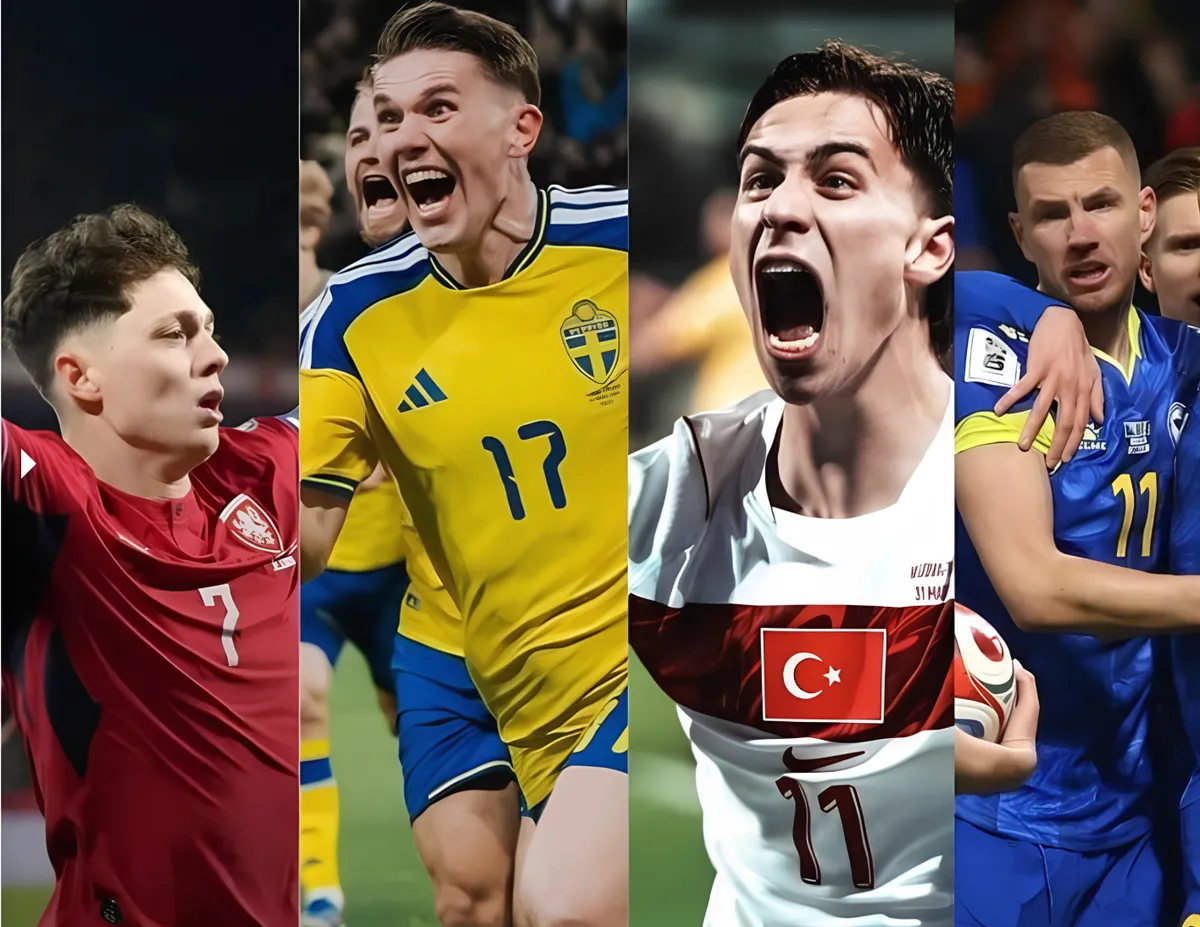
Night Five, Six, Seven: The collateral
Turkey 1-0 Kosovo. Kerem Aktürkoğlu, 53rd minute, at Pristina. Kosovo’s first attempt at a World Cup qualification ended on their home field. The stands emptied before the final whistle.
DR Congo 1-0 Jamaica. Extra time, 119th minute, at Guadalajara. Axel Tuanzebe — on loan at Ipswich, born in Kinshasa, raised in Rochdale — came on as a substitute and scored the only goal. Jamaica’s goalkeeper Andre Blake went down to his knees at full time. For the Leopards of Congo, it was their first World Cup since 1974.
Iraq 2-1 Bolivia. 31 March, at the Estadio BBVA in Guadalupe. Bolivia’s coach Óscar Villegas told reporters afterwards: “We are heartbroken but we are proud.” Iraq’s coach, the Australian Graham Arnold, said: “We made 46 million people happy tonight.”
Bolivia had been a point from the World Cup when they beat Brazil 1-0 in La Paz on 9 September. They had been a match from the World Cup when they beat Suriname 2-1 in Monterrey. They are a full World Cup cycle from their next chance. They will not play Arnold’s Iraq in a friendly any time soon.
What changed
Italy’s absence is the single biggest story of this qualifying cycle. Not because it was unexpected — Italy had been wobbling since their Euro 2024 group-stage exit — but because it is the third in a row. No previous four-time champion (Italy, Germany, Brazil, or the Argentina-Uruguay co-champions era) has ever missed three straight World Cups. The gap is now structural.
The 48-team format was supposed to make qualifying easier. Europe got 16 slots instead of 13. That’s more than half of Europe’s top teams, mathematically. And yet: Italy out, Austria out, Denmark out, Romania out, Kosovo out, Poland out (Poland finished their qualifying campaign in 6th in Group E and did not get a playoff lifeline).
The teams that got in: Bosnia, Czechia, Sweden, Turkey, Scotland. Four of those five have not played in a World Cup since before 2010. Three of them were not in 2022. Two — Czechia and Scotland — were not in 2018 or 2022.
This is not a quiet passing of the baton. This is a reshuffle. The last qualifying cycle before 2018, Germany, Spain, France, Italy, England, Portugal, and Belgium all qualified first in their group. In 2026, those group-stage leaders are Spain, France, England, Portugal, Germany, Netherlands, Switzerland, Austria, Croatia, Belgium. Italy is not first in anyone’s group, because Italy is not going.
What’s next
Steve Clarke has said Scotland will base its World Cup camp in Toronto, to be close to Group C matches that will be played in Seattle, Vancouver, and Kansas City. McTominay, Tierney, and McLean will almost certainly start the first match.
Gattuso will be under contract with Italy until June 2026. After that: open question. Italian media reports that he is already being offered club jobs. He has not said whether he will take one.
Bosnia will likely play their group matches in Toronto and Philadelphia. Their training camp will be based in Ottawa. Nikola Vasilj, the goalkeeper, is expected to get a Serie A move before the tournament. Haris Tabaković is expected to stay at Hertha.
Denmark, Italy, and Kosovo will watch the 2026 tournament at home. The BBC’s Scottish coverage team has reportedly booked two full production crews to follow the team across North America. Italian state broadcaster RAI has not announced a World Cup production plan.
The tournament begins on June 11. For Italy, June 11 is a Thursday. There will be no matches that matter.
Sources: Sky Sports News, Al Jazeera, The Washington Post, UEFA.com, BBC Scotland, STV News, SPFL, Sports Mole, ESPN, GB News, UEFA European Qualifiers match reports, Gattuso and Barbarez post-match press conferences on 31 March 2026.