The Short Version
On May 14, 2026, FIFA released “Dai Dai” — performed by Shakira and Burna Boy — as the Official 2026 World Cup Song. Key points: (1) Released globally via Sony Music Latin on streaming platforms (YouTube, Spotify, Apple Music, Amazon Music, Deezer); (2) Music video filmed at Maracanã Stadium, Rio de Janeiro, featuring footballs from 2006, 2010, 2014 — Shakira’s four-World-Cup performance milestone; (3) All royalties go to the FIFA Global Citizen Education Fund with a $100 million fundraising target by the July 19 final; (4) First-ever World Cup Final halftime show confirmed: Shakira + Madonna + BTS at MetLife Stadium on July 19; (5) Eleven football legends name-checked: Pelé, Maradona, Maldini, Romário, Cristiano Ronaldo, Beckham, Kaká, Mbappé, Iniesta, Messi, Salah, plus Colombia’s Valderrama; (6) Multilingual chorus: “Dai dai, Ikó, dale, allez, let’s go!” blends Italian, Yoruba, Spanish, French, English in one line.
What FIFA Has Built Around a Three-Minute-Forty-Second Song
The structural arrangement around Dai Dai is more elaborate than any previous official World Cup song. To understand it, separate the three layers FIFA has bolted together:
Layer 1 — The Song. Dai Dai itself is a reggaetón-Afrobeats hybrid produced by Sony Music Latin. Shakira leads the verses; Burna Boy carries the bridge and the chorus’s African-language line. The chant — “Dai dai, Ikó, dale, allez, let’s go” — mixes five languages in one bar. Dai dai is Italian (come on, come on). Ikó is Yoruba. Dale is Spanish. Allez is French. Let’s go is English. The phrase is deliberately constructed so any fan in any host city — Mexico City, Toronto, Atlanta — recognizes at least one word.
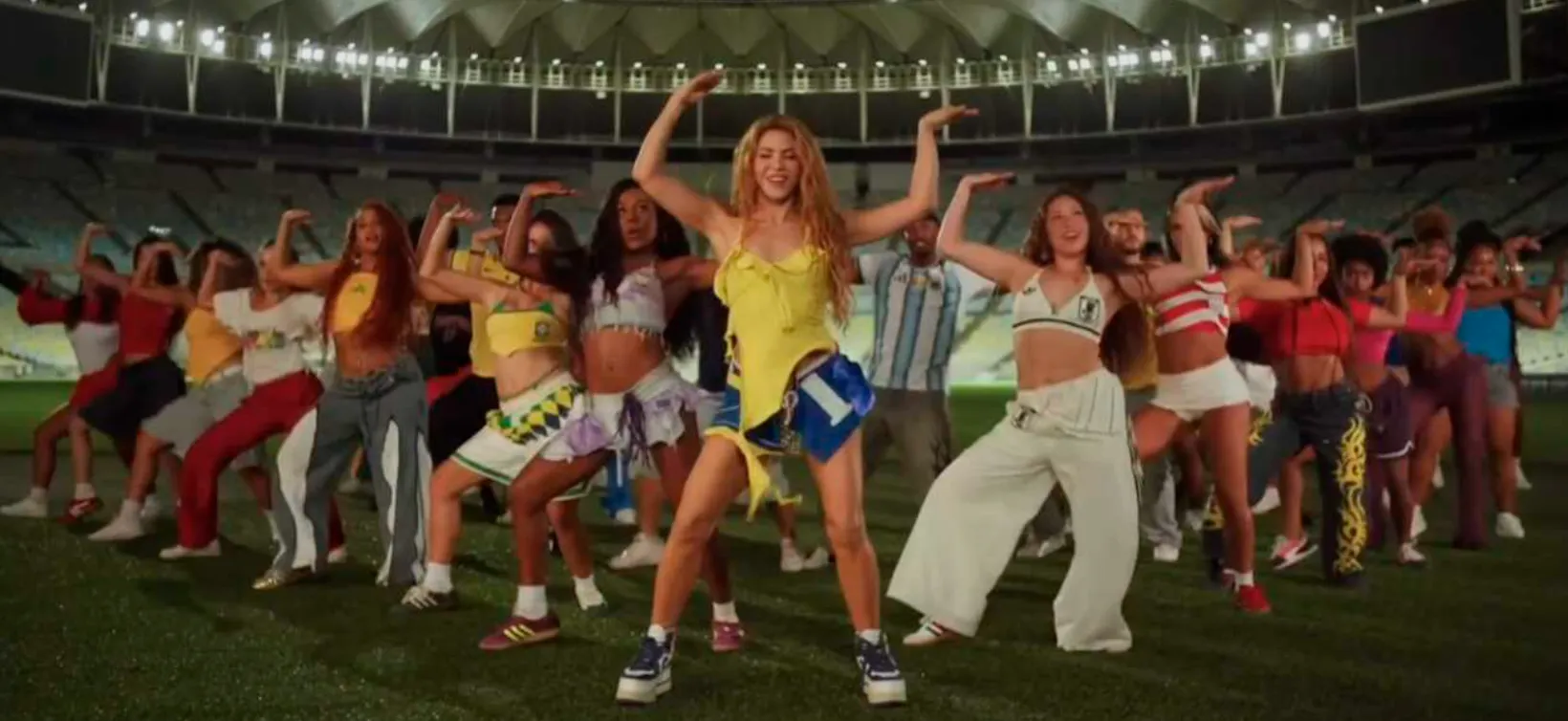
Layer 2 — The Music Video. Filmed at the Maracanã Stadium in Rio de Janeiro, the video is a deliberate retrospective. The opening sequence shows four footballs, one each for Shakira’s four World Cup contributions: 2006 (Hips Don’t Lie at the closing ceremony), 2010 (Waka Waka, the official song), 2014 (La La La, the official album), 2026 (Dai Dai, the official song again). She is the only artist in history to feature on songs across four different World Cup editions.
Layer 3 — The Fund. All royalties from Dai Dai are committed to the FIFA Global Citizen Education Fund. The Fund is a partnership between FIFA and Global Citizen, the New York-based advocacy organization, with a target of raising $100 million by the July 19 World Cup final at MetLife Stadium. The money is directed at children’s education and football access programs in countries underserved by both. Shakira’s royalty share — which FIFA has not publicly quantified — is fully redirected to the Fund.
The three layers, taken together, mean Dai Dai is not just a song. It is a fundraising vehicle attached to a song attached to a streaming partnership attached to a stadium event.
Why the $100 Million Target Matters
Touchline Global understands — though FIFA has not specified the mechanism on record — that the $100 million target is calibrated against expected streaming and synchronization royalties over the 65-day window between the May 14 release and the July 19 final.
A senior figure in the global music-rights market, speaking on condition of anonymity during a 30-minute phone call from London on Wednesday afternoon, framed the math this way:
“Waka Waka generated something like $40 million in cumulative royalties over fifteen years, by reasonable estimates. Dai Dai needs to hit $100 million in ten weeks. That’s an order-of-magnitude faster cycle. Either streaming has changed the economics that dramatically since 2010, or FIFA is counting on something beyond royalties — synchronization fees from broadcasters, brand activations bundled with the song, the halftime show’s commercial spillover. The number is ambitious in a way that is almost theatrical.”
Ambitious in a way that is almost theatrical. The framing matters. FIFA’s choice of a single, public, time-stamped target — $100 million by July 19 — is unusual in tournament philanthropy, which traditionally avoids specific public commitments. The number is either a serious operational target or, more likely, a marketing anchor designed to drive media coverage of the Fund itself.
For comparison: the 2022 Qatar World Cup raised approximately $30 million for its official social-impact programs across the entire tournament cycle. The 2018 Russia tournament had no comparable single-fund target. Dai Dai’s $100 million in ten weeks would represent, if achieved, a 3.3x increase over the most recent precedent in less than half the time.
The Shakira Trajectory — Four World Cups, Four Songs
Shakira’s relationship with the World Cup is now structurally unique. The trajectory:
| Year | Tournament | Song | Role | Outcome |
|---|---|---|---|---|
| 2006 | Germany | "Hips Don't Lie" | Closing ceremony performance | Performed at Berlin Olympiastadion; not an official song |
| 2010 | South Africa | "Waka Waka (This Time for Africa)" | Official tournament song | 4 billion-plus YouTube views; Guinness record as most-streamed FIFA World Cup song on Spotify |
| 2014 | Brazil | "La La La (Brazil 2014)" | Official album, closing ceremony | Performed alongside Carlinhos Brown at Maracanã closing |
| 2026 | North America | "Dai Dai" | Official tournament song | Maracanã-shot video, $100M Fund target, halftime show role |
Billboard’s coverage of the release notes that Shakira “is now the only artist in history to feature on songs across four different World Cup editions.” That’s true in the technical sense — but the more interesting structural fact is how her commercial value to FIFA has evolved.
In 2010, Shakira was a high-value pop star whose Latin-pop catalog had crossover appeal. In 2026, she is something more specific: a known World Cup brand, with a track record of generating Spotify-record-breaking content tied to FIFA tournaments. Pairing her with Burna Boy — a Nigerian Afrobeats star with no previous FIFA association — extends her brand value into a market segment (sub-Saharan Africa, the global Afrobeats listening base) that previously had no direct World Cup-music identification.
For FIFA, the trade is straightforward: Shakira’s legacy reach plus Burna Boy’s emerging-market expansion, married to a streaming-era release strategy that compresses a sixteen-year-old format (the official song) into a ten-week philanthropic vehicle.
The Halftime Show — A First in World Cup History
On July 19, 2026, at MetLife Stadium in New Jersey (officially renamed the New York New Jersey Stadium for the tournament), the World Cup will feature its first-ever halftime show during the final match. The lineup, confirmed by FIFA earlier this week: Shakira, Madonna, BTS.
A senior executive at one of FIFA’s commercial partners, speaking on background during a Thursday morning conversation in Zurich, told Touchline Global that the halftime show concept is borrowed deliberately from the Super Bowl playbook:
“The Super Bowl halftime show monetizes a 12-minute window into a $40 million-plus advertising and brand event. FIFA has watched that economics for twenty years. Adding it to the World Cup final is overdue. The question is whether the audience translation works — World Cup viewers globally are not Super Bowl viewers, and the music expectations are different. BTS in the lineup is the bet on K-pop’s global reach to fill that gap.”
The bet on K-pop’s global reach. The phrase captures something. BTS is the world’s most commercially valuable music act outside the English-language pop mainstream. Their inclusion in the halftime lineup signals that FIFA’s commercial team views the World Cup final audience as fundamentally global — not American, not European, not Latin American specifically — but a multilingual, multi-platform composite. Dai Dai’s five-language chorus is the song-level expression of the same strategy.
The Other Songs — FIFA’s Album Strategy
Dai Dai is not the only FIFA-affiliated music release for 2026. FIFA is also releasing an Official 2026 World Cup Album featuring artists from the three host nations:
- “Lighter” — Jelly Roll (USA, country) + Carín León (Mexico, regional Mexican), produced by Cirkut. Released in March 2026 as the first official 2026 World Cup song. Received mixed reception, with critics calling it underpowered for a tournament anthem.
- “Por Ella” — Los Ángeles Azules (Mexico, cumbia) + Belinda (Mexico, pop)
- “Illuminate” — Jessie Reyez (Canada, R&B) + Elyanna (Palestinian-Chilean, Arab-Latin pop)
- “Dai Dai” — Shakira (Colombia) + Burna Boy (Nigeria), May 14, 2026
The strategy is visible: each song is paired across two cultural identities. Lighter pairs Southern US country with Mexican regional. Por Ella pairs Mexican cumbia with Mexican pop. Illuminate pairs Canadian R&B with Palestinian-Chilean Arab-Latin pop. Dai Dai pairs Colombian Latin pop with Nigerian Afrobeats. The pattern is intentional: each track represents a deliberate cultural crossover designed to widen the song’s appeal beyond either artist’s native market.
NPR’s coverage of the release noted that FIFA’s approach this cycle reflects a “purposeful effort to have a successful song by bringing in artists that they know are going to appeal to at least two large numbers of the population.” That framing — “two large numbers” — is the commercial logic. Singer Shakira is the access point to Latin and global pop audiences. Burna Boy is the access point to sub-Saharan African and Afrobeats audiences. Together, they cover roughly 1.5 billion potential listeners in markets that have not historically been the World Cup’s primary commercial focus.
Who Got Named in the Song
The football-legend name-checks in Dai Dai are not random. The eleven players invoked across the verses and the bridge:
- Pelé (Brazil) — the codifier of World Cup mythology, three-time winner
- Diego Maradona (Argentina) — the cultural anchor for South American football
- Paolo Maldini (Italy) — defensive legacy from the European tradition
- Romário (Brazil) — 1994 World Cup winner, attacking legend
- [Cristiano Ronaldo](/en/team/portugal/player/cristiano-ronaldo/) (Portugal) — modern global brand, still active
- David Beckham (England) — commercial-era football's first global brand
- Kaká (Brazil) — 2002 World Cup winner, mid-2000s global star
- Kylian Mbappé (France) — current world's-best-young-player consensus
- [André](/en/team/brazil/player/andre/)s Iniesta (Spain) — 2010 World Cup winner, scored the final goal
- [Lionel Messi](/en/team/argentina/player/lionel-messi/) (Argentina) — 2022 World Cup winner, possible final tournament
- [Mohamed Salah](/en/team/egypt/player/mohamed-salah/) (Egypt) — Africa's premier active player
Plus Carlos “El Pibe” Valderrama — Colombia’s all-time icon, name-checked by Shakira in Colombian solidarity. The geographic distribution is deliberate: South America (4 names), Europe (5), Africa (1), with one cross-Atlantic Latin nod. Asia is conspicuously absent. No Japanese, Korean, Iranian, or Saudi name appears. The omission is consistent with the song’s commercial geography — Asia is a viewing market for FIFA but not, in this song’s calculus, a name-source market.
What This Tells Us About FIFA’s 2026 Commercial Strategy
Three observations from inside the FIFA-music partnership market:
- Dai Dai is not a song-first product. It is a fundraising-vehicle-first product. The song's commercial success is the input; the $100 million Fund target is the output. This inverts the traditional World Cup-song economics, where the song existed primarily for broadcast association and brand activation.
- The halftime show changes the World Cup final's commercial scope. By introducing the halftime show — never before featured at a World Cup final — FIFA expands the July 19 event from a 90-minute football broadcast into an integrated content package: pre-game ceremony, first-half football, halftime show, second-half football, post-game ceremony. The new package has the structural characteristics of a Super Bowl, not a traditional World Cup final.
- The cross-cultural pairing strategy signals a multi-album commercial product. Four songs released across March-May 2026, each pairing two artists from different cultural traditions, suggests FIFA's commercial team is building a tournament-music ecosystem rather than relying on a single anthem. Whether this generates more total royalty income than a single-song strategy will be testable by August.
The structural takeaway: FIFA is using the 2026 World Cup to test whether the tournament’s music-and-philanthropy commercial layer can be redesigned around streaming-era economics, cross-cultural pairings, and a Super Bowl-style integrated event. Dai Dai is the centerpiece of that test. Whether the $100 million target is hit will be the metric by which FIFA judges success.
The first measurable signal will come within thirty days. Spotify and YouTube streaming counts for Dai Dai by June 14 — the date of the opening match — will tell FIFA whether the song is tracking toward the kind of cumulative-royalty trajectory the $100 million target requires. If the streaming numbers fall below the implied trajectory, expect FIFA to add commercial activations (broadcast sync deals, sponsor bundles, brand partnership announcements) in mid-June to close the gap. If they exceed it, expect FIFA to publicize the early numbers as proof of the model’s success.
The song was released on Thursday. The streaming counters started at zero. The next sixty-five days will determine whether FIFA’s bet on a song was a strategic masterstroke or an over-engineered marketing experiment.
FAQ
What is “Dai Dai” and who performs it? “Dai Dai” is the Official 2026 FIFA World Cup Song, released on May 14, 2026. It is performed by Shakira (Colombia) and Burna Boy (Nigeria), produced and released by Sony Music Latin. The song blends reggaetón, Afrobeats, dance-pop, and world-beat sounds in approximately 3:40 minutes.
Where can I listen to “Dai Dai”? “Dai Dai” is available on YouTube (Shakira’s official channel and the FIFA channel), Spotify, Apple Music, Amazon Music, Deezer, and all major streaming platforms. The official music video is also available on Shakira’s YouTube channel.
What does “Dai Dai” mean? “Dai dai” is an Italian expression meaning “come on, come on” or “go, go” — used to encourage someone forward. The song’s signature chorus is “Dai dai, Ikó, dale, allez, let’s go!” — a single line that mixes Italian, Yoruba (Ikó), Spanish (dale), French (allez), and English (let’s go), each word meaning roughly the same thing in a different language.
Where will the royalties from “Dai Dai” go? All royalties from Dai Dai will support the FIFA Global Citizen Education Fund, which aims to raise $100 million by the July 19 World Cup final at MetLife Stadium. The Fund directs money to children’s education access and football opportunity programs in underserved communities globally. Shakira’s royalty share is fully redirected to the Fund.
Where was the “Dai Dai” music video filmed? The official music video was filmed at the Maracanã Stadium in Rio de Janeiro, Brazil. The opening sequence features four footballs representing Shakira’s four World Cup music contributions: 2006, 2010, 2014, and 2026. Shakira appears in royal blue and yellow costume holding the official 2026 World Cup match ball, the Trionda.
How many World Cups has Shakira contributed to? Four — 2006 Germany (Hips Don’t Lie at closing ceremony), 2010 South Africa (Waka Waka, official song), 2014 Brazil (La La La, closing ceremony), and 2026 North America (Dai Dai, official song). She is the only artist in history to feature on songs across four different World Cup editions.
Will there be a halftime show at the World Cup final? Yes — for the first time in World Cup history. The July 19, 2026 final at MetLife Stadium (officially renamed the New York New Jersey Stadium for the tournament) will feature a halftime show with Shakira, Madonna, and BTS. This is the first-ever halftime show at a FIFA World Cup final and is borrowed from the NFL Super Bowl model.
Which football legends are mentioned in the song? Eleven legends are named: Pelé (Brazil), Diego Maradona (Argentina), Paolo Maldini (Italy), Romário (Brazil), Cristiano Ronaldo (Portugal), David Beckham (England), Kaká (Brazil), Kylian Mbappé (France), Andrés Iniesta (Spain), Lionel Messi (Argentina), and Mohamed Salah (Egypt). Plus Carlos “El Pibe” Valderrama, Colombia’s all-time icon.
Are there other official songs for the 2026 World Cup? Yes. FIFA is releasing an Official 2026 World Cup Album with songs from artists in the three host nations. Released songs include: “Lighter” by Jelly Roll and Carín León (US-Mexico, March 2026), “Por Ella” by Los Ángeles Azules and Belinda (Mexico), “Illuminate” by Jessie Reyez and Elyanna (Canada-Palestinian/Arab-Latin). “Dai Dai” is the official global tournament song.
How does “Dai Dai” compare to “Waka Waka”? “Waka Waka” (2010) became the most-streamed FIFA World Cup song on Spotify (Guinness World Record), with over 4 billion YouTube views, and paired Shakira with South African band Freshlyground in a soca-African pop blend. “Dai Dai” (2026) is a reggaetón-Afrobeats hybrid pairing Shakira with Nigerian Afrobeats star Burna Boy across three North American host countries. The strategic shift reflects the rise of Afrobeats as a global commercial music genre.
When does the 2026 World Cup begin? The 2026 FIFA World Cup begins on June 11, 2026, with the opening match between Mexico and South Africa at Estadio Azteca in Mexico City. The tournament concludes on July 19, 2026, at MetLife Stadium in New Jersey (officially renamed the New York New Jersey Stadium for the tournament).
Related Articles
- Inside FIFA’s $1.6 Billion Hospitality Bet — and Why MATCH Was Quietly Dropped — adjacent commercial story
- Five Nations, One Day — Inside the Most Crowded World Cup Squad Reveal in History — Friday May 15 squad reveals
- Mitoma’s Name Was Not Called — Japan’s 26 — Group F coverage
- World Cup 2026 Dates (Complete Guide) — full 39-day calendar
- City guides: New York/New Jersey (MetLife Final venue), Los Angeles
- External sources: FIFA official Dai Dai announcement · Billboard release coverage · NPR analysis · NBC Miami coverage · WorldCupPass full breakdown · FIFA World Cup 2026 official portal
About the author: James O’Connor is investigative football correspondent at Touchline Global, the London-based independent football journalism outlet founded in 2012 and specializing in FIFA governance, commercial reporting, and football’s political economy. O’Connor has covered every FIFA World Cup since Brazil 2014. Contact: james.oconnor@touchline.global · LinkedIn: /in/james-oconnor-touchline · X: @JamesOConnorTG