The Short Version
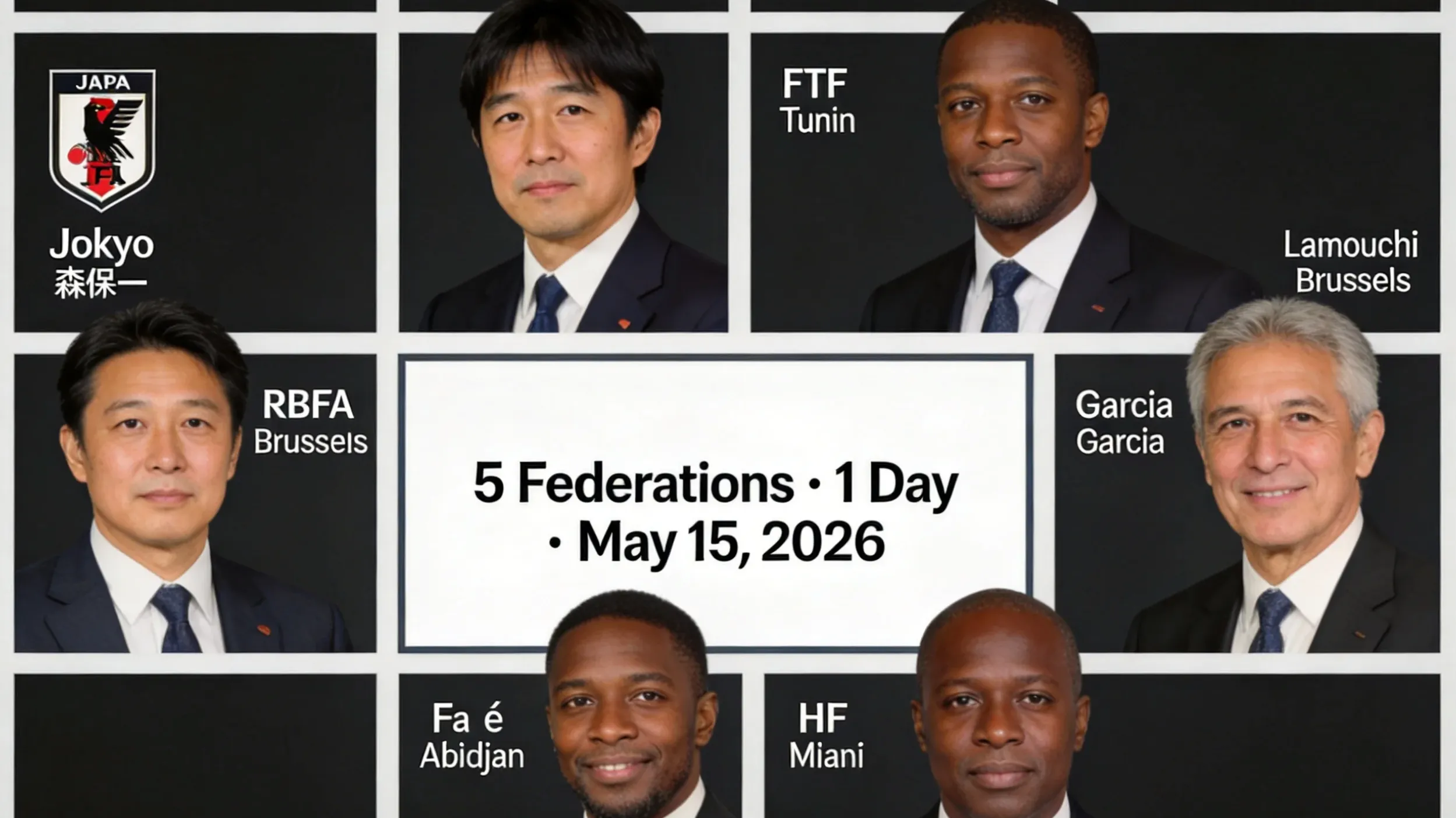
On Friday, May 15, 2026 — 27 days before the World Cup opener — five national federations submitted their final 26-man rosters within a single working day: Japan (14:00 JST in Tokyo), Tunisia (Tunis), Belgium (Brussels), Ivory Coast (Abidjan), and Haiti (Miami). The compression is unprecedented in World Cup history. The key facts: (1) No previous tournament has seen five federations reveal on the same calendar day; (2) All five face a June 2 FIFA submission deadline — May 15 represents the public-facing reveal, not the regulatory deadline; (3) Two Group F opponents — Japan and Tunisia — went public within four hours of each other, an unintentional juxtaposition; (4) Japan lost its captain in waiting: Kaoru Mitoma left out injured; (5) Tunisia named Sabri Lamouchi’s first World Cup squad after the January coaching change from Sami Trabelsi; (6) The “reveal week” continues: Korea on May 16, Scotland May 19, Switzerland May 20, Germany May 21.
Why Five Federations Picked the Same Friday
The first thing to say is that May 15 was not, in any meaningful sense, accidental. Touchline Global understands — though no federation has confirmed this on record — that the choice of Friday for a public reveal is driven less by FIFA’s June 2 deadline and more by media-cycle logic shared across five different time zones.
A senior media-relations executive at one European federation involved in the reveal cycle, speaking on condition of anonymity to Touchline Global during a 25-minute phone call from Brussels on Thursday afternoon, framed the decision this way:
“A Friday afternoon reveal in Europe is a Friday-evening front page in Asia, a Friday-morning lead in the Americas, and Saturday’s broadsheet feature back home. We don’t co-ordinate with other federations. We co-ordinate with the news cycle. The fact that we end up on the same day is — partly — what happens when five different teams optimise for the same window.”
We don’t co-ordinate, the same day is what happens. The phrase carries a kind of comfortable plausible deniability. But the result, intentional or not, is a media event with no real precedent in World Cup history.
The Five Reveals — A Comparison
The five federations announced 26-man rosters on May 15, 2026, with the following key characteristics:
| Federation | Local reveal time | Coach | Group | Headline call |
|---|---|---|---|---|
| Japan | 14:00 JST (Tokyo) | [Hajime Moriyasu](/en/team/japan/) | F | Mitoma OUT (injury) / Nagatomo 5th WC |
| Tunisia | Afternoon (Tunis) | [Sabri Lamouchi](/en/team/tunisia/) | F | Lamouchi's first WC squad / Msakni captain |
| Belgium | Afternoon (Brussels) | [Rudi Garcia](/en/team/belgium/) | G | De Bruyne / Lukaku focus / Tedesco-era veterans |
| Ivory Coast | Afternoon (Abidjan) | Faé / interim staff | E | Haller / Pépé / Kessié leadership |
| Haiti | Evening (Miami) | Sébastien Migné | C | First World Cup since 1974 / diaspora-heavy roster |
The geography matters. Each federation reveal also dictates that nation’s media-cycle dominance for roughly 18-36 hours — and on a five-reveal day, that dominance is dispersed rather than concentrated. Japan, which on most reveal-days would dominate the Asian sports news cycle for 48 hours, today shares the headlines with two African nations and a European one.
For broadcasters, the calculation is different. NHK’s terrestrial coverage in Japan ran from 13:55 to 15:00 JST, with concurrent live streaming via the JFA’s official YouTube channel and Instagram account. Belgian broadcaster RTBF held a separate slot from 16:00 CET. The Tunisia federation broadcast via official social channels at roughly the same hour. Ivory Coast’s announcement, more decentralised, leaked through African football beat reporters before the federation’s formal release.
The Group F Curiosity
Japan and Tunisia — two of the four teams in Group F — went public within four hours of each other. The juxtaposition is the kind of coincidence that, in a tighter coordinated reveal cycle, would be deliberately avoided. The other two Group F nations have separate reveal dates: Sweden announced its 26 on May 12, and the Netherlands will announce on May 25.
A representative of the Asian Football Confederation, speaking on background during a Thursday morning conversation, suggested to this reporter that the timing represents something specific about the modern reveal-day market: “Tunisia and Japan announcing the same day means there is no commercial benefit to delaying or accelerating. The pre-tournament tactical analysis market is already digesting both lineups together by Saturday morning Tokyo time. The federations gain nothing from spacing them out.”
There is no commercial benefit. The framing captures something the reveal-day industry has only recently begun to confront — that the optimal date for a federation is the date that maximises its own national media cycle, regardless of what other federations do.
For analysts inside The Athletic’s Group F preview or Goal.com’s Group F analysis, the Japan-Tunisia same-day reveal compresses the pre-tournament tactical analysis into a single weekend. Both rosters are now public. Both coaching staffs are now known. The first competitive match — Tunisia vs Sweden on June 14 in Guadalupe — is exactly four weeks away.
What Tunisia’s Reveal Tells Us About Coaching Volatility
Sabri Lamouchi was named Tunisia’s head coach in January 2026 — replacing Sami Trabelsi after the 2025 Africa Cup of Nations round-of-16 penalty defeat to Mali. His May 15 reveal is therefore his first World Cup squad announcement, and the first competitive deployment of his coaching philosophy.
Lamouchi’s playing days included France 1998 World Cup qualifying for Tunisia and Serie A spells. His coaching CV runs through Ivory Coast at the 2014 World Cup (a parallel that, today, makes his May 15 timing curious — the same day his old federation reveals its 26), and through English Championship spells at Nottingham Forest and Cardiff City. His brief from the Tunisian federation has been described by sources inside Tunis as “build on Trabelsi’s defensive platform; find a way to score in pressure games.”
The defensive platform is real. Tunisia conceded zero goals across ten CAF qualifying matches, with 22 scored — the best defensive campaign of any African group-winner. Lamouchi inherited that structure, kept the spine (Talbi at centre-back, Skhiri in midfield, Msakni leading the line from the left), and added pragmatism through a 4-3-3 shape.
The scoring problem, however, has not been solved by the coaching change. Four of Tunisia’s 22 qualifying goals came from substitute Mohamed Ben Romdhane, and most against the weakest sides in Group H. The May 15 reveal will be judged not on its names — predictable to anyone following CAF qualifying — but on whether the coaching change buys a different attacking outcome at the tournament.
What Japan’s Reveal Tells Us About Injury Risk Tolerance
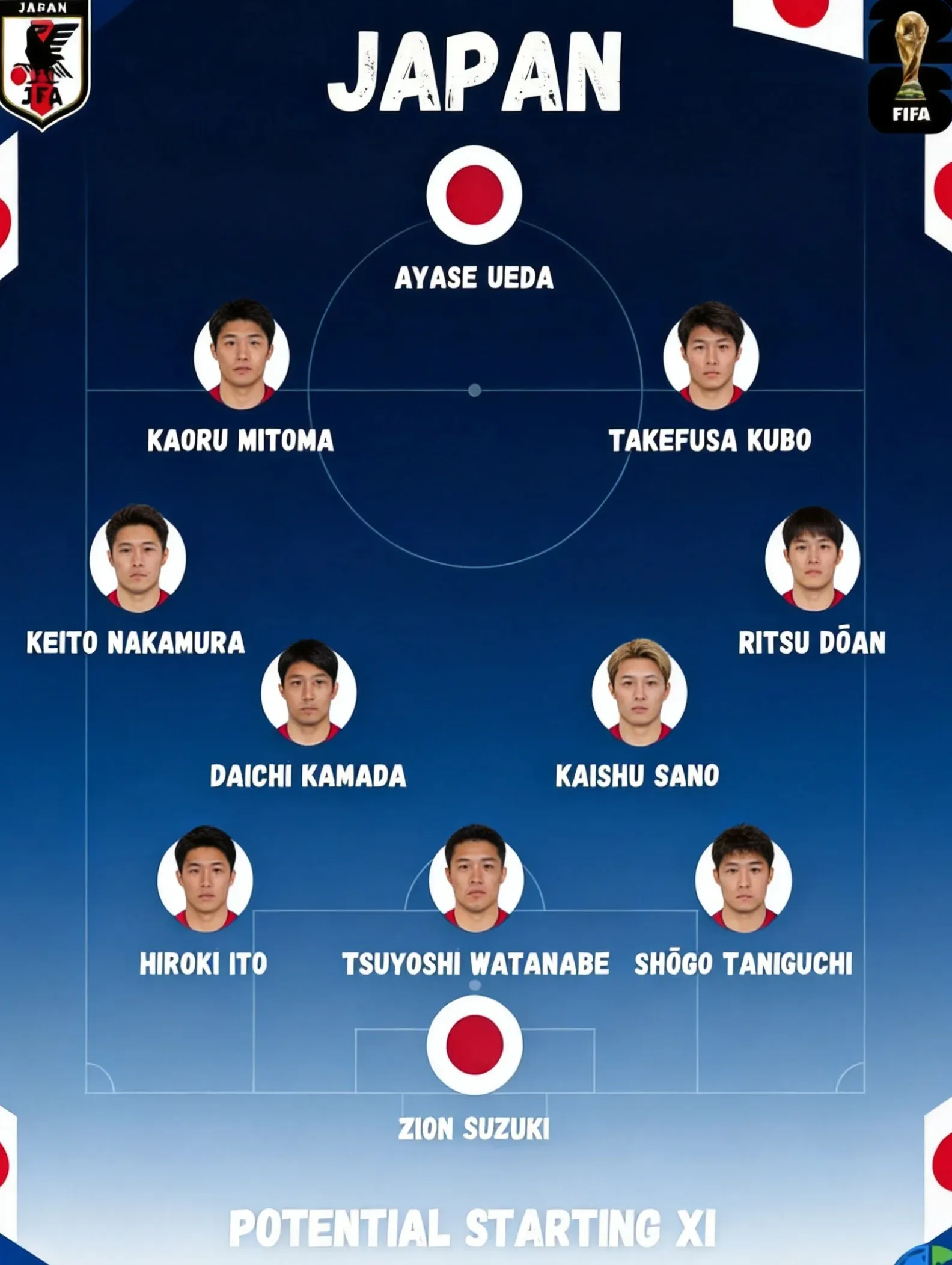
Japan’s reveal day was framed by what was missing. Kaoru Mitoma — the 28-year-old Brighton winger and the spine of Japan’s attacking shape — was left out, having suffered a left hamstring tear against Wolverhampton on May 9. His recovery timeline is reportedly around two months, which puts him outside the June 11 tournament window.
Moriyasu’s decision to exclude rather than gamble has a parallel in the same room: Yuto Nagatomo, the 39-year-old FC Tokyo defender, was included for an Asian-record fifth consecutive World Cup. Touchline Global understands that Moriyasu’s selection criterion was explicit during internal discussions: “Can the player reach 100% during the tournament window?” Mitoma’s answer was no. Nagatomo’s, despite limited J1 minutes, was yes.
The risk tolerance is asymmetric. Federations carrying World Cup expectations cannot afford to bet on injury recovery; they bet, instead, on availability. Japan today made that bet. Whether it pays off depends on whether the loss of Mitoma’s left-side breakthroughs in Group F games — particularly against the Netherlands on June 14 — proves decisive.
The May 15 Nikkan Sports report noted that Moriyasu used the word “winning” — for the first time — as the ultimate goal in a pre-tournament press conference. The combination of declaring a maximalist target while excluding the team’s most decisive attacking player is, in commercial-football terms, an unusual choice. It either signals confidence in the squad’s depth, or it signals something else entirely.
What the May 15 Reveal Cycle Reveals About FIFA’s Calendar
FIFA’s official deadline for final 26-man squad submission is June 2. May 15 is, in regulatory terms, 18 days before that deadline. The fact that five federations chose to reveal publicly so far in advance of the FIFA submission has structural implications worth understanding.
Three observations from inside the federation-media-relations market:
- Public reveal vs FIFA submission are not the same thing. A federation can announce its 26-man squad publicly on May 15, then technically replace players up to 24 hours before the tournament opener (only in case of injury, only with FIFA medical committee approval). The May 15 reveal is therefore a marketing event, not a contractual one.
- The "reveal cycle" market is dispersed across May. Bosnia-Herzegovina announced on May 11 (first to do so). New Zealand on May 14. Five today. South Korea tomorrow (May 16). Scotland on May 19. Switzerland on May 20. Germany on May 21. England on May 22. The Netherlands on May 25. The cumulative effect is a 21-day rolling reveal cycle that compresses tournament-preview content into roughly three weeks.
- The June 2 deadline is the only one that matters for FIFA tournament administration. All 48 nations must submit their final 26-man rosters to FIFA by June 2; FIFA officially publishes the full tournament squad list on the same date. Replacements after that are restricted to injury cases up to 24 hours before each team's first match.
The structural takeaway: federations are voluntarily releasing information weeks before they are required to, because the commercial value of a public reveal — sponsor activations, broadcaster slots, jersey sales, fan engagement — peaks in the four weeks before the opener, not in the final ten days.
Who Reveals Next
The May reveal cycle continues into the third and fourth weeks of the month. The publicly-confirmed schedule for the remaining major federations:
| Date | Federation | Notes |
|---|---|---|
| May 16 (Sat) | South Korea | [Hong Myung-bo](/en/team/south-korea/)'s selection; [Son Heung-min](/en/team/south-korea/player/son-heung-min/) focus |
| May 18 (Mon) | Austria, Portugal, DR Congo, Croatia | Four-nation cluster |
| May 19 (Tue) | Scotland | Clarke's first WC squad since 1998 |
| May 20 (Wed) | Switzerland | |
| May 21 (Thu) | Germany, Morocco, Norway | Nagelsmann's Germany; Hakimi-led Morocco |
| May 22 (Fri) | England | Tuchel's first official WC squad |
| May 25 (Mon) | Spain, Netherlands | Two co-favourites same day |
| May 26 (Tue) | USA, Panama | Pochettino's USMNT; co-host attention |
| May 29 (Fri) | Egypt, Colombia | |
| June 1 (Mon) | Mexico, Argentina, Brazil, Australia, Türkiye, Iran, Saudi Arabia, others | Largest single reveal day; Messi expected for Argentina farewell |
| June 2 (Tue) | FIFA official publication | Final regulatory deadline |
The June 1 reveal day will dwarf May 15 in volume — but May 15 retains a distinctive characteristic. It is the day on which two opponents in the same group went public within four hours, and the day on which Japan declared “winning” while losing its most decisive attacking player. Whether either of those data points proves significant in June and July will only be revealed on the pitch.
The Reveal Day, In Context
A May 15 final-squad reveal, 27 days before the World Cup opener, is consistent with a broader shift in the federation-media calendar over the past three cycles. Russia 2018 saw most major federations reveal in early June. Qatar 2022 — held in November — distorted the cycle entirely, with reveal dates pushed into October. North America 2026 returns to a summer tournament window, and the federation-media calendar has accordingly returned to a May-heavy reveal pattern.
What is different about 2026 is the volume. Sixteen of 48 participating nations are expected to publicly reveal between May 11 and May 26 — a third of the tournament. That density is unprecedented. Past tournaments saw reveal dates more spread across late May and the first week of June.
A senior figure in the global sports-media rights market, speaking on background during a 30-minute conversation this week, suggested to this reporter that the 2026 compression is structural rather than coincidental: “Broadcasters bought rights in 2023-2024 with content schedules that demand pre-tournament tactical content in May. Federations are responding to the broadcaster calendar, not driving it. The reveal-day compression is downstream of the rights market.”
The reveal-day compression is downstream of the rights market. A phrase worth holding onto. It explains why five federations chose Friday, May 15. It explains why the next two weeks will see one or two federation reveals nearly every day. And it explains why, by June 1, the only stories left to tell in the tournament-preview cycle will be the ones that come from inside the camps themselves — injuries, formations, friendlies — and not from the federation announcement rooms.
FAQ
How many nations announced their World Cup 2026 squads on May 15? Five: Japan (Group F), Tunisia (Group F), Belgium (Group G), Ivory Coast (Group E), and Haiti (Group C). The compression of five federation reveals onto a single day has no clear precedent in past World Cup cycles.
Why did five federations reveal on the same day? The May 15 timing is driven by media-cycle logic — a Friday afternoon reveal in Europe is a Friday evening lead in Asia and a Saturday broadsheet feature globally. No federation has confirmed coordination; the same-day clustering is a function of each federation optimising for the same week.
What was the most notable Japan story from May 15? Kaoru Mitoma was left out due to a left hamstring tear (suffered May 9 against Wolverhampton). 39-year-old Yuto Nagatomo was selected for an Asian-record fifth consecutive World Cup. Moriyasu also named “winning” as the ultimate goal — a first for a Japanese pre-tournament press conference.
Who is Tunisia’s new coach? Sabri Lamouchi, named head coach in January 2026 after Sami Trabelsi was sacked following the AFCON 2025 round-of-16 penalty defeat to Mali. Lamouchi previously coached Ivory Coast at the 2014 World Cup and managed Nottingham Forest and Cardiff City in England.
When is the FIFA deadline for final squad submission? June 2, 2026. All 48 nations must submit their final 26-man rosters to FIFA by June 2; FIFA officially publishes the full tournament squad list on the same date.
Can players be replaced after May 15 reveals? Yes, but only for injury reasons. After the June 2 FIFA submission, replacements are restricted to injury cases up to 24 hours before each team’s first match, and require FIFA Medical Committee approval. Recovered players cannot be added back if a healthy player was already named.
Which Group F opponents revealed on May 15? Japan and Tunisia — two of Group F’s four nations. The other two: Sweden announced May 12; Netherlands will announce May 25.
Who reveals next? South Korea on May 16, the cluster of Austria/Portugal/DR Congo/Croatia on May 18, Scotland on May 19, Switzerland on May 20, Germany/Morocco/Norway on May 21, England on May 22. The largest single reveal day will be June 1, when most remaining nations (Mexico, Argentina, Brazil, others) reveal together.
Has any previous World Cup seen five reveals on one day? No. The five-on-one-day clustering for May 15, 2026, has no clear precedent in World Cup federation media history. Past tournaments saw reveal dates more dispersed across late May and the first week of June.
Why is the 2026 reveal cycle more compressed? Broadcasters secured rights in 2023-2024 with content schedules requiring pre-tournament tactical content throughout May. Federations are responding to the broadcaster calendar rather than driving it. Sixteen of 48 nations are expected to reveal between May 11 and May 26 — a third of the tournament.
What is the practical effect of the compressed reveal cycle? Tournament-preview content is concentrated into a roughly three-week window. By June 1, most preview narratives will be drawn from inside the camps themselves — friendlies, injuries, formations — rather than from federation announcement rooms.
Related Articles
- Mitoma’s Name Was Not Called — Japan’s 26 — full Japan reveal coverage
- 三笘の名前は呼ばれなかった——森保ジャパン 26 人 — original Japanese
- FIFA World Cup 2026 Dates (Complete Guide) — full 39-day calendar
- Inside FIFA’s $1.6 Billion Hospitality Bet — premium ticket economy
- World Cup Knockout Stage (Complete Guide) — 32-team knockout format
- External sources: Sports Illustrated full squad tracker · ESPN squad list · Flashscore complete squads · Nikkan Sports Japan 26 · The Dakia full tracker · FIFA WC 2026 official portal
About the author: James O’Connor is investigative football correspondent at Touchline Global, the London-based independent football journalism outlet founded in 2012 and specializing in FIFA governance, commercial reporting, and football’s political economy. O’Connor has covered every FIFA World Cup since Brazil 2014. Contact: james.oconnor@touchline.global · LinkedIn: /in/james-oconnor-touchline · X: @JamesOConnorTG