

Quick Reference
| Detail | Information |
|---|---|
| Stadium | Lumen Field / Seattle Stadium (tournament name) |
| Capacity (WC) | ~68,740 (NFL config: 68,740, expandable to 72,000+) |
| Matches hosted | 6 (4 group stage + 1 Round of 32 + Round of 16, July 6) |
| Location | SoDo district, southern downtown Seattle, on Elliott Bay |
| Nearest airport | Seattle-Tacoma International (SEA) — 21 km / 13 mi south |
| Recommended days | 4 nights |
| Budget level | High (Pacific Northwest pricing, comparable to Boston) |
| Best neighborhoods | Downtown, Belltown, Pioneer Square, Capitol Hill, Pike Place / Waterfront |
| Avoid | Renting a car; underestimating SoDo congestion; assuming a “Seattle freeze” |
| Currency | US Dollar (USD) |
| Tap water | Safe to drink. Among the best municipal water in the United States. |
The northernmost US World Cup venue, and arguably the country’s most soccer-obsessed city. The USA Men’s National Team plays Australia here on June 19, 2026 — Juneteenth, a federal holiday — making this the first World Cup match ever played on America’s newest national holiday. Seattle hosts Belgium vs. Egypt (June 15), USA vs. Australia (June 19), Qatar vs. UEFA playoff winner (June 24), Egypt vs. Iran (June 26), a Round of 32 on July 1, and a Round of 16 on July 6. The stadium is Lumen Field — Seahawks home, Sounders home, MLS Cup host, and one of the loudest stadiums in world sport. The Sound Transit Link 1 Line drops you at Stadium Station, a 5-minute walk from Pioneer Square. Welcome to Seattle — where coffee culture started, where grunge rock invented itself, where Asia meets America at Pike Place Market, where Mount Rainier shows itself on clear days, and where the Emerald City Supporters invented modern American supporter culture in 2005.
The Stadium
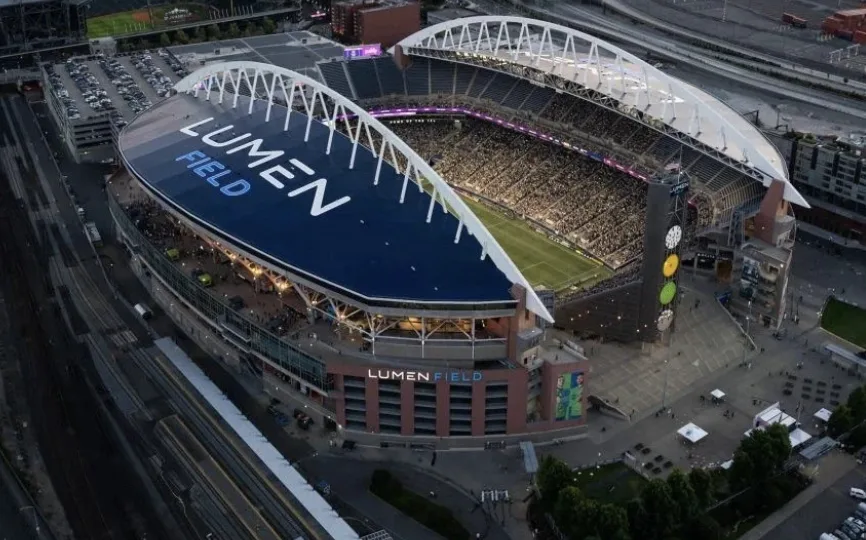
Lumen Field opened on July 28, 2002, replacing the demolished Kingdome (the same site, the same plot, a different building). Originally named Seahawks Stadium, then Qwest Field (2004-2011), then CenturyLink Field (2011-2020), then Lumen Field since 2020. For the 2026 World Cup, FIFA renames it Seattle Stadium for the duration — Lumen Technologies is not a FIFA sponsor, so the corporate name comes off.
The venue was specifically authorized by Washington state voters in 1997 with the explicit ability to host the FIFA World Cup. The 1997 referendum legislation that approved public funding called out international soccer hosting capacity as a design requirement. Lumen Field was, in a real sense, built for this tournament.
For 2026, the FieldTurf surface has been replaced with a temporary natural grass overlay — required by FIFA technical standards. The grass installation began in May 2026 and will be removed after the tournament ends in early July. The Seahawks will resume play on FieldTurf for the 2026 NFL season.
Capacity for the World Cup is expected to be ~68,740 — Lumen Field’s standard NFL configuration. Special events have hit 70,000+; the 2014 Sounders MLS regular-season opener drew 67,385.
Acoustic legend: Lumen Field is registered by the Pacific Northwest Seismic Network, the regional earthquake monitoring system, because Seahawks fan noise generates measurable seismic activity. The 2011 “Beast Quake” — Marshawn Lynch’s 67-yard touchdown run vs. New Orleans Saints — registered a magnitude 1.0 earthquake on the regional seismometer system. The stadium is among the loudest in world sport, and any World Cup match here will benefit from the same acoustic engineering.
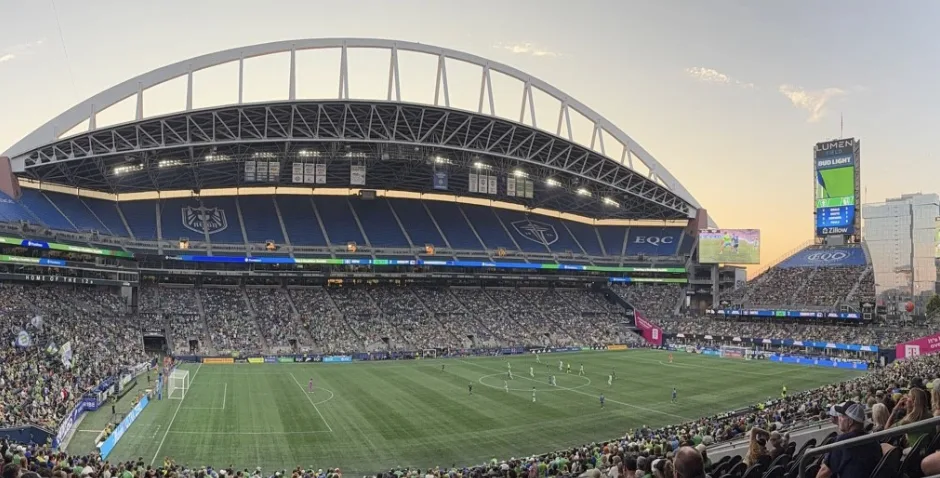
The six matches scheduled here:
- June 15 — Belgium vs. Egypt (Group G) — Belgium’s training base camp is in Seattle
- June 19 — USA vs. Australia (Group D) — Juneteenth federal holiday
- June 24 — Qatar vs. UEFA Playoff A winner (Group B) — Italy/Wales/N. Ireland/Bosnia path
- June 26 — Egypt vs. Iran (Group G), 8 PM PT
- July 1 — Round of 32
- July 6 — ROUND OF 16
The June 19 USA-Australia match is the venue’s defining moment. Juneteenth — the federal holiday commemorating the end of US slavery, signed into law by President Biden in 2021 — falls on a Friday in 2026. No World Cup match has ever been played on Juneteenth before. The USA Men’s National Team plays in front of the country on a national holiday, in the second-most soccer-passionate city in America (only LA out-rivals Seattle’s Latino soccer culture and ECS combined organization). The atmosphere is expected to exceed any USMNT home match in modern history.
Belgium will train at Sounders FC’s Providence Swedish Performance Center — the team’s full-time facility in Renton, 25 km southeast of Seattle. The training base announcement (April 2026) confirms Belgium will spend 4-6 weeks in the Pacific Northwest.
Getting There
From Seattle-Tacoma International Airport (SEA) to the Stadium
SEA is 21 km / 13 mi south of Lumen Field. Travel time 25-40 minutes in normal traffic, 45-75 minutes on match days.
Sound Transit Link 1 Line (light rail) is the optimal option:
- Direct from SEA to Stadium station — 38 minutes, $3.25
- Trains run every 6-8 minutes during World Cup hours
- Stadium station is a 5-minute walk from Lumen Field’s main gates
- The Link continues north to Capitol Hill, University of Washington, Northgate
- No rental car needed for any World Cup activity — the Link covers SEA, Stadium, downtown, Capitol Hill, U-District
By rideshare (Uber/Lyft): $35-55 from SEA in normal traffic, $70-130 on match days. Drop-off zones are at designated lots near Lumen Field with 8-12 minute walks to gates.
FIFA dedicated shuttle service runs match days from downtown Seattle, Bellevue, and SEA Airport. Routes confirmed in May 2026; check with your hotel for shuttle pickup points.
By driving — strongly discouraged: SoDo (the stadium district) becomes effectively closed to private vehicles on match days. Reserved parking is limited; off-street parking around Lumen Field runs $60-150 on match days. Pre-book via SpotHero or ParkWhiz if you must drive.
Visa & Entry
Standard US rules. VWP countries (Japan, UK, France, Germany, etc.): ESTA required. Visa-required countries (Brazil, China, India, Russia, Mexico, Argentina) should apply 6+ months in advance.
SEA handles 50+ million passengers annually and is a Delta and Alaska Airlines hub. Immigration lines on match days will run 30-60 minutes for non-Global Entry holders.
SEA-Vancouver direct flights (about 60 minutes flight time, 200 km / 125 mi by road) are widely booked for World Cup overlap travel — Seattle and Vancouver are the only two host cities within direct driving distance of each other.
Where to Stay
| Neighborhood | Train/Drive to Stadium | Double Room/Night | Vibe | Best For |
|---|---|---|---|---|
| Downtown / 3rd Ave | 8 min by Link | $300-500 | High-rises, convention center, Pike Place Market | Best public-transport access |
| Belltown | 12 min by Link | $250-400 | Bars, restaurants, walking-distance to Pike Place | Foodies, nightlife |
| Pioneer Square | 5 min by Link | $200-380 | Historic district, oldest neighborhood, walkable to stadium | Closest stadium proximity |
| Pike Place / Waterfront | 10 min by Link | $280-450 | Tourist heart, ferry terminal, Puget Sound views | First-time visitors, families |
| Capitol Hill | 15 min by Link | $200-380 | Bars, restaurants, LGBTQ+ heart, indie scene | Younger travelers, foodies |
| South Lake Union | 15 min by Link | $260-400 | Tech corporate corridor, Amazon HQ neighborhood | Business travelers |
| U-District (matchday only) | 25 min by Link | $150-260 | College town, university museum | Budget stays |
Pioneer Square is the smart default for World Cup visitors. It’s the closest neighborhood to Lumen Field (5-minute walk), Seattle’s oldest district (gold-rush 1890s), home to the Underground Tour, restored brick buildings, and the King Street Station (Amtrak). Hotels: Hotel Sorrento ($320), Embassy Suites Seattle Downtown ($280), The Inn at the Market (~$290).
Downtown / 3rd Ave is the largest hotel concentration. The Convention Center, Westlake Park, the monorail to Seattle Center. Hotels: The Westin Seattle ($340), Sheraton Grand Seattle ($300), Grand Hyatt Seattle ($420), Hotel Theodore ($260, boutique).
Belltown is the food-and-drink default. The neighborhood directly between Pike Place and the Space Needle, with the most concentrated restaurant scene per square block in Seattle. Hotels: Belltown Inn ($200, boutique), Edgewater Hotel ($340, on the water).
Pike Place / Waterfront is the quintessential Seattle pick. The original Pike Place Market (1907), ferry departures to Bainbridge Island, the new Waterfront Park (opened 2024), the Aquarium. Hotels: The Edgewater ($340), Inn at the Market ($290), Mayflower Park Hotel (~$240).
Capitol Hill is the indie pick. Walking distance to Pike Place via 3rd-and-Pike, but a real Seattle neighborhood (not tourist) — independent restaurants, the Volunteer Park observatory, the Asian Art Museum. Hotels: Hotel Sorrento ($320, historic 1909), Capitol Hill Hostel ($80 dorm).
What to avoid: Hotels in Bellevue or Tukwila marketed as “Seattle” — these are 12-25 km east/south of downtown, and traffic to Lumen Field on match days will be 60+ minutes. Read addresses carefully.
Stadium-area hotels (Embassy Suites, The Mercer Hotel SoDo): convenient on match day but isolating. Limited dining outside Lumen Field, no Pike Place walking distance.
Book by April 30. Seattle is the second-most expensive 2026 host city behind New York; the June 19 USA-Australia match week (Juneteenth) is sold out at most downtown 4-star hotels by April. Even mid-tier rooms run $200-300 baseline, $350+ premium, during World Cup weeks. The June 26 Egypt-Iran night match brings strong Iranian-American traveler demand, particularly from Los Angeles and the Bay Area.
Beyond the Stadium
Pike Place Market
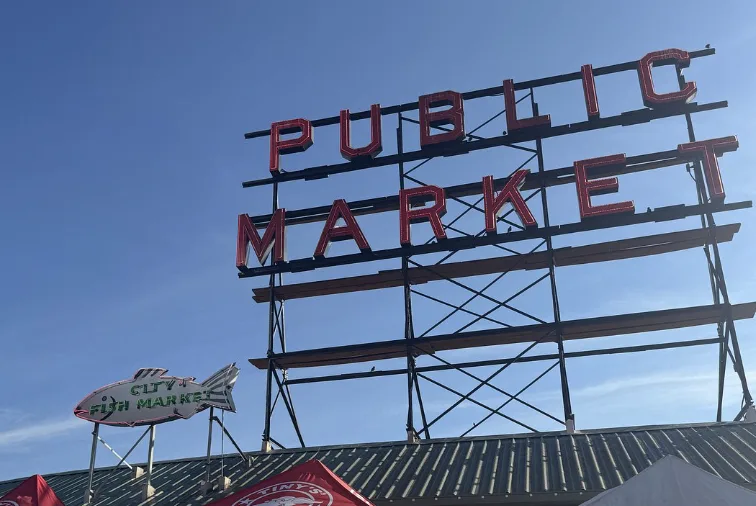
The original 1907 farmers market — the country’s oldest continuously operating farmers market. Free entry. Allow 2-3 hours. Don’t miss: Pike Place Fish Market (the famous fish-throwing); the original Starbucks (1971); the Gum Wall (a deeply weird tourist tradition); fresh Pacific salmon at the seafood vendors. Avoid 11 AM-1 PM — the most crowded window. Best at 8-10 AM or after 4 PM.
Space Needle + Chihuly Garden and Glass
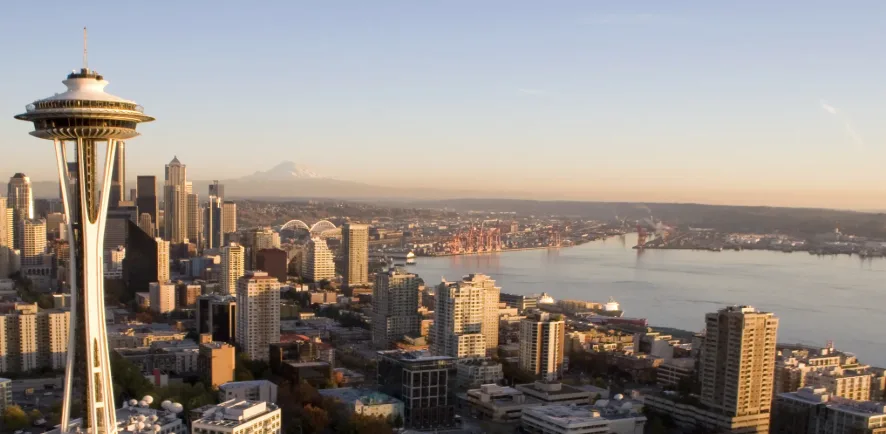
Two attractions on the Seattle Center grounds (1962 World’s Fair site). Space Needle ($35 entry) — the 184-meter observation tower, with rotating outdoor deck. Best at sunset. Chihuly Garden and Glass ($35 entry) — Dale Chihuly’s blown-glass sculptures, both indoor and outdoor garden installations. Combined ticket $50.
The Seattle Center also hosts the 2026 FIFA Fan Festival — confirmed location at the Space Needle base / Fisher Pavilion area. Big screens, live music, food vendors. Free entry.
Museum of Pop Culture (MoPOP)
Frank Gehry’s spectacular building on the Seattle Center grounds. The Nirvana exhibit is worth the visit alone — Cobain’s guitars, original lyric sheets, the 1991 Nevermind context. Strong horror and science fiction exhibits. $32 entry.
Pioneer Square Underground Tour
The 1889 Great Seattle Fire destroyed downtown. The reconstructed neighborhood was built on top of the previous one — 3 stories higher. The Underground Tour (75 minutes, $25) walks the original 1880s streets, now subterranean. Touristy but genuinely interesting; Bill Speidel started it in 1965.
Mount Rainier National Park
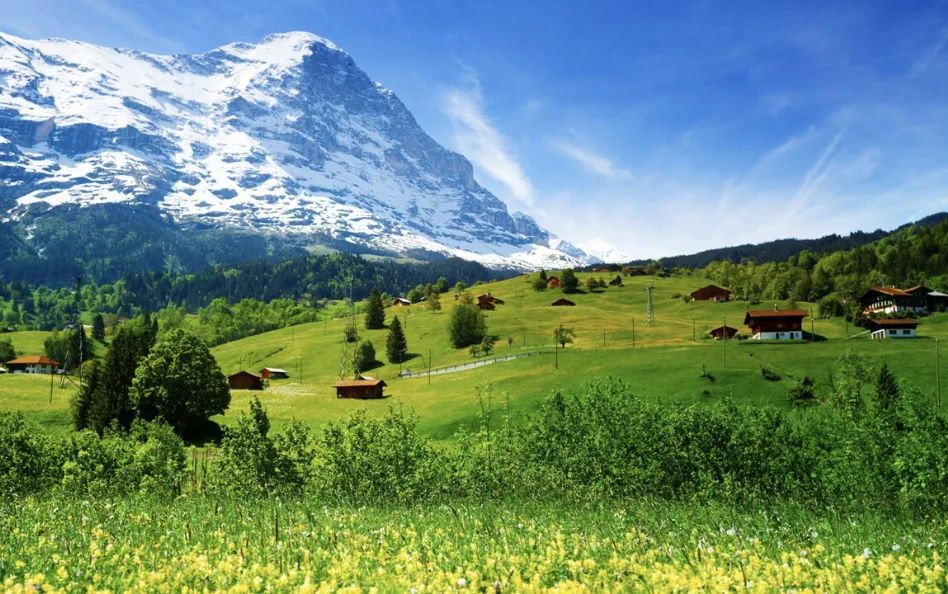
3 hours by car south. Mount Rainier (4,392 m) is the most prominent peak in the Lower 48. June and July are the prime visiting months — wildflower meadows at Paradise are at peak. Drive to Sunrise (the highest point road-accessible). Park entry $30/vehicle. Allow a full day.
Olympic National Park
3.5 hours by car + ferry. The Hoh Rain Forest (one of the rare temperate rainforests in the world), Hurricane Ridge (alpine meadows), La Push (Pacific beach). Dramatic but requires a full day’s drive.
Day Trips Within Seattle
Bainbridge Island (35-minute ferry from Pier 52, $9.85 round trip walk-on): bookstore, restaurants, Bainbridge Island Museum of Art. Excellent half-day.
The Boeing Future of Flight Tour (30 min north of Seattle, in Everett): tour the world’s largest building by volume — the Boeing factory where 747s and 777s were built. $30 entry. Allow 4 hours.
Where to Eat and Drink
Pacific Northwest Seafood (the religion)
Walrus and the Carpenter (Ballard). Anthony Bourdain’s #1 Seattle pick. Oysters, crudo, lighter fare. Reservations 30+ days out. $50-90.
Taylor Shellfish Oyster Bar (Pioneer Square, Capitol Hill). Walk-in oyster bars from the West Coast’s largest oyster farm. $30-60.
Westward (Lake Union). Mediterranean-influenced seafood with Lake Union views. Best brunch in Seattle. $50-80.
Pike Place Chowder (Pike Place Market). The famous clam chowder. Lines from 11 AM. $15-25.
Asian Cuisine (the depth)
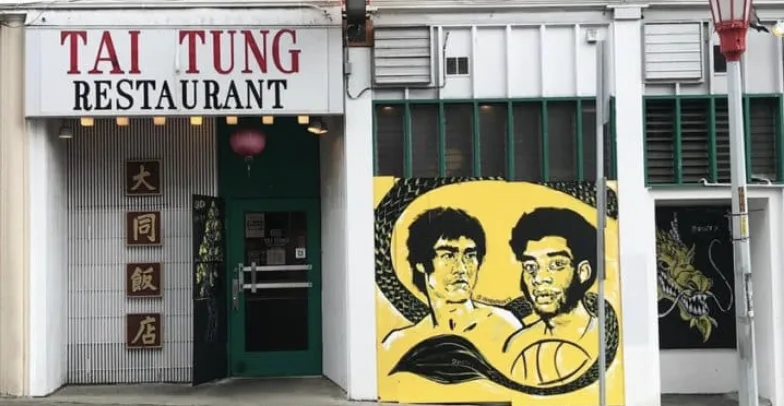
Seattle has the strongest Asian food scene of any 2026 US host city, reflecting the city’s deep Pacific Rim demographic and historical connection. The International District / Chinatown has the best concentrated Asian dining in the Pacific Northwest.
Tai Tung (International District, since 1935). The oldest Chinese restaurant in Seattle. Bruce Lee was a regular — he’s photographed at this restaurant in the 1960s. Cantonese, fried rice, hung yu (steamed fish). $25-45.
Maneki (International District, since 1904). The oldest Japanese restaurant on the West Coast — 122 years operating. Sushi, izakaya menu, $15 chirashi at lunch. $30-60.
Phở Bắc (Little Saigon). The original Vietnamese pho counter — Seattle has the largest Vietnamese-American population in the United States outside California. $15-25.
Yamasaki (Bellevue). High-end omakase. Reservations 60+ days out. $200+ per person.
Beecher’s Handmade Cheese (Pike Place). Cheese curds and grilled cheese. $10-18.
Coffee (the obligation)
Seattle invented modern American coffee culture. The original Starbucks (1971) at 1912 Pike Place is a tourist landmark — but coffee culture here goes far deeper.
Victrola Coffee Roasters (Capitol Hill, Pike). Third-wave reference point.
Espresso Vivace (Capitol Hill). David Schomer’s flagship — Italian-style espresso, considered the city’s defining espresso bar.
Storyville Coffee (Pike Place). Wood interior, 360° market view. Best espresso in the market.
Slate Coffee Roasters (Capitol Hill). Light-roast, single-origin focus.
Modern Pacific Northwest
Canlis (Queen Anne, since 1950). Fine dining with Lake Union views. James Beard Foundation Outstanding Restaurant winner. $200+ tasting menu. The most prestigious restaurant in Seattle.
Salare (Ravenna). Edouardo Jordan, James Beard semifinalist. New American with Italian and Caribbean influences. $80-120.
Wild Ginger (Belltown). Pan-Asian fusion, since 1989. The duck-soong is signature. $40-70.
Beer
Pike Brewing Company (Pike Place, since 1989). Brewery, beer hall. Walking distance from the market.
Fremont Brewing (Fremont, north of Lake Union). The Universale Pale Ale is the regional standard.
Reuben’s Brews (Ballard). Multiple Great American Beer Festival medals.
The Fan Experience
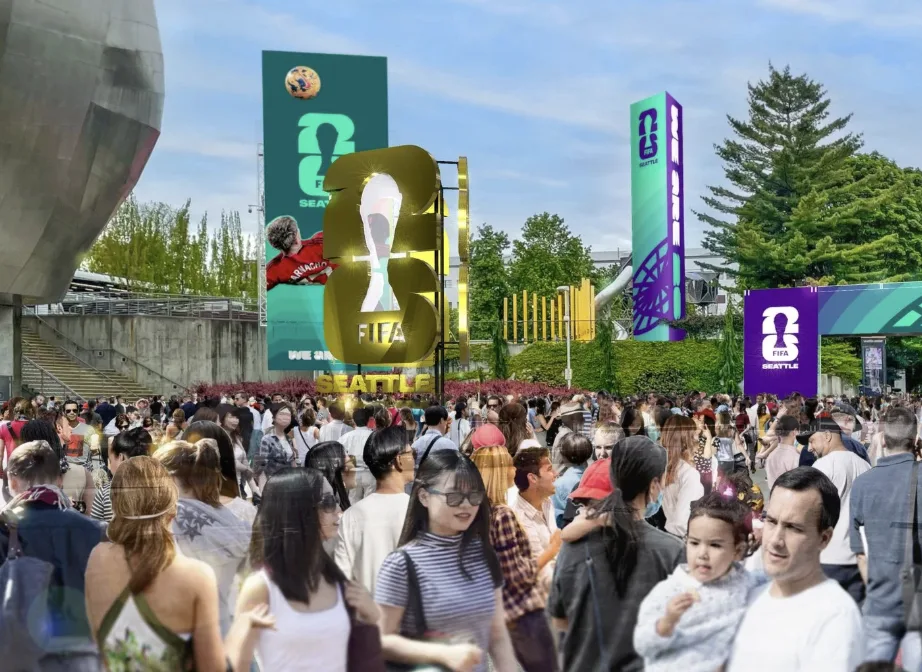
FIFA Fan Festival — Seattle: Confirmed at Seattle Center near the Space Needle. Big screens, food trucks, live music. Free entry. The setting — at the base of the Space Needle, with Mount Rainier visible on clear days — is the most iconic Fan Festival location of any 2026 host city.
Sports bars:
- Stoup Brewing (Ballard) — beer and major-screen soccer
- The Atlantic Crossing (Roosevelt) — the legendary Seattle soccer pub, English-style, has shown every World Cup since 1990
- The George and Dragon Pub (Fremont) — English Premier League home in Seattle
- The Pickle and Mr. Pickle (Capitol Hill, Belltown) — Australian/Kiwi pub with rugby and soccer
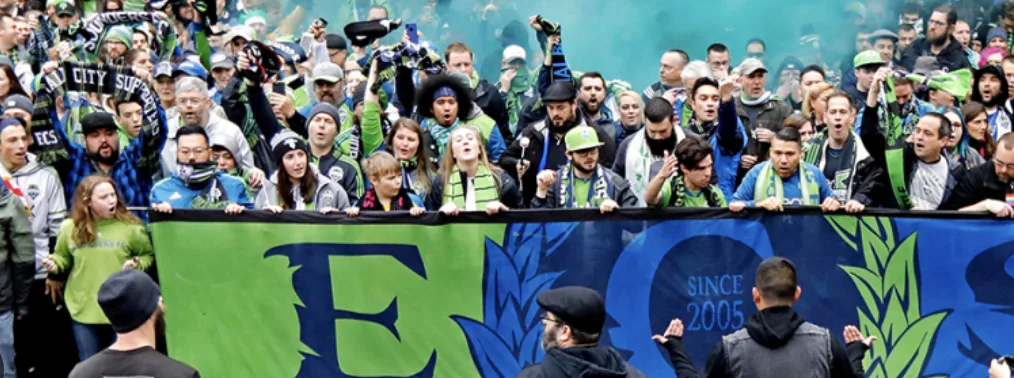
Sounders FC and Emerald City Supporters: Seattle Sounders FC plays at Lumen Field on MLS regular-season match days when the World Cup is not running. Their supporters group, the Emerald City Supporters (ECS), founded in 2005 (when the team was in USL), is the original architect of modern American MLS supporter culture — they invented the March to the Match (the supporters’ walk from Pioneer Square to the stadium 90 minutes before kickoff), the Brougham End standing section (Sections 121-123), the modern American tifo display, the smoke-bomb tradition. With 5,000+ members as of 2017 (likely 7,000+ today), ECS is the largest MLS supporter group. The Cascadia Cup rivalry against Portland Timbers and Vancouver Whitecaps — created in 2004 by fan organizations — is the most authentic regional soccer rivalry in North America.
During the 2026 World Cup, ECS will host watch parties for every Sounders-relevant match — including all six matches at Lumen Field. Their organized presence will be the most visible supporter culture of any non-host-nation match in the United States.
Seattle’s Asian-American Soccer Demographics
Seattle has substantial Korean-American, Japanese-American, and Vietnamese-American populations. The June 19 USA-Australia match will draw a strong Asian-American USMNT supporter contingent — particularly Korean-American fans whose presence at USMNT matches has become significant since the 2018 World Cup. Iran will benefit from Seattle’s substantial Iranian-American population (especially in Bellevue and Mercer Island). The Egypt vs. Iran night match (June 26, 8 PM PT) is expected to be the city’s most internationally-flavored World Cup atmosphere.
The Story
March 19, 2009. CenturyLink Field, Seattle. Sounders FC vs. New York Red Bulls. MLS Cup season opener.
The Seattle Sounders had just been admitted to Major League Soccer. The franchise was formerly the USL Sounders, dating back to 1994. The new MLS Sounders had been built around 28-year-old Colombian midfielder Fredy Montero (signed from Independiente), 36-year-old Nigerian goalkeeper Kasey Keller (returned from Borussia Mönchengladbach), and 22-year-old Brazilian winger Sebastian Le Toux. The head coach was Sigi Schmid, the most successful coach in American soccer history.
The opening match was vs. the New York Red Bulls. Match 1 of MLS Match 1 of the Sounders MLS era. CenturyLink Field sold 32,523 tickets — at that time, the largest paying crowd for an MLS opener in history.
The Emerald City Supporters had been working on this moment for two years. Founded in 2005 to support the USL Sounders, ECS had organized the March to the Match — supporters gathering at Pioneer Square Pyramid Brewery 90 minutes before kickoff, marching to the stadium together, dozens of flares, smoke bombs, drum sections. They had built their first major tifo display — a multi-section display covering Seahawks corporate signage. They had organized chants in English and Spanish.
When the teams entered the field, the ECS unfurled a tifo of Fredy Montero, Brian Schmetzer, and Kasey Keller — three icons honoring the new Sounders era.
The match itself was a 3-0 Seattle victory. Montero scored. The crowd noise was so loud it generated discussion in the local media for weeks. Roger Levesque (a USL Sounders veteran kept on for the MLS team) later said: “It was insane. The crowd was nuts. It was awesome.”
What happened that night was the birth of modern American soccer supporter culture. Before March 19, 2009, MLS supporter groups existed but were small. After March 19, 2009, the model spread:
- The March to the Match is now a standard tradition at every MLS team
- Tifo displays — the giant fan-made art unfurled before kickoff — are now expected at every match
- The standing-section culture at the south end of stadiums is now an MLS norm
- The bilingual chanting that ECS pioneered (English + Spanish) is now standard at LA Galaxy, FC Dallas, Houston Dynamo, San Jose Earthquakes
- The smoke bombs and flares that ECS introduced are now expected (and league-regulated) at every MLS supporter section
Seattle Sounders averaged 30,943 fans per match in 2009. The 2014 average was 43,734 — at the time, the largest average attendance in any North American sport for a single team. The 2024 average is 34,000+, still the highest in MLS.
When the World Cup opens at Lumen Field on June 15, 2026 — Belgium vs. Egypt — the section that ECS has stood in for 20 years (Sections 121-123, the Brougham End) will be different. The supporters won’t be there. World Cup matches use FIFA’s neutral seating arrangement. The Brougham End during World Cup will be filled with Belgian and Egyptian fans, not the green-and-blue of Sounders supporters.
But on June 19 — USA vs. Australia, Juneteenth, the federal holiday, the first World Cup match ever played on America’s newest national holiday — the Brougham End will be reorganized for the USMNT. The ECS will not coordinate the section officially (FIFA owns it), but the architects of American supporter culture will be in the building. Many will be in their original seats. Many will have organized friend-and-family groups across the south end. The single most influential American supporter culture, born on this exact pitch on March 19, 2009, will host the World Cup that finally arrived 17 years later.
When 68,000 American fans sing “I Believe That We Will Win” before kickoff on June 19, 2026 — a chant invented by the US Naval Academy in 1998 and adopted by the American Outlaws supporter group around 2010 — they will be standing in the building where the modern American supporter movement was first organized.
The acoustic record set by Seahawks fans at this stadium (a magnitude 1.0 earthquake in 2011) is still on the regional seismometer logs. The atmosphere on June 19, 2026 — Juneteenth, USMNT, World Cup — is expected to break it.
Seattle: where American soccer fans first organized into culture, in 2005, on this exact pitch. Now hosting the World Cup at home, on a federal holiday, with the country watching. The Pacific Northwest waited 32 years for this moment. The Brougham End was waiting for a long time. The world is finally here.