9 July 2006, Berlin.
The grass outside the Olympiastadion had been soaked for a week. That summer’s thunderstorms over Germany were out of season; it had rained for three days straight leading into the final. The pre-kickoff sky over Berlin carried a metallic grey you only see at high latitudes.
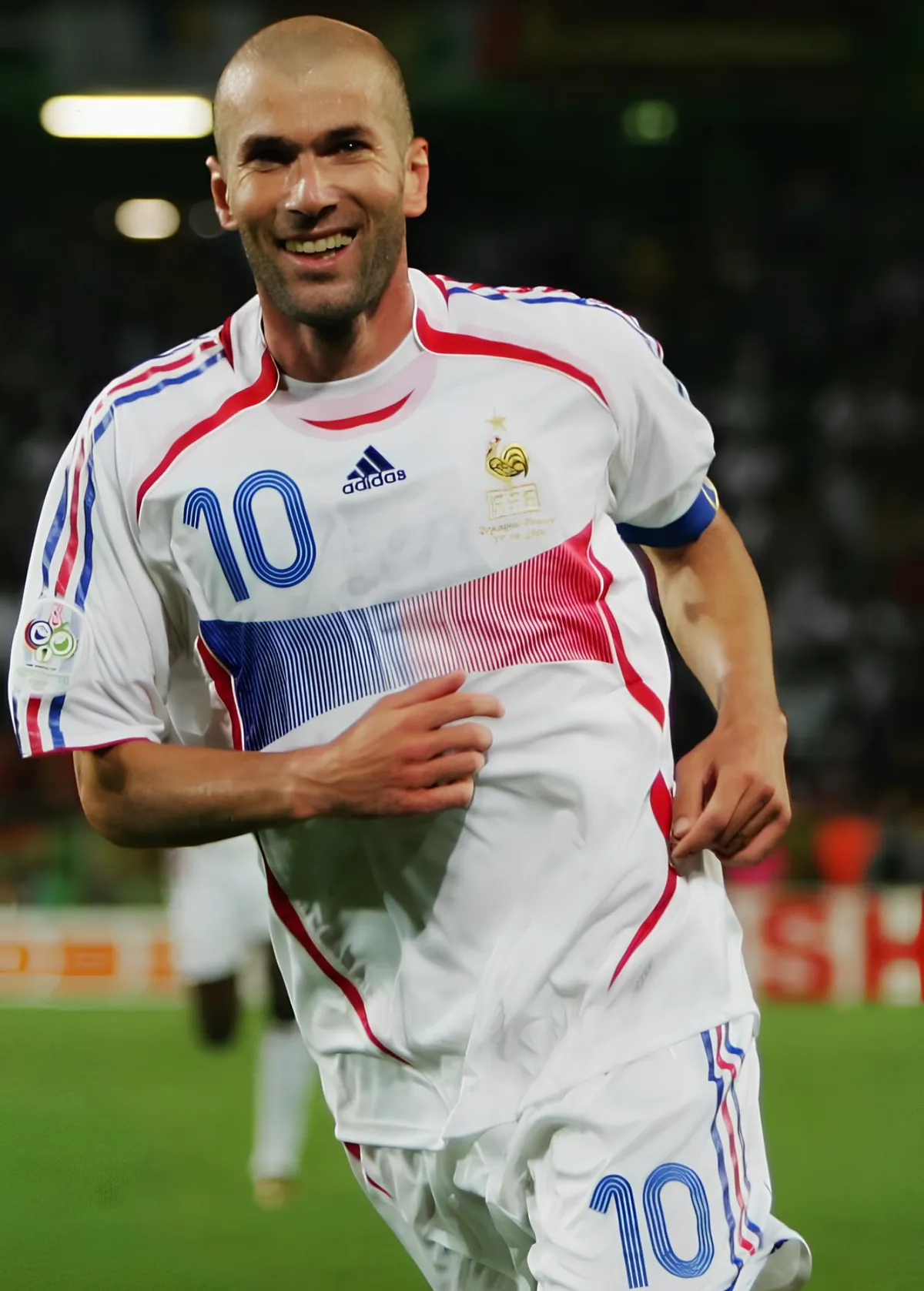
Argentine referee Horacio Elizondo stood in the centre circle, shaking hands with the two captains. France’s captain was Zinedine Zidane, 34. He had publicly announced that he was retiring after this final, whatever the result.
Three hours later he would keep that promise. In a way no one saw coming.
7th minute: A Panenka
In the 7th minute, Malouda was brought down in the box by Materazzi. Penalty, France.
Zidane walked to the spot. Opposite him stood Gianluigi Buffon — the keeper who would win that tournament’s Best Goalkeeper award, whose Italy side had conceded just two goals across the whole World Cup, one of them an own goal.
The safe play was to hit it hard and aim for a top corner.
He didn’t.
He took three steps back, ran in, and at the very last moment before making contact, slowed the swing down and chipped the ball with the laces.
The ball rose like a feather, traced an arc over the goal, kissed the underside of the crossbar and dropped in.
Buffon, who had committed to diving bottom-left, was already on the turf. When he got up he shook his head — not at Zidane, not in anger, but with a look that said I’ve seen this one before.
It was the first Panenka in a World Cup final.
In the French broadcast booth, commentator Thierry Gilardi shouted a line that would later be cut into the French Football Federation’s memorial video: “C’est Zidane, bien sûr. C’est lui.” — “It’s Zidane, of course. It’s him.”
For a 34-year-old Zidane, the Panenka wasn’t just a goal. It was a performance telling the world: I’m still the smartest man on this pitch.
France 1-0.
19th minute: Materazzi’s header
Twelve minutes later, Italy had a corner. Pirlo stepped up.
Materazzi came in from the far post, climbed over Vieira, and headed it cleanly in. It smashed into the bottom-left corner of the French goal.
1-1.
That was Italy’s second equalizer of the tournament. Materazzi hadn’t been a popular pick before the World Cup — he was one of the more controversial names on the 2006 Italy squad, with a track record of reckless moments. But in that minute, he became Italy’s most unlikely saviour.
Nobody yet knew that 90 minutes later, the same man would be the protagonist of something else entirely.
104th minute: Buffon’s fingertips
Extra time. Both sides had created chances. Neither had converted.
In the 104th minute, Zidane met a crossed free kick, timed his run to the far post, and headed on goal.
The ball flew hard and heavy, dipping toward the bottom-right corner. Buffon dived and, with his fingertips, pushed it over the bar.
That replay got run a lot afterwards. Zidane stood up, watched the ball go out, didn’t clap his hands, didn’t show any frustration, just walked slowly back to his own half.
The Belgian writer Jean-Philippe Toussaint described that exact moment in his 2006 essay La Mélancolie de Zidane. He argued that in that instant, Zidane realized he no longer had the time, the legs, or the will to pull off the perfect goodbye.
Toussaint’s line, roughly translated: “Form was refusing him. Unable to accept his own impotence, he chose to ruin his perfect exit.”
That’s a literary reading after the fact. The 90,000 people in the stadium at the time didn’t know it. But six minutes later, they would see the concrete version of “ruining perfection.”
110th minute: Those four seconds
The second half of extra time was in its tenth minute. Still 1-1. Everyone was getting ready for penalties.
A French attack was broken up. The ball got cleared downfield. Zidane jogged slowly back toward the halfway line.
Materazzi was behind him, maybe five metres away.
They were walking toward each other. As Materazzi passed Zidane, he tugged at his shirt.
What was said next has had at least five different versions over the past 20 years.
Zidane, Canal+ France, September 2006: “He repeatedly insulted my mother and my sister with very harsh words.” He refused to give the exact wording.
Materazzi, Gazzetta dello Sport, September 2006: “I insulted him, but I did not insult his mother.” He refused to give the exact wording.
Materazzi, August 2007 (first public wording): “I told him — I prefer the whore that is your sister.”
Materazzi, AS newspaper, Spain, 2020 (added context): “Actually Zidane started it. He said to me, ‘You want my shirt, you can have it after the game.’ And that’s when I said what I said.”
Materazzi, Vivo Azzurro (Italian FA channel), March 2026 (latest version): “I tugged at his shirt. He said, ‘You can have it after the game.’ I said I’d rather have his sister. Then he said something, and I said something back — ‘the kind of things we used to say as kids playing street football.’”
The truth will probably never settle into a single version.
But what happened on the pitch is not disputed. Zidane walked on two steps, stopped, turned, and drove his forehead into Materazzi’s sternum.
Materazzi went down.
The referee, 25 metres away, didn’t see it
Elizondo told the story in full in a 2011 interview with the British magazine The Blizzard:
“I was about 25 or 30 metres away from them. I saw Materazzi go down — not the kind of fall you do when someone trips you, the kind when you’ve been hit. I waited for him to get up. He didn’t get up. He didn’t get up. He didn’t get up. I stopped play.”
Elizondo asked both linesmen over his earpiece: “What did you see?” Both said “Nothing.”
It should have been the end of it — a quiet pause, play on.
Then a third voice came through the headset. Fourth official Luis Medina Cantalejo: “Horacio, Horacio, I saw it. Zidane headbutted Materazzi in the chest. Brutal.”
Strictly speaking, the fourth official wasn’t supposed to use video replay to make decisions — that was the 2006 rule. Cantalejo had caught the slow-motion replay on the stadium’s big screen (the host broadcaster had cut to it).
That detail would later trigger an internal FIFA investigation. The final ruling was that Cantalejo’s source was legitimate, because he was “observing live” — the big screen happened to be in his field of view. The red card stood.
Elizondo reached for the red card.
Zidane lowered his head and walked toward the tunnel.
The World Cup trophy was right there as he walked past
The 2006 World Cup final podium would rise out of the ground near the centre circle after the match. But during extra time, the trophy itself was already sitting on a glass display stand next to the players’ tunnel, pre-positioned for the ceremony.
Zidane’s route off the pitch took him directly past it.
The photograph that came out of that moment became one of the defining images of the 2006 World Cup — Zidane, head down, walking past the trophy a metre away, not looking at it.
FIFA’s official photographer Georges Laporte told L’Équipe in a 2016 interview: “I hit the shutter three times in that instant. I didn’t know what I was photographing, but I knew I had to.”
That photograph would go on to win second prize in the sports category at the 2007 World Press Photo awards.
The 12 minutes that were left
With Zidane gone, France was down to ten.
Trezeguet, Henry, Malouda were still on the pitch. But France’s rhythm was gone — not because a man was missing, but because the missing man was Zidane.
The match ended 1-1, and went to penalties.
- Pirlo → scored
- Vieira → scored
- Materazzi → scored
- Trezeguet → off the underside of the bar, out
- De Rossi → scored
- Abidal → scored
- Del Piero → scored
- Sagnol → scored
- Fabio Grosso → scored!
Italy 5-3, a fourth World Cup. Materazzi — the man Zidane had headbutted — was one of Italy’s converted penalty takers.
France walked back to the dressing room with silver medals. French defender Mikaël Silvestre told talkSPORT afterwards:
“Zidane was already in the dressing room. He’d showered. He was apologising to everyone. I didn’t understand what he was apologising for. Not until I walked into the mixed zone and saw the replay on the TVs. I stood there and all I could say was ‘wow, wow, wow, okay.’”
A few hours later: Zidane was named Golden Ball winner
Within hours of Zidane being sent off, FIFA officially announced him as the winner of the Golden Ball — the tournament’s best player award.
It was the first and only time in football history that a player sent off in a World Cup final — a player whose red card helped his team lose the final — was voted the best player of the entire tournament.
FIFA and AIPS (the International Sports Press Association, which runs the journalist vote) cast their ballots based on the whole tournament, not the final alone. By that standard, Zidane, who scored the winner in the round of 16 against Spain, bossed the quarter-final against Brazil, and converted the semi-final penalty against Portugal — had every case to win the award.
But the award would be given, with permanent controversy attached, to a 34-year-old man who had just been sent off.
The French government put out a short statement that night. President Jacques Chirac called Zidane “a man of heart and conviction”. A poll on 11 July 2006 showed that 61% of French people said they had already forgiven him, and 52% said they understood why he did it.
18 years later, Materazzi is still talking
In 2024, Materazzi told an Italian podcast: “I still have the dream. In the dream, Zidane doesn’t turn around, and we both walk away alive.”
Zidane has never shaken his hand.
In 2010 he told French radio station RTL: “I would rather die than apologise to Materazzi.” In the same interview, a few minutes later, he added: “But if they’d let me stay on that pitch and win the World Cup — I couldn’t have lived with myself.”
Read together, those two sentences make an uneasy symmetry. He doesn’t regret the headbutt; he doesn’t regret losing the World Cup because of it. He seems to understand, more clearly than anyone: if he had let that moment pass, he would have lost himself some other way.
Summer 2026
According to the French Football Federation’s official announcement in January 2026, Zidane will formally take over as France head coach after the 2026 World Cup, succeeding Didier Deschamps.
Which means — this summer, he will be in the stands at every France match as the next France manager. He will watch Mbappé, Camavinga, Dembélé. His eldest son Enzo Zidane has retired; his second son Luca is Sevilla’s keeper; his youngest son Théo just turned 24.
He will not be driving his head into anyone else’s chest.
But those ten minutes in Berlin on 9 July 2006 — from Buffon’s fingertip save at the 104th minute, to those four seconds in the 110th, to the shot of him walking past the trophy without looking at it — will keep getting played back before every World Cup.
In four seconds of fury, a genius gave the only farewell he knew how to give.
Sources: Wikipedia entry on the 2006 FIFA World Cup Final; Goal.com, “Why did Zidane headbutt Materazzi”; Sports Illustrated’s Jonathan Wilson, “Zinedine Zidane’s World Cup final headbutt recalled, 10 years later” (2016); The Blizzard, issue 11, interview with Horacio Elizondo; Jean-Philippe Toussaint, La Mélancolie de Zidane; Canal+ France Zidane interview, September 2006; Football-italia.net, Materazzi interview, March 2026; RTL France Zidane interview, 2009; French Football Federation official statement on Zidane’s succession, January 2026.