June 22, 1986, Mexico City, Azteca Stadium. Afternoon, temperature 26°C, altitude 2200 meters.
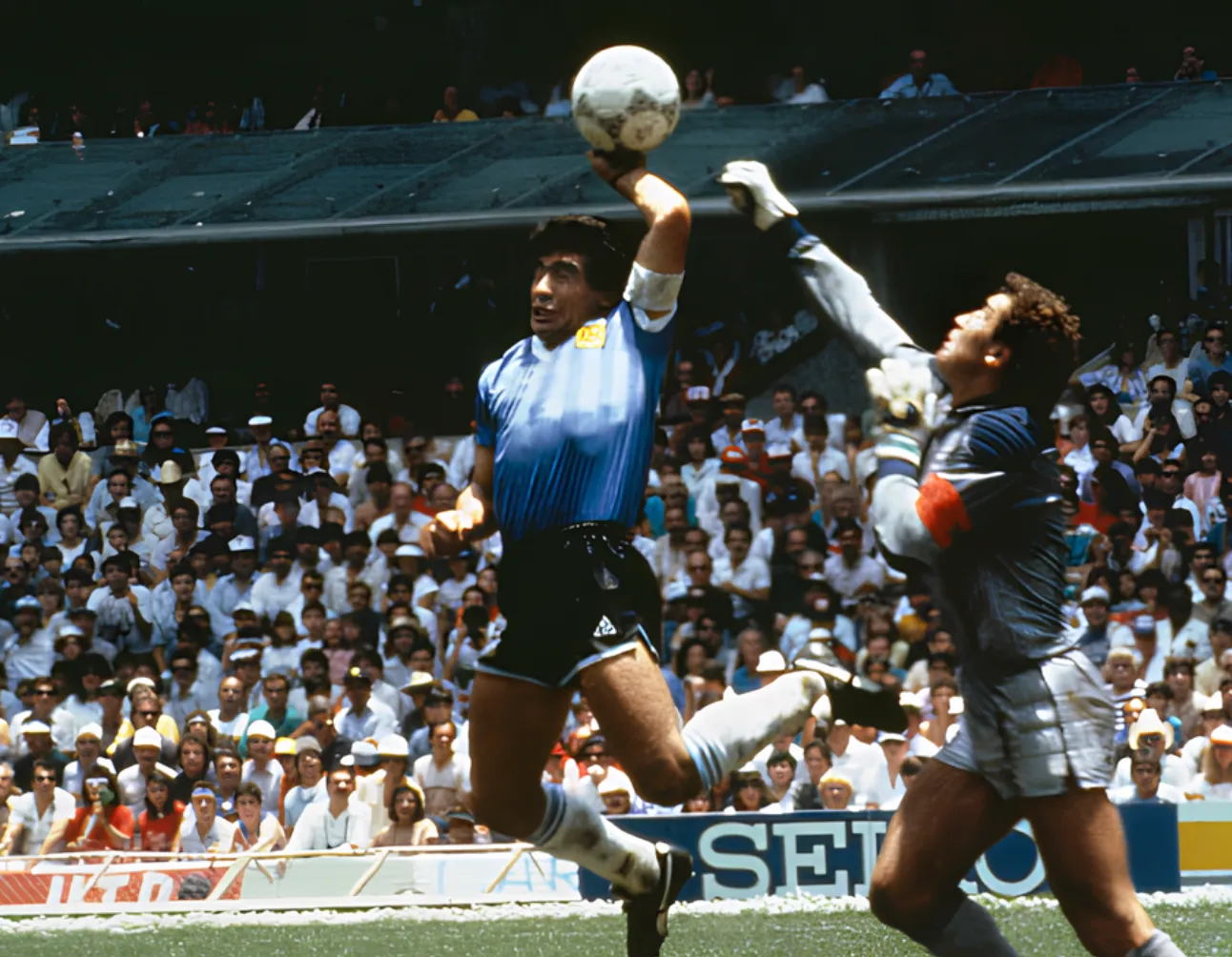
From the 51st to the 55th minute of the second half—a full 4 minutes—Diego Armando Maradona, with a “Hand of God” and a five-man dribble, simultaneously completed the most shameless and greatest goals in World Cup history.
That was the quarter-final between Argentina and England. It was two teams that hated each other, facing each other in a match shrouded in politics, war, and humiliation.
Forty years ago today, World Cup history was redefined by one man.
I. Background: Something More Important Than Football
To understand the 1986 Argentina vs. England match, we must first understand 1982.
April 1982: The Argentine military junta declared the occupation of the British Falkland Islands (known as the Malvinas Islands by the British). Ten weeks later: Britain launched a counter-offensive, and Argentina suffered a crushing defeat. 649 Argentine soldiers and 255 British soldiers perished in this war, which lasted only 74 days.
The psychological impact on Argentine society was devastating. Most ordinary Argentinians only learned the truth after the defeat—the military junta had consistently told them “Argentina is winning.”
Four years after the 1986 World Cup, Argentina was rebuilding democracy, facing economic crisis, inflation, and the simultaneous purge of the military junta. This World Cup was not just a sporting event for Argentina, but a form of national psychological therapy.
And England was the country that “took away the Falklands.”
The night before the quarter-final, Maradona told his teammates in the locker room, “We all remember those young men who died.” But at the pre-match press conference, he cautiously said, “It’s just a football match.”
Everyone knew this was more than just a game.
II. 51st Minute: The Hand of God
Shortly after the start of the second half, Argentina launched a counter-attack in their own half. Maradona dribbled past two English players before passing to Valdano. Valdano’s attempt was disrupted by English midfielder Steve Hodge—the 165cm tall Argentine was about to face the 188cm tall English goalkeeper Peter Shilton.
Hodge’s back pass contained a technical error—he instepped the ball high into his own penalty area. The ball fell in the air, and Shilton rushed out of his goal to receive it. Maradona burst in from Shilton’s side.
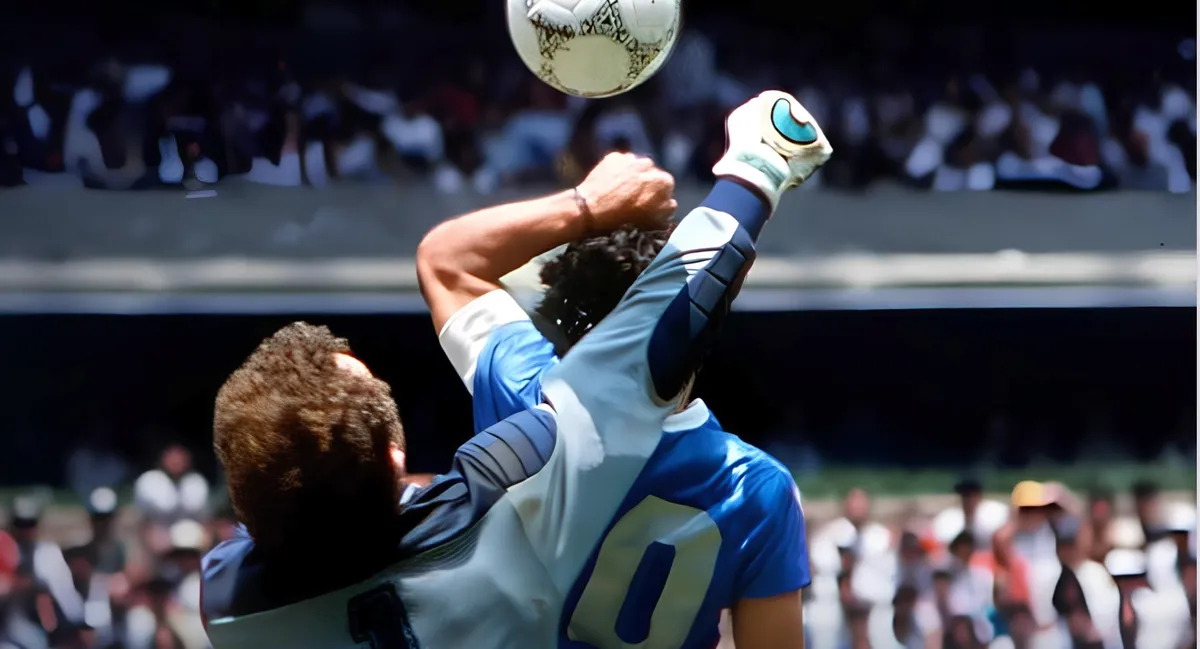
Given his height, Maradona couldn’t possibly reach the ball. But he jumped. Hilton jumped up too.
Just as Hilton’s right fist was about to touch the ball, Maradona, with his left fist, struck it first.
The ball flew past Hilton’s fingertips, soaring high into the far corner of the England goal.
Maradona turned to celebrate, but he didn’t immediately run—according to BBC footage of the match and Maradona’s later recollections in his autobiography, Yo Soy El Diego:
“I glanced sideways at the linesman and the referee—they didn’t react. I yelled to my teammates: ‘Come hug me, or the referee will see through it!’”
The Tunisian referee, Ali Bin Nasser, had his view partially obstructed by Hilton and the crowd from his position. He hesitated for a few seconds, then looked at the Bulgarian linesman, Bogdan Dotchev (who should have had the clearest view). Dotchev did not raise his flag.
Goal! Argentina 1-0.
III. 55th Minute: The Goal of the Century (Gol del Siglo)
Just four minutes after the goal, Maradona received the ball near his own half.
Then he did something that defies description.
Starting from his own half, he dribbled past five English players in succession—in order:
-
Peter Beardsley
-
Peter Reid (cut inside and out)
-
Terry Butcher (fell to the ground)
-
Terry Fenwick (lost position due to the tempo)
-
Butcher again (chased back but left out)
-
Goalkeeper Peter Shilton (dribbled past by Maradona’s sudden stop on the left)
The entire sequence took 10.6 seconds, 60 yards (approximately 55 meters), and involved 11 touches. Finally, despite nearly falling, Maradona pushed the ball into the empty net with his left foot.
The Spanish-language live broadcast by Uruguayan commentator Víctor Hugo Morales, which was repeatedly played, later became a classic commentary that no other language in the world could replicate:
“Maradona receives the ball, two players mark him, he steps on the ball, a genius starts from the right wing… Maradona! Genius! Genius! Genius! There, there, there—goal!!!! God, I want to cry, long live football!”
English commentator Barry Davies exclaimed in the BBC studio:
“You have to say that was magnificent.”
You have to admit that it was a truly great goal.
In the subsequent 2002 FIFA official poll, this goal was voted the Goal of the Century with an overwhelming number of votes. In comparison, Owen’s goal against Argentina in 1998, which ranked second, received only half the votes. Fourth place also belongs to Maradona—another solo breakthrough goal he scored against Belgium in the World Cup semi-final.
IV. The Remaining 35 Minutes: England’s Desperation and the Final Outcome
The match wasn’t over yet.
After Argentina took a 2-0 lead, England made a double-attack substitution—Barnes and Waddle came on. Gary Lineker (the tournament’s Golden Boot winner) pulled one back in the 81st minute with a header, making it 2-1.
If it had been one minute later, England might have equalized. But the match ultimately ended with Argentina 2-1.
Throughout the match, England’s interceptions, fouls, and shots were all no fewer than Argentina’s—they were not a weaker team than Argentina. The problem was—England didn’t have Maradona.
V. Seven Days Later: Argentina 3-2 West Germany, Lifting the Cup
After the quarter-finals, Maradona continued his dominance:
- Semi-final vs. Belgium: Scored two goals (one ranked fourth in FIFA’s Goals of the Century);
Final vs. West Germany: Argentina narrowly won 3-2, with Maradona contributing a crucial assist—in the 84th minute, Burruchaga’s winning goal was a through ball from Maradona while under pressure.
Argentina won their second World Cup title. Maradona won the Golden Ball (Most Valuable Player of the Tournament). Lineker won the Golden Boot (6 goals).
The entire 1986 World Cup is still known as “Maradona’s World Cup”—in World Cup history, there are only two exceptions to naming an entire tournament after one person: Pelé’s 1958 World Cup and Maradona’s 1986 World Cup.
VI. How much did that ball ultimately sell for?
In November 2022, the match ball (Adidas Azteca Mexico) that Maradona used to score in the 1986 quarter-final match was auctioned at Christie’s in London.
The final price was approximately £2 million (about $2.5 million). The buyer was an anonymous private collector from Qatar.
According to the auction description, referee Ali Bin Nasser kept the ball after the match, explaining why he kept it as a “gift from God.” This is the highest-priced single match ball in football history.
VII. Maradona’s Explanation: From Jokes to Confession
After the match, a reporter asked Maradona how he scored the first goal. He smiled and uttered the phrase that would be permanently etched into the dictionary:
“A little bit with Diego’s head, a little bit with God’s hand.”
“A little bit with Diego’s head, a little bit with God’s hand.”
This phrase was later simplified to “Mano de Dios” (The Hand of God) and widely used in global media.
19 years later, in 2005, Maradona finally publicly admitted on the Argentine television program La Noche del 10 (The Night of the 10):
“That was my hand. Not God’s hand. It was Diego’s hand.”
In the 2019 Asif Kapadia documentary Maradona, he further linked the goal to the Falklands War:
“As Argentinians, we didn’t know what the military government was doing. They told us Argentina was winning… actually England was winning. The atmosphere of that match was like fighting another war. I knew it was my hand—not something I planned beforehand, it just happened so fast the linesman didn’t see it… the referee told me ‘goal.’ The feeling at that moment was comfortable, like a symbolic revenge.”
VIII. 40 Years Later: In 2026, Azteca once again becomes the center of the World Cup
History sometimes closes.
- 1986 Azteca: Maradona’s World Cup;
2026 Azteca: The Opening Match Stadium of this World Cup.
At 3 PM on June 11th, host nation Mexico will face South Africa in this stadium that holds the triple historical significance of the 1970 final (Pelé’s Brazil won), the 1986 final (Maradona’s Argentina won), and the 2026 opening match.
Azteca thus becomes the only stadium in world football history to have hosted three World Cups (including three finals/opening matches).
And Maradona will never see it all. On November 25, 2020, he passed away in Buenos Aires from a heart attack at the age of 60.
His Argentine team lifted their third World Cup trophy in Qatar in 2022. On the final field, that team’s number 10 was Lionel Messi.
Maradona’s image won’t appear at the 2026 Azteca opening match, but every Argentine fan, every football fan worldwide, will remember him.
IX. Why has no one come close to his four minutes?
Forty years have passed, and football has changed a lot: VAR arrived, the offside rule changed, professional players’ physical training has evolved several generations, and the pace of the game is at least 30% faster.
But there are three things that no one has been able to replicate to this day:
1. Scoring both the “most shameless goal” and the “greatest goal” in the same match. This requires more than just technique; it requires a complete character—the ability to both deceive and conquer. No other player dares to simultaneously display their “light” and “darkness” to the world in the same crucial match.
2. Single-handedly carrying a “non-top team.” The 1986 Argentine team was only considered upper-middle tier by the standards of the time. Without Maradona, they were no match for Germany, Brazil, or France. Maradona led her all the way to the trophy—the ultimate example of “individuals determining the team” in football history.
3. Able to perform under multiple pressures: politics, nationalism, and history That match against England was a game burdened with national sentiment, wartime memories, and personal honor. Maradona withstood all of these—while most of today’s top players don’t have the opportunity to experience the same intensity of “off-field pressure.”
Those four minutes between 3:06 PM and 3:10 PM on June 22nd, 40 years ago, contained everything that football can contain: deception and glory, controversy and art, the tragedy of the loser and the ecstasy of the winner.
This was not an ordinary quarter-final match.
This is the 4 minutes in the 90th minute section that comes closest to “what is football”.
Information sources: Wikipedia entries for “The Hand of God” and “Argentina v England (1986 FIFA World Cup),” ESPN “Argentina legend Diego Maradona scores two historic goals in 1986,” CNN “How the ‘Hand of God’ redefined football,” Britannica “Was Maradona’s Hand of God Goal Legal?”, Goal.com’s Maradona’s Goal of the Century feature, excerpts from Maradona’s autobiography “Yo Soy El Diego,” the 2019 documentary “Maradona” directed by Asif Kapadia, and public information from Christie’s 2022 match ball auction.