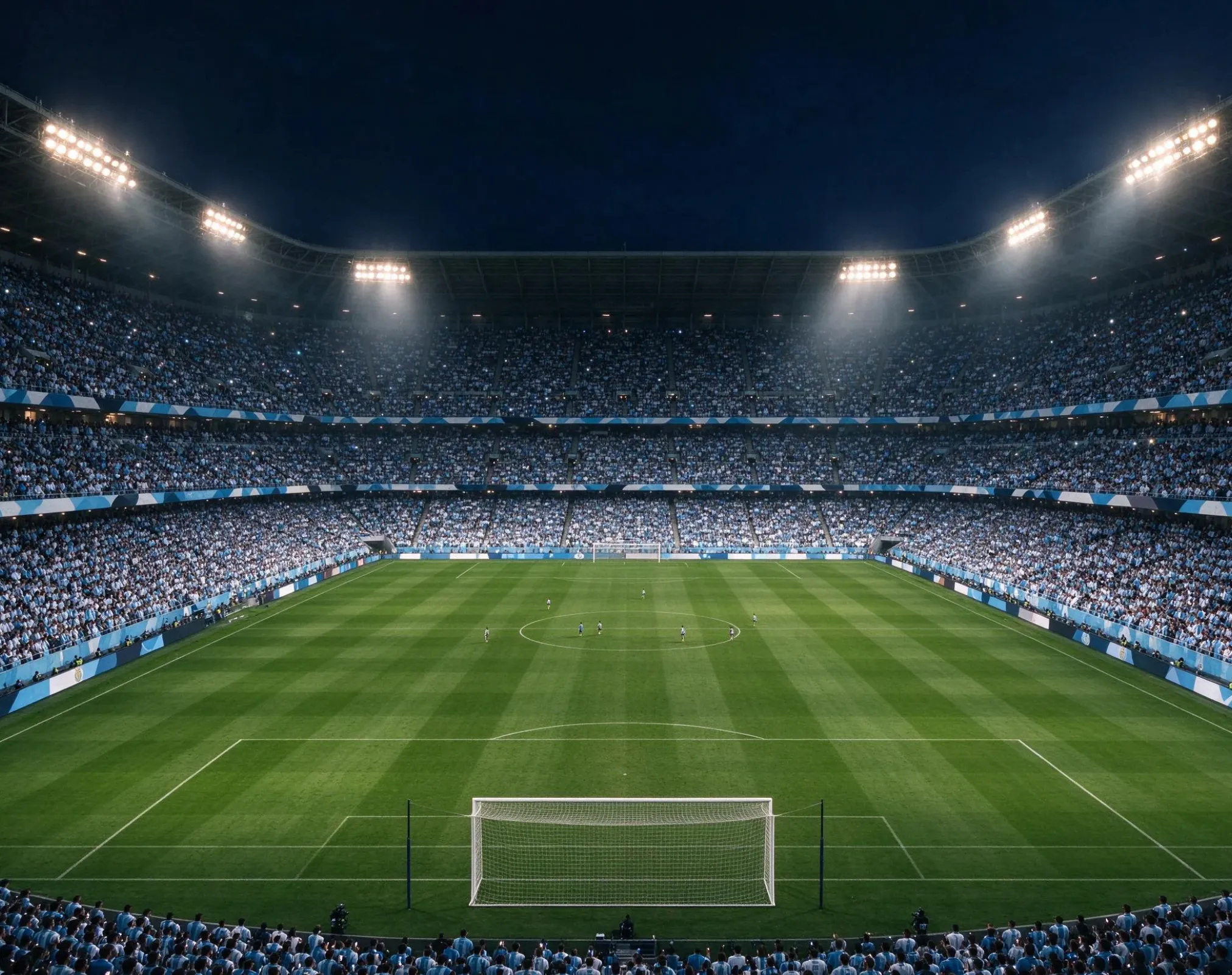

On June 11, 2026, the 23rd FIFA World Cup kicks off at Mexico City’s historic Estadio Azteca. It is the first edition co-hosted by three nations — the United States, Mexico, and Canada — and the first with 48 teams after the expansion from 32. By every measurable standard, this will be the largest, longest, and most complex sporting event ever organized: more teams, more matches, more venues, and more fans than any World Cup before it.
The scale is staggering. Over 39 days of competition, 104 matches will be played across 16 cities spanning three countries and four time zones. FIFA projects cumulative in-stadium attendance of approximately 5.5 million, surpassing the previous record of 3.57 million set at the 1994 World Cup in the United States. An estimated 5 billion television viewers worldwide will tune in at some point during the tournament, according to FIFA’s broadcast projections.
This is not just an expansion. It is a reimagining of what the World Cup can be.
By the numbers
- Teams: 48, across 12 groups of four
- Matches: 104 — up 40 from Qatar 2022’s 64
- Host cities: 16 (11 in the USA, 3 in Mexico, 2 in Canada)
- Duration: June 11 – July 19, 2026 (39 days)
- Stadiums: 16 venues across three nations
- Estimated attendance: 5.5 million total
- Broadcast reach: 200+ countries and territories
Historical significance: a tournament of firsts
The 2026 World Cup marks several unprecedented milestones. It is the first FIFA World Cup hosted by three nations simultaneously, following the successful model of the 2002 tournament co-hosted by Japan and South Korea — but adding a third country to the equation introduces logistical complexity that dwarfs anything previously attempted.
For Mexico, this is a record-setting third time hosting the World Cup, following 1970 and 1986. The Estadio Azteca becomes the first venue in history to host matches at three separate World Cups — and will have the honor of hosting the opening match on June 11. It is the stadium where Maradona scored the “Hand of God” and the “Goal of the Century” in 1986, and where Pele lifted the trophy in 1970. The ghosts of football past will be very much present.
For the United States, it is a return to hosting for the first time since 1994, when the tournament set attendance records that stood for decades and catalyzed the growth of soccer in American culture. The establishment of Major League Soccer in 1996 was a direct consequence of that World Cup’s success.
For Canada, it is an entirely new chapter. The country has never hosted a FIFA senior men’s tournament of any kind. The two Canadian host cities — Toronto and Vancouver — represent the nation’s growing football culture and its desire to be seen as a serious footballing nation, not just a hockey country.
The 48-team format itself is historic. The World Cup expanded from 24 to 32 teams in 1998, a move that was initially controversial but ultimately embraced as it brought nations like Japan, South Korea, Senegal, and Croatia into the spotlight. The jump to 48 follows the same logic — more nations, more stories, more global representation. For the first time, the tournament will feature expanded representation from the AFC (eight spots plus one playoff), CAF (nine spots plus one playoff), and CONCACAF (six automatic spots plus two playoffs), per FIFA’s allocation formula approved in 2023.
The format: how 48 teams become one champion
The tournament structure has been redesigned to accommodate the expanded field while maintaining competitive intensity.
Group Stage (June 11 – June 28): 48 teams are divided into 12 groups of four. Each team plays three group matches, as in previous World Cups. The top two teams from each group advance automatically — that is 24 teams — plus the eight best third-placed teams, bringing the total to 32 teams advancing from the group stage.
The third-place qualification rule is borrowed from the UEFA European Championship format, where it has been used since the expansion to 24 teams in 2016. It ensures that even a single win in the group stage gives a team a realistic chance of advancing, reducing the number of “dead rubber” final group matches.
Round of 32 (June 30 – July 3): The first knockout round, a new addition to the World Cup format. Sixteen matches over four days.
Round of 16 (July 5 – July 8): The traditional knockout round, now featuring the 16 survivors from the Round of 32.
Quarterfinals (July 10 – July 11): Four matches over two days.
Semifinals (July 14 – July 15): Two matches.
Third-place match (July 18): Played at Hard Rock Stadium in Miami Gardens, Florida.
Final (July 19): Played at MetLife Stadium in East Rutherford, New Jersey, with a capacity of approximately 82,500. The venue, home to both the New York Giants and New York Jets of the NFL, has been extensively modified for the tournament, with a natural grass surface installed over its usual artificial turf.
The venues: a continental stage
The 16 host stadiums represent a mix of purpose-built football venues, NFL stadiums converted for the tournament, and historic grounds with deep footballing heritage.
United States (11 venues):
- MetLife Stadium, East Rutherford, NJ — capacity 82,500, hosts the Final
- AT&T Stadium, Arlington, TX — capacity 80,000, hosts a semifinal
- SoFi Stadium, Inglewood, CA — capacity 70,240, hosts a semifinal
- Hard Rock Stadium, Miami Gardens, FL — capacity 65,326, hosts the third-place match
- NRG Stadium, Houston, TX — capacity 72,220
- Mercedes-Benz Stadium, Atlanta, GA — capacity 71,000
- Levi’s Stadium, Santa Clara, CA — capacity 68,500
- Lincoln Financial Field, Philadelphia, PA — capacity 69,176
- Lumen Field, Seattle, WA — capacity 68,740
- Gillette Stadium, Foxborough, MA — capacity 65,878
- BC Place (note: BC Place is in Vancouver, Canada — see below)
Mexico (3 venues):
- Estadio Azteca, Mexico City — capacity 87,523, hosts the opening match
- Estadio Akron, Guadalajara — capacity 49,850
- Estadio BBVA, Monterrey — capacity 53,500
Canada (2 venues):
- BMO Field, Toronto — capacity expanded to 45,000 for the tournament
- BC Place, Vancouver — capacity 54,500
The altitude factor in Mexico City is worth noting. The Estadio Azteca sits at 2,240 meters above sea level, which can significantly impact player endurance and ball flight. Teams playing their opening matches at altitude will need specific acclimatization protocols, according to FIFA’s medical committee guidelines.
Technology: the next generation of officiating
The 2026 World Cup will feature the most advanced officiating technology in the tournament’s history, building on innovations introduced at Qatar 2022.
Semi-Automated Offside Technology (SAOT) will return in an upgraded form. The system, which uses 12 dedicated tracking cameras in each stadium and an inertial measurement unit embedded in the match ball, can determine offside positions within approximately 25 seconds — down from the initial 70-second average at the 2022 Club World Cup trials. FIFA reports that the average delay for offside reviews at Qatar 2022 was 40 seconds; the target for 2026 is under 20 seconds.
VAR 2.0 will incorporate improved camera angles, with each stadium equipped with a minimum of 42 cameras, up from 32 at Qatar 2022. The additional angles are specifically designed to improve reviews of handball incidents and penalty-area contact, which were the two most controversial categories of VAR decisions at the previous tournament, according to FIFA’s Refereeing Committee post-tournament report.
Connected ball technology, introduced with the Adidas Al Rihla in 2022, will be enhanced in the 2026 tournament ball. The embedded chip provides real-time data on ball position, speed, and spin at 500 readings per second, enabling both more accurate offside calls and richer data for broadcast analysis.
Tickets: pricing and access
FIFA’s ticketing structure for 2026 is designed across four categories. Category 1 tickets for the final at MetLife Stadium are priced at $1,100 USD, while Category 4 tickets for group-stage matches start at $35 USD — the lowest entry price for any World Cup since 2010, adjusted for inflation. FIFA has allocated approximately 750,000 tickets across all categories for its global ballot, with an additional allocation for host-nation residents.
A new “Follow My Team” package allows fans to purchase tickets for all of their chosen team’s group-stage matches plus a potential Round of 32 match, with prices starting at $250 USD for a three-match package. This model, first trialed at the 2024 Copa America, proved popular and has been scaled up for the World Cup.
Accessibility tickets for fans with disabilities are available at Category 4 pricing across all match categories, with enhanced wheelchair platforms and sensory rooms available at all 16 venues, per FIFA’s accessibility guidelines published in January 2026.
Fan experience: beyond the stadium
Each of the 16 host cities will operate an official FIFA Fan Festival, the successor to the “Fan Fest” concept introduced at Germany 2006. These free-entry zones will feature giant screens broadcasting every match, live music, cultural programming, and food and beverage from participating nations.
The largest Fan Festival will be located in New York City’s Central Park, with a capacity of 40,000 — the biggest single fan zone in World Cup history. Mexico City’s Fan Festival will be held at the Zocalo, the main public square in the historic center, which hosted celebrations for Mexico’s 1970 and 1986 tournaments. Vancouver’s Fan Festival at Jack Poole Plaza will offer views of the harbor and mountains, combining the spectacle of the tournament with one of North America’s most scenic urban settings.
Cultural programming across all three host nations will include exhibitions, concerts, and public art installations. FIFA’s Cultural Programme, announced in March 2026, includes partnerships with institutions like the Smithsonian, Mexico’s National Museum of Anthropology, and the Art Gallery of Ontario.
Economic impact
The economic projections for the 2026 World Cup are significant. A study commissioned by FIFA and conducted by Ernst & Young estimated the total economic impact across all three host nations at $11.2 billion USD, with the United States accounting for approximately $7.5 billion, Mexico $2.1 billion, and Canada $1.6 billion.
The tourism sector alone is expected to generate $4.8 billion in spending, with an estimated 3.5 million international visitors traveling to North America specifically for the tournament, per projections from the United Bid Committee’s economic analysis. Hotel occupancy in host cities during the tournament is projected to exceed 95% on match days.
Job creation across all three countries is estimated at 120,000 temporary and permanent positions, spanning construction, hospitality, security, transportation, and event management, according to organizing committee reports.
Learning from history: the 24-to-32 expansion
When the World Cup expanded from 24 to 32 teams in 1998, critics warned of diluted quality, bloated schedules, and too many mismatches. What actually happened was the opposite. France 1998 produced some of the tournament’s most iconic moments: Croatia’s stunning third-place finish in their first World Cup as an independent nation, Michael Owen’s wonder goal against Argentina, and Zinedine Zidane’s two-headed final triumph.
The 32-team format also introduced the world to footballing nations that have since become regular participants. Japan and South Korea, first-time qualifiers in 1998, went on to co-host in 2002 and have qualified for every World Cup since. Senegal, beneficiaries of expanded African representation, reached the quarterfinals in 2002 in one of the great underdog stories.
FIFA’s gamble is that the 48-team expansion will produce similar stories — that a debutant from Southeast Asia, the Caribbean, or Central Africa will capture the world’s imagination the way Croatia and Senegal did in previous eras.
The risk, acknowledged even by FIFA in internal planning documents reported by The Athletic, is that the group stage could feature too many uncompetitive matches. To mitigate this, the three-team-per-group format initially proposed was scrapped in favor of four-team groups, preserving the tactical dynamics that make group-stage football compelling.
The countdown
From the opening ceremony at the Estadio Azteca on June 11 to the final at MetLife Stadium on July 19, the 2026 FIFA World Cup will be 39 days of global spectacle. It will test the infrastructure of three nations, the endurance of 48 squads, and the capacity of football to unite a divided world around a shared passion.
FIFA Watch will be here through every match, every city, and every story. Stay with us through tournament kickoff.