The Short Version
Argentina beat Iceland 3-0 at Jordan-Hare Stadium in Auburn, Alabama on Tuesday June 9 in its final pre-World Cup friendly. The headline moment: Lionel Messi entered as a 70th-minute substitute and converted a penalty within his first significant touches, giving him his 117th international goal and the title of oldest scorer in Argentine soccer history at age 38. The penalty arrives eight years after Argentina’s 2018 World Cup opener against the same opponent — a match Iceland famously held to a 1-1 draw, with Messi missing his own penalty attempt. The smaller story but the one that lingered: at full-time, Iceland’s players approached Messi for photos and shirt exchanges, the now-routine ritual of opposing teams seeking the GOAT recognition moment. Argentina now turn to their World Cup opener against Algeria on June 16 in Group J — the defending champions arriving at a tournament with one of the most settled squads since their 2022 run.
The 2018 Echo
To understand what Tuesday night meant, rewind eight years.
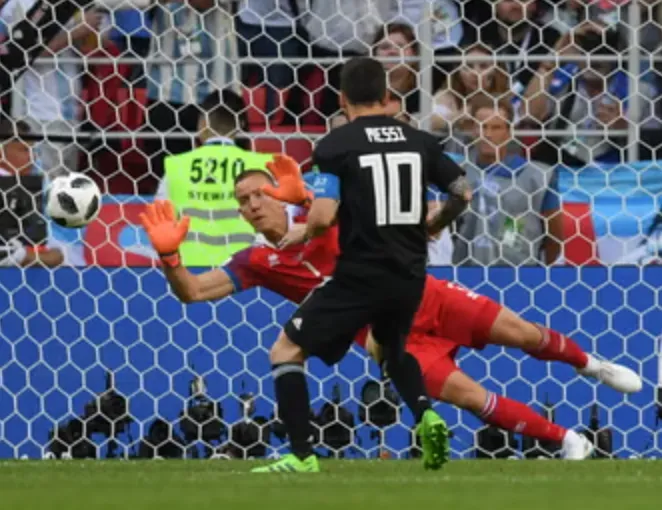
On June 16, 2018, at Moscow’s Spartak Stadium, Argentina opened its World Cup against Iceland — the smallest nation to ever qualify for a World Cup at the time, a country of 350,000 facing the team led by Messi. Iceland’s “Vikings” defending stayed compact, frustrated Argentina’s possession, and produced the most-replayed image of that group stage: Messi standing at the penalty spot, his shot saved by Hannes Halldórsson, the match drawn 1-1. Iceland celebrated like champions. Argentina left the field bewildered, in a tournament that ended for them in the Round of 16.
That 2018 group stage became a foundational reference point for Argentina’s eventual 2022 World Cup victory — the moment that exposed both the brilliance and limits of relying on Messi alone, the moment Scaloni’s eventual project began correcting toward. The famous penalty miss has been replayed thousands of times, including in documentaries and montage cuts of Messi’s career, as part of “the imperfect great” narrative arc that 2022 finally completed.
On Tuesday night in Auburn, Alabama, against the same opponent — eight years older, eight years more experienced, eight years post-redemption — Messi entered as a substitute in the 70th minute. His first significant touch released Lautaro Martínez into a one-on-one. Martínez was fouled. Penalty.
Messi stepped up.
This time, he scored.
The replay of the 2018 miss should age differently from here forward. The shot was not technically spectacular — it was a calmly placed effort into the bottom corner, the kind of penalty Messi has scored hundreds of times. But the narrative weight of the moment, against the same opponent, eight years on, was the kind of footballing closure that does not happen often.
The Match: Argentina 3-0 Iceland
Per ESPN’s game recap, Argentina manager Lionel Scaloni used the friendly as both a tactical sharpener and a Messi-fitness test. Iceland — which did not qualify for the 2026 World Cup — was the kind of opponent willing to compete physically but lacking the depth to threaten consistently.
Argentina’s three goals came in three phases:
Valentín Barco, 8th minute. The Brighton-by-way-of-Boca midfielder cut inside from the left and drove a left-footed finish past Elías Ólafsson after a goalmouth scramble. Per Sofascore’s match analysis, Barco was the only player on either team to create multiple chances. He now has two goals in four senior appearances for Argentina — a stake in the squad rotation for the World Cup.
Messi (penalty), ~71st minute. Coming on as a 70th-minute substitute alongside Lautaro Martínez and Gonzalo Montiel, Messi’s first impactful touch was a cushioned throughball that put Martínez through one-on-one. The defender’s foul produced the penalty, and Messi converted into the bottom corner. Per ESPN, this was Messi’s 911th career goal across club and country, his 117th international goal for Argentina, and made him the oldest scorer in Argentine national team history at age 38.
Thiago Almada, late. Messi fed Rodrigo De Paul, who delivered the cross. Almada finished. This third goal closed out the match and represented exactly the kind of attacking continuity Scaloni has built since 2022 — multiple sources of goals, with Messi as the connector rather than the only finisher.
The match itself was, per the Bolavip recap, notably one-sided. Iceland collected six yellow cards in the second half as the match grew fractious. Argentina’s defenders — Cristian Romero, Nicolás Otamendi, Nahuel Molina, Nicolás Tagliafico — were rarely tested. Goalkeeper Gerónimo Rulli, starting in place of Emiliano Martínez who was managed with this fixture, was relatively unbothered.
The 88,000-strong Jordan-Hare crowd, normally reserved for Auburn University football games, was largely there to see Messi. Auburn’s Heisman-era quarterback Cam Newton wears #1 here; Bo Jackson #34. On Tuesday, the dominant jersey was #10 in white and sky blue.
The Post-Match Scene
The story that lingered, however, was not the goals.
At full-time, Iceland’s players approached Messi. Some sought photos. At least one player sought a shirt exchange. The phenomenon is by now a ritual familiar to anyone who watches Argentine matches: opposing players, including those who spent ninety minutes trying to dispossess Messi, queueing for the moment of acknowledgment that this is the greatest player most of them will share a pitch with.
It has happened repeatedly in Messi’s recent career:
- After Argentina’s 2022 World Cup quarter-final against Australia, Marco Tilio, Joel King, and Keanu Baccus were seen waiting outside Argentina’s dressing room for photos.
- After Argentina’s 2023 friendly against Curaçao, the Curaçao goalkeeper Eloy Room exchanged shirts and revealed Messi had complimented his saves.
- After Argentina’s 2023 friendly against Mauritania at the Bombonera, the Mauritania coaching staff broke protocol to take selfies with Messi after the final whistle.
- Ecuador goalkeeper Hernán Galíndez explained his post-match shirt swap with Messi by recounting their shared childhood in Rosario.
Iceland on Tuesday joined this pattern. The Iceland players who came up to Messi after the final whistle did so not as defeated rivals but as participants in a moment — the kind of moment that will populate their social media feeds and personal histories for decades.
This phenomenon is in some ways uncomfortable to write about. It can read as patronizing toward the players queueing — as if they are merely tourists rather than athletes. The reality is more interesting. These are professional footballers who recognize that Messi’s career is finite, and that the chance to share a pitch with him before he retires is something they will not have again. The selfie or the shirt swap is an honest acknowledgment of a historical moment.
For Messi himself, the pattern has become routine. He often complies — the smile is genuine, even if measured — and moves on. There is no evidence that he resents it. The shirt exchanges have become almost a parallel currency: Messi’s worn shirts now circulate at hundreds of opposing players’ homes across world football.
For Iceland specifically, this acknowledgment carries an additional layer. The 2018 draw is a defining moment in Icelandic football history. Halldórsson’s penalty save is shown at every Icelandic youth football clinic. To play Messi again, eight years later, and to lose 3-0 but be the recipient of the post-match photo ritual — that is its own kind of closure for Iceland too.
What We Learned About Messi’s Fitness
The fitness question, which dominated the buildup to this match, was answered partially.
Messi suffered a hamstring issue at Inter Miami on May 24 against Philadelphia Union, exiting in the 73rd minute. He missed Argentina’s previous friendly against Honduras as a precaution. Scaloni’s pre-match comments per World Soccer Talk had been deliberately ambiguous: “He is going to play; what I don’t know is how many minutes.”
The 20-minute cameo delivered two pieces of information:
- Messi is physically capable of playing match minutes. The acceleration on the throughball to Martínez — a half-yard burst — was unhindered. The penalty was struck cleanly. He participated in the third goal’s buildup. There were no visible signs of restraint or compensation in his movement.
- Argentina is not yet committing to starting him. A 70th-minute substitution suggests Scaloni still wants to manage his exposure rather than maximize his minutes. This is consistent with how Scaloni has handled Messi since 2022 — the strategy of preserving him for the matches that matter, on the principle that a fresh Messi at the right moment is more valuable than 90 minutes of a worn one.
The likely path forward: Messi will probably start against Algeria on June 16, the World Cup opener, but his minutes may be limited if the match is well in hand. The deeper Argentina advances, the more total Messi minutes Scaloni will need to accept.
The good news for Argentina fans: there is no indication, from the body language on the pitch or from Scaloni’s measured public comments, that the May 24 hamstring problem is a structural concern. The fitness conversation moves from “can he play” to “how much should he play.”
Algeria, June 16: The Group J Opener
Argentina’s World Cup begins seven days from now against Algeria, the first match of Group J. Group J also contains Austria and Jordan, and the path through it is straightforward in theory:
- June 16: Argentina vs Algeria
- June 22: Argentina vs Jordan (at Levi’s Stadium, Bay Area — covered in our SF Bay city guide, where Jordan plays its second of three group matches)
- June 26: Argentina vs Austria
Algeria is the most credible threat in the group. Their squad combines veterans — Riyad Mahrez at 35, still capable of moments of brilliance — with a young midfield led by Houssem Aouar (formerly of Lyon and Roma, currently in Saudi Arabia). Algeria qualified for this World Cup by topping its African qualifying group, conceding only 4 goals in 10 matches.
For Argentina, the opener carries asymmetric stakes. A win sets up the rest of Group J. A draw or loss creates immediate pressure on the matches against Jordan and Austria, neither of which is a guaranteed three points. The defending champions narrative does not automatically translate into easy matches — every team Argentina faces will arrive at maximum motivation against the world champions.
The squad picture looks settled. Goalkeeper Emiliano Martínez (Aston Villa) starts. The defensive line of Tagliafico-Otamendi-Romero-Molina is intact. The midfield trio of Mac Allister-De Paul-Fernández is the spine. Up front, Lautaro Martínez and Messi are the senior pair, with Almada, Álvarez, and Barco rotating around them. Leandro Paredes remains out with the hamstring injury that kept him from the Iceland match. Marcos Acuña is available again after late recovery. Lisandro Martínez continues to manage his knee issue but is expected to be ready.
The Iceland 3-0 win settles nothing about Argentina’s tournament potential. Friendlies often produce nothing but optimism that does not survive contact with tournament football. But the win does establish three useful things:
- Messi is fit enough to play. The most important pre-tournament question is answered.
- Argentina’s bench is deep. Barco, Almada, De Paul off the bench were all decisive in different ways.
- The squad chemistry is intact. The team that won in Qatar is, in large part, the team that will play in 2026.
FAQ
What was the result of Argentina vs Iceland on June 9? Argentina won 3-0 at Jordan-Hare Stadium in Auburn, Alabama. Valentín Barco scored in the 8th minute, Lionel Messi converted a penalty around the 71st minute, and Thiago Almada scored late after a Rodrigo De Paul cross.
Did Messi play? Yes. Messi entered as a 70th-minute substitute, replacing one of the starters. He scored a penalty in his first significant touches and was involved in the buildup to Thiago Almada’s late goal.
Why does this game matter? It was Argentina’s final pre-tournament friendly before the 2026 World Cup, which begins for them against Algeria on June 16. The match also closed a narrative arc with Iceland — in the 2018 World Cup opener, Messi missed a penalty against the same opponent in a 1-1 draw.
What was special about Messi’s penalty? It was his 911th career goal across club and country, his 117th international goal for Argentina, and made him the oldest scorer in Argentine national team history at age 38. It also followed the 2018 World Cup penalty miss against the same opponent — closing an eight-year narrative arc.
Did Iceland players approach Messi after the match? Yes. Iceland players sought photos and shirt exchanges with Messi after the final whistle, fitting a pattern of opposing teams’ players seeking recognition moments with him. This is now a routine post-match ritual when Messi plays.
What’s Argentina’s next match? Argentina opens its 2026 World Cup against Algeria on June 16, 2026 — the first match of Group J. Group J also contains Austria and Jordan.
Is Messi fully fit for the World Cup? Based on his 20-minute cameo against Iceland, yes — he showed no visible signs of restraint or compensation. The Inter Miami hamstring concern from May 24 appears resolved. Scaloni is likely to manage his minutes through the tournament rather than letting him play 90 minutes routinely.
Where can I read more about Argentina’s path? Group J fixtures are at FIFA’s 2026 World Cup site. Argentina vs Jordan on June 22 will be played at Levi’s Stadium in Santa Clara, also covered in our SF Bay city guide.
Who else scored for Argentina? Valentín Barco (8th minute, left-footed volley) and Thiago Almada (late, assist from Rodrigo De Paul). Barco now has two goals in four Argentina appearances. Almada is making his case for World Cup minutes.
What’s the bigger context? Argentina is the defending champion. The 2022 World Cup victory in Qatar settled the “great-without-the-title” debate around Messi. The 2026 tournament is the chance to defend, and a chance for Messi — at 38 — to close his international career with one more title or to walk away with the 2022 win still as the final image.
When was Iceland’s last World Cup appearance? Iceland appeared in the 2018 World Cup — their only senior World Cup ever. They did not qualify for 2022 or 2026. The 2018 group-stage 1-1 draw with Argentina remains the highlight of their international football history.
What’s Argentina’s World Cup history? Three-time World Cup champions (1978, 1986, 2022). Two World Cup final losses (1930, 1990, 2014). Argentina enters 2026 ranked among the favorites alongside Brazil, France, Spain, and Germany.
Related Articles
- USA vs Paraguay: The Market Hasn’t Caught Up to Enciso’s Absence. — Our Group D opener analysis, parallel to Argentina’s Group J path — both groups feature CONMEBOL teams in tough situations (predictions cluster).
- Paraguay Plays Twice at Levi’s Stadium. Both Decide Group D. — Argentina vs Jordan on June 22 is also at Levi’s, sharing the venue with Paraguay’s two Group D matches (tickets-travel cluster).
- 9 New Rules at the 2026 World Cup. Most Will Surprise You. — Including the mandatory 3-minute hydration breaks and the center-circle anthem ceremony Argentina’s players will experience on June 16 (events cluster).
Sources (ESPN game recap, Yahoo Sports Auburn coverage, LiveScore match recap, Sofascore analysis, FotMob coverage, Bolavip recap, and the FIFA 2026 World Cup site) are linked inline. Messi’s career goal tally (911) and Argentina-specific record (117 international goals, oldest scorer) are sourced from ESPN’s match-day documentation. The 2018 World Cup penalty-miss reference is from Argentina’s group opener against Iceland on June 16, 2018 in Moscow. This article was finalized in the hours after the final whistle on June 9 and may be updated as additional details emerge.
About the author: James O’Connor is investigative football journalist at Touchline Global, the London-based independent football platform focused on governance, sports diplomacy, and the intersection of football and politics. O’Connor has covered FIFA governance since 2014 and has reported on every World Cup cycle since 2018. Contact: james.oconnor@touchlineglobal.com · LinkedIn: /in/jamesoconnor-touchline · X: @JamesTouchline