The Short Version
Ahead of Norway’s squad announcement on May 21, 2026, this is a look at what Erling Haaland did to get them there. Key points: (1) 16 goals in 8 qualifiers, scoring in every single game — double the next-highest scorer in the campaign; (2) He became only the second player ever to score in eight consecutive World Cup qualifiers, a feat neither Messi nor Ronaldo managed; (3) His 16 goals equalled Robert Lewandowski’s European qualifying record but in two fewer matches (8 vs 10); (4) He holds Norway’s all-time scoring record — 55 goals, breaking Jørgen Juve’s 90-year-old mark of 33; (5) Scoring for a nation ranked 29th is statistically far harder than scoring for a club like Manchester City — the equivalent of scoring 2.6 goals per game for a mid-table Premier League side; (6) Norway are in Group I with France, Senegal, Iraq; opener June 16 vs Iraq in Boston; (7) Captain Martin Ødegaard’s fitness is the biggest open question heading into the tournament.
San Siro, November 16, 2025
Norway needed nothing from the night. They arrived in Milan with qualification all but secured, a vast goal-difference cushion over Italy. Italy needed a nine-goal win to steal top spot — an impossibility — but they came out wanting to wound, and led through Francesco Pio Esposito.
Then Haaland did what Haaland does. A volley past Gianluigi Donnarumma. A poacher’s finish minutes later. Norway won 4-1 at the home of the four-time world champions, and the Azzurri were dropped into the playoffs they would not survive.
It was the eighth qualifier in a row that Haaland had scored in. It was goals 15 and 16 of a campaign that had no equal in the cycle. And it sent Norway to a World Cup for the first time since 1998 — a tournament most of the current squad were too young to remember, and some too young to have been born for.
16 Goals Messi and Ronaldo Never Managed
Start with the raw number: 16 goals in eight matches. He scored in every single one. The next-highest scorer across the entire European qualifying campaign managed eight — exactly half.
But the raw number undersells the rarity. By scoring against Italy, Haaland became only the second player in history to score in eight consecutive World Cup qualifying matches. Not Lionel Messi. Not Cristiano Ronaldo. Neither of the two defining forwards of the century ever strung together a qualifying run like it.
His 16 goals equalled the European record for a single World Cup qualifying campaign, set by Robert Lewandowski on the road to Russia 2018. But Lewandowski needed ten matches to reach the mark. Haaland did it in eight, averaging two goals per game across the whole campaign. Against Moldova he scored five in one match — part of an 11-1 result. Against Israel, three. Against Estonia, three. Against Italy, the strongest opponent in the group, three across two meetings.
These are the numbers that travel around the world as a highlight reel. What the reel leaves out is how hard they actually were.

Why These Goals Are Harder Than They Look
Here is the part the word “machine” obscures.
When Haaland scores for Manchester City, he does it inside the most expensively assembled attacking system in football — fed by elite midfielders, defended by a team built to dominate possession, against opponents who are usually inferior. The goals are remarkable, but the structure flatters them.
For Norway, ranked 29th in the world, the structure does the opposite. As the Premier League’s own analysis noted, Haaland’s international record “ought to take centre stage… because in theory it ought to be harder to score goals for his country.” The analysis put a figure on it: scoring at this rate for a 29th-ranked nation is the equivalent of scoring 2.6 goals per game for a mid-table Premier League side.
2.6 goals per game. For context, no forward in Premier League history has averaged anywhere close to that across a season. That is the rate Haaland sustained — for a country whose other forwards, however good, do not command the service a City or a Real Madrid provides.
The “machine” framing turns this into something inevitable, mechanical, almost boring. But there is nothing inevitable about a single player carrying a mid-tier football nation across a 28-year chasm. The goals were not produced by a system. In Norway’s case, Haaland frequently is the system — the reference point defenders collapse around, which is exactly why his return is so improbable.
The 90-Year-Old Record That Fell
To understand how far Haaland sits outside Norwegian norms, you have to go back to a man who has been dead since 1983.
Jørgen Juve — nicknamed “The Lightning” — played for Norway between 1928 and 1937. He scored 33 goals in 45 caps, captained the side to Olympic bronze in 1936, and then became a journalist and author. His 33-goal record stood for 90 years. It outlasted Ole Gunnar Solskjær, John Carew, Jan Åge Fjørtoft — generations of Norwegian forwards who came and went without touching it.
Haaland passed it in October 2024, with a brace against Slovenia, in his 36th cap. He now stands at 55 goals in 48 caps. Juve’s widow, Eva Røine — a former Miss Norway, now 95 — spoke to the newspaper VG when the record fell. “It’s almost scary. Imagine how fast the years have passed,” she said. “Now I’m going to watch Haaland and then I’m going to see if he’s as good as they say.”
He is. He became the sixth player ever, and the first in 53 years, to reach 50 international goals before his 50th cap. The previous Norwegian record had stood for 90 years; Haaland is on pace to put the new one somewhere no one will reach for far longer.
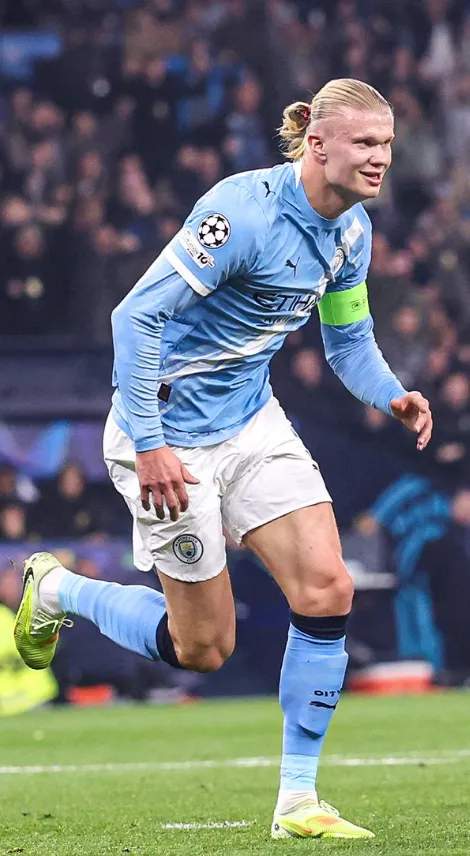
A machine does not break a 90-year-old record while a 95-year-old widow watches to see if the man is real. That is a human story, with a human on both ends of it.
What Comes Thursday — and in June
On May 21, Solbakken names his 26. Haaland is the one certainty. The questions lie elsewhere.
The biggest is Martin Ødegaard. The Arsenal captain — Norway’s actual captain, and the creative conductor who led European qualifying in assists — has battled a knee issue, and his fitness for June is the single largest variable in how far Norway can go. When Ødegaard threads the passes and Haaland finishes them, Norway are a genuine knockout-round threat. When Ødegaard is absent, as he was for a 2-1 friendly loss to the Netherlands in March, the machine framing collapses in the other direction: Haaland alone is not enough.
Norway are in Group I with France, Senegal, and Iraq. They open against Iraq on June 16 in Boston, face Senegal, and close against France’s Kylian Mbappé on June 26 — the group decider, a meeting of two of the tournament’s most lethal forwards. France are clear favourites; Norway are second favourites to advance.
For Solbakken, this is the tournament he was hired to reach — and likely his last, with a step-down expected afterward. For most of his squad, it is a first major tournament. For Haaland, 25, it is the stage that has been missing from a career already crowded with records.
He carried Norway here. Thursday’s list will confirm the cast around him. June will ask whether the most ruthless scorer of his generation can do at a World Cup what he did to get to one — and whether, when the cameras pull back, anyone still believes the man who broke a 90-year record is a machine.
FAQ
When does Norway announce its 2026 World Cup squad? On May 21, 2026 (Thursday), manager Ståle Solbakken is expected to confirm Norway’s 26-man squad. Senegal and Morocco announce on the same day.
Is Haaland’s qualifying record better than Messi or Ronaldo? In one specific sense, yes: Haaland became only the second player ever to score in eight consecutive World Cup qualifiers, a feat neither Messi nor Ronaldo achieved. His 16 goals in eight games also equalled Lewandowski’s European qualifying record in two fewer matches. Across full careers, Ronaldo and Messi have scored far more international goals overall.
How many goals did Haaland score in 2026 World Cup qualifying? 16 goals in 8 matches, scoring in every game — double the next-highest scorer in the entire European campaign, and an average of two goals per match.
What is Norway’s all-time scoring record? Haaland holds it, with 55 goals in 48 caps. He broke Jørgen Juve’s record of 33 goals in October 2024 — a mark that had stood for 90 years, since Juve’s career ended in 1937.
Why are Haaland’s Norway goals considered harder than his club goals? Norway are ranked 29th in the world and cannot provide the elite supply line of a Manchester City. Premier League analysis estimated that scoring at Haaland’s international rate for a 29th-ranked nation is equivalent to scoring 2.6 goals per game for a mid-table Premier League side — a rate no forward sustains over a season.
Is this Haaland’s first World Cup? Yes. At 25, the 2026 World Cup will be Erling Haaland’s first major international tournament. Norway last qualified for a World Cup in 1998 and last reached any major tournament at Euro 2000.
What is Norway’s group at the 2026 World Cup? Group I, with France, Senegal, and Iraq. Norway open against Iraq on June 16 in Boston (Foxborough), then face Senegal, and close against France on June 26 — the likely group decider.
Who is Norway’s captain? Martin Ødegaard (Arsenal) is the regular captain; Haaland has worn the armband in his absence. Ødegaard’s recovery from a knee issue ahead of June is the squad’s biggest fitness question.
How did Norway qualify for the 2026 World Cup? With a perfect record: eight wins from eight matches, 37 goals scored, five conceded — the highest goals-per-match average of any European qualifying group (4.6). They sealed it with a 4-1 win away to Italy at the San Siro in November 2025.
Will this be Solbakken’s last tournament as Norway coach? It is widely expected. Ståle Solbakken, who was part of Norway’s 1998 World Cup squad as a player, has indicated he will likely step down after the 2026 campaign. He took charge in December 2020.
Who held Norway’s scoring record before Haaland? Jørgen Juve, nicknamed “The Lightning,” with 33 goals in 45 caps between 1928 and 1937. He captained Norway to Olympic bronze in 1936 and later became a journalist. His record stood for 90 years.
Related Articles
- Cristiano Goes to His Sixth: Portugal Names the 26 for 2026 — Another forward chasing the one trophy missing from his collection
- The 43-Year-Old and the 28-Year Wait: Scotland Names Its 26 — Another nation ending a long World Cup absence this week
- Neymar’s Name Was Called: Brazil’s 26 for the 2026 World Cup — May 18 announcement; Neymar returns for his fourth World Cup
- 52 Years After Zaire: The List That Waited Since 1974 — A longer wait still, ended this week
- City guide: Boston (Foxborough) — Norway’s Group I opener vs Iraq at Gillette Stadium
- External sources: Premier League — Is Haaland the best striker in the world? · UEFA — European Qualifiers top scorer Haaland · Man City — the man who held the record for 90 years · Goal.com — Haaland heading to World Cup · FIFA Norway official page
About the author: James O’Connor is a football correspondent at Touchline Global, the international football publication. O’Connor has covered World Cups, European Championships, and Copa América since 2010, with a focus on tactical analysis and the smaller footballing nations. Contact: james.oconnor@touchline.global · Twitter: @JOConnorTL · Profile: touchline.global/authors/james-oconnor