The Short Version
On June 2, 2026, FIFA approved South Korea’s request to add 24-year-old centre-back Cho Wi-je (Jeonbuk Hyundai Motors) to its 26-man World Cup squad, replacing 29-year-old Cho Yu-min (Sharjah Cultural Club, UAE Pro League), who was ruled out with a foot injury sustained in Korea’s 5-0 friendly win over Trinidad and Tobago on May 30. This is the first FIFA-approved injury replacement of the 2026 tournament — Scotland’s Tyler Fletcher swap for Billy Gilmour on May 31 preceded FIFA’s June 2 official confirmation deadline. Cho Wi-je was playing in K League 2 for Busan IPark as recently as January 2026 before joining K League 1 champions Jeonbuk. He was already in Utah with the national team as a training partner. Korea opens Group A on June 11 against Czechia at Estadio Akron in Guadalajara, then faces co-host Mexico on June 18.
What Happened on June 2
On the same morning that FIFA officially confirmed the 26-man squad lists of all 48 teams competing at the 2026 World Cup, the Korean Football Association quietly slipped one line into the bottom of its submission: Cho Yu-min, out; Cho Wi-je, in.
The replacement was processed under FIFA’s standard injury-substitution protocol — a team doctor’s certification plus the FIFA General Medical Officer’s sign-off, both required, both produced within 48 hours of the original injury. Cho Yu-min had played most of the 5-0 friendly against Trinidad and Tobago on May 30 in Utah, where Korea has been holding its pre-tournament training camp. He left the match with a foot injury that was initially expected to be minor but, by Monday, had been re-graded as serious enough to rule him out of the tournament window.
Cho Wi-je was already on site. Multiple Korean defenders had been training with the national squad as non-roster partners — a common Korean practice that involves bringing 3-5 additional players to camp to ensure intensity in drills. Of those training partners, Cho Wi-je had the most plausible case to step up: a centre-back, 24 years old, with a single full season at the K League 1 level. By Monday evening Utah time, he had moved into a hotel room previously assigned to Cho Yu-min, swapped his training-partner bib for the official Korea kit, and given his first press conference as a member of a World Cup squad.
His reaction, in his own words: “If someone told me last year that I would be going to the World Cup in 2026, I would never have believed that.”
Who Cho Yu-min Was Going to Be
Cho Yu-min, 29, is the more experienced of the two centre-backs — a Sharjah Cultural Club regular in the UAE Pro League, where he played 1,184 minutes during the 2025-26 season at an average FotMob rating of 6.63. In Korea’s qualifying campaign for the 2026 World Cup, he started consistently as Kim Min-jae’s preferred partner at centre-back, particularly in Group B’s third-round AFC fixtures.
His role in this Korean squad was significant. With Kim Min-jae (Bayern Munich) commanding the air and physical contests, Yu-min was the ball-progressing half of the partnership — comfortable in possession, willing to step into midfield, and trusted to handle the deeper positional reads when Korea pressed. That role is precisely what Korean head coach Hong Myung-bo has spent the last 18 months building the team around: a high defensive line, aggressive pressing in transition, and a centre-back pair where the half-spaces matter more than aerial dominance.
Cho Wi-je’s quote about his predecessor was warm and clear: “Yu-min played such an important role in helping us qualify for the World Cup, and it was really tough to see him leave. To fill his void, I just have to perform as well as I can.”
Cho Wi-je’s Six Months
The career arc that brought Cho Wi-je from Korea’s second-division to a World Cup squad in six months is, even by football standards, fast.
January 2026 and earlier: Cho Wi-je was a Busan IPark centre-back in K League 2, the second tier of Korean professional football. Busan IPark are one of Korea’s traditional clubs but have been in K League 2 since their 2021 relegation, alternating between promotion battles and mid-table stability. Cho had been a regular starter but had attracted limited national attention.
January 2026: A transfer to Jeonbuk Hyundai Motors, the reigning K League 1 champions. Jeonbuk needed depth in central defence after several injury issues across their 2025-26 AFC Champions League run and signed Cho Wi-je as a developmental piece, not a guaranteed starter.
February to May 2026: Cho impressed in his first taste of top-flight football, working his way into Jeonbuk’s first XI within a few months. By the time the K League 1 season hit its mid-spring stretch, he was a regular starter alongside more established names.
May 2026: Cho was invited to Korea’s pre-World Cup training camp in Utah as a training partner — not in the 26, but close enough to be ready. The fact that the national team brought him at all signalled that Hong Myung-bo’s staff had been tracking him.
June 2, 2026: He’s in.
In total, four months from K League 2 to a World Cup squad. Korea’s three group-stage opponents — Czechia, Mexico, and South Africa — are not all of equal threat, but two of them (Mexico, Czechia) have centre-forwards who scored in Europe’s top-five leagues this season. Cho Wi-je, who has never started a competitive game in any of those leagues, will be matched against them.
The Pairing With Kim Min-jae
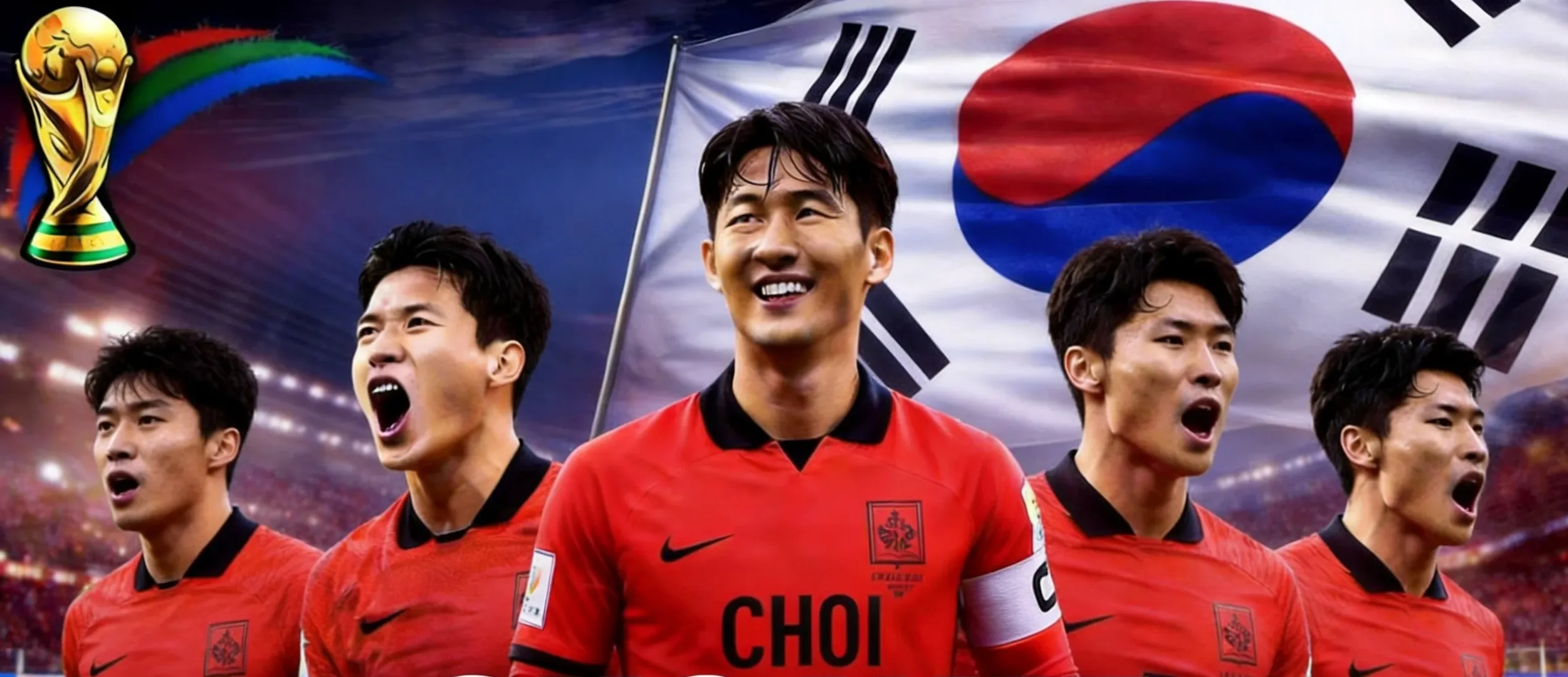
Kim Min-jae is one of the world’s best centre-backs. Now 29, he’s been at Bayern Munich since 2023 after rising through Beijing Guoan, Fenerbahçe, and Napoli. With Napoli, he won Serie A in 2022-23 under Luciano Spalletti. With Bayern, he’s been a starter at the Champions League level. He has approximately 80 caps for Korea and has been the defensive anchor of the national team for half a decade.
Pairing Kim Min-jae with Cho Wi-je is the question Korea’s tournament likely turns on. The two have never played a competitive match together. Cho Wi-je has never faced Champions League-level opposition. The Utah training camp is the only window they have to build a working partnership before facing Czechia on June 11, then Mexico on June 18 — both teams capable of testing the chemistry quickly.
Korean fans on social media have been broadly supportive but watchful. The history of late call-ups at major tournaments is mixed: for every Davor Šuker at Euro 96 or Iniesta-in-extra-time at South Africa 2010, there’s a replacement who never makes it onto the pitch. Hong Myung-bo’s job, between June 3 and June 11, is to compress weeks of partnership-building into days.
What “First FIFA-Approved Replacement” Actually Means
Cho Wi-je is being widely reported as the first injury replacement of the 2026 World Cup. The technical precision matters here.
Scotland’s Tyler Fletcher replaced Billy Gilmour on May 31, 2026 — one day before FIFA’s official June 2 confirmation deadline for the 26-man squads. Gilmour, who plays for Napoli, withdrew with an injury, and Fletcher (a Manchester United midfielder) was named into the slot. This swap occurred at the level of the Scottish FA’s still-fluid pre-FIFA-confirmation roster.
Cho Wi-je’s elevation happened on June 2, after FIFA had officially confirmed Korea’s 26. The mechanism here is different: this is the formal injury-replacement protocol that runs from June 2 through 24 hours before each team’s first match. Korea’s first match is June 11 against Czechia at Estadio Akron in Guadalajara, so Korea’s replacement deadline is June 10 at approximately 22:00 ET. Cho Wi-je was processed eight days inside that window.
In strict procedural terms, Cho Wi-je is therefore the first FIFA-approved injury replacement of the 2026 World Cup. He won’t be the last. Argentina has 10 players on its concern list ahead of the June 16 opener, including Leandro Paredes (hamstring tear) and Emiliano Martínez (broken finger). France has questions over William Saliba. By the time the tournament opens, more replacements are likely.
The Group A Path
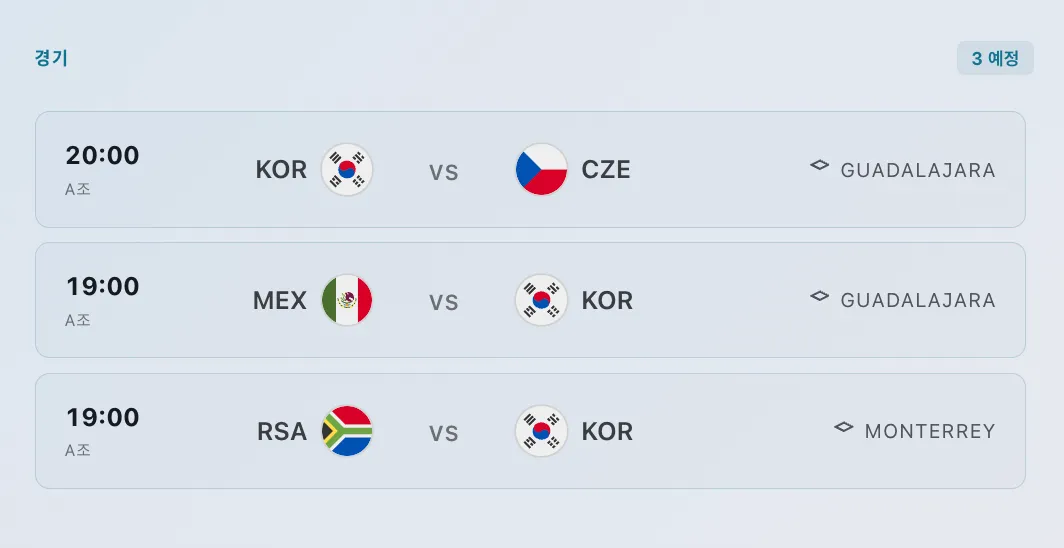
South Korea is in Group A with Mexico, South Africa, and Czechia. The schedule:
| Date | Match | Venue | Time (ET) |
|---|---|---|---|
| June 11 | Korea vs Czechia | Estadio Akron, Guadalajara | 10:00 PM |
| June 18 | Mexico vs Korea | Estadio Akron, Guadalajara | 9:00 PM |
| June 24 | South Africa vs Korea | Estadio BBVA, Monterrey | 9:00 PM |
The June 18 fixture against host Mexico at Estadio Akron in Zapopan, Guadalajara is the marquee group-stage match for Korea. It is also the second consecutive group match Korea plays at Akron — meaning Cho Wi-je’s first taste of World Cup atmosphere comes in the same stadium twice in a week.
Mexico’s 26-man squad — confirmed June 1 — features 17-year-old Gilberto Mora (Tijuana), 39-year-old Guillermo Ochoa (AEL Limassol), and a host of attackers including Raúl Jiménez and Santiago Giménez. Cho Wi-je will likely be matched against Mexico’s striker rotation at Akron in front of a partisan local crowd. The pressure differential — first World Cup match versus 30,000 hostile fans in a stadium designed for Chivas, Mexico’s most followed club — would test players with twice his experience.
The FIFA Replacement Rule, Briefly
FIFA’s 2026 regulations follow the 2022 framework but with one key change. Replacements are permitted up to 24 hours before a team’s first match. The mechanism:
- Trigger: A player on the official 26-man squad sustains an injury or illness severe enough to prevent participation
- Certification: Both the team doctor and the FIFA General Medical Officer must independently confirm the injury severity
- Sourcing: The replacement player does not need to come from the original 55-man preliminary list (this is the 2026 change — previously, replacements had to come from the prelim list)
- Window: Up to 24 hours before the team’s first match (after that, no field-player replacements; goalkeeper replacements are still permitted through the tournament under specific conditions)
This is why Cho Wi-je being a training partner mattered. He wasn’t on Korea’s 55-man preliminary list. Under 2022 rules, that would have made him ineligible. Under 2026 rules, he was eligible the moment Korea needed him and FIFA’s medical office cleared the injury severity.
The 2026 rule change was made partly because of qualifying-window disruptions (FIFA wanted teams to have maximum flexibility in case of late injuries) and partly to reflect modern squad management — many federations now treat training partners as effectively part of the extended squad. Korea has just demonstrated the practical use of this flexibility.
What Comes Next for Cho Wi-je
The eight days between June 2 and Korea’s first match on June 11 are Cho Wi-je’s intensive build period. He needs to:
- Build chemistry with Kim Min-jae in training
- Internalize Hong Myung-bo’s defensive shape and pressing triggers
- Get fitness-tested at altitude (Utah camp is 4,500 feet; Guadalajara is 5,138 feet — comparable)
- Manage the media attention (Korean press is covering the story heavily; Cho is now the most-photographed K League player not at a European club)
Whether he starts on June 11 against Czechia is unclear. Hong Myung-bo may opt for a more experienced reserve in Kim Ji-soo or Park Yong-woo for the opener, easing Cho into the second match. Or he may decide Cho’s fresh legs and Jeonbuk form make him the better pairing for the high-pressing shape. There is also the political dimension — playing the new call-up early sends a signal of confidence; playing him late risks insulting the player’s family, club, and country.
The most likely scenario, based on Korean training-camp reporting: Cho starts against South Africa on June 24, comes on as a substitute against Czechia on June 11, and is held in reserve against Mexico on June 18. But the player himself has earned the right to be ready for whatever Hong asks.
His final words on Monday at the Utah camp: he had to perform as well as he could. The next match is in eight days.
FAQ
Who is Cho Wi-je? Cho Wi-je (조위제) is a 24-year-old South Korean centre-back. He plays for Jeonbuk Hyundai Motors in K League 1, having transferred from Busan IPark (K League 2) in January 2026. He was added to South Korea’s 2026 World Cup squad on June 2 as an injury replacement for Cho Yu-min.
Why was Cho Yu-min ruled out? Cho Yu-min, 29, suffered a foot injury during South Korea’s 5-0 friendly win over Trinidad and Tobago on May 30, 2026, held in Utah. The injury was initially expected to be minor but was re-graded as serious enough to rule him out of the tournament by June 1.
Is Cho Wi-je the first injury replacement at the 2026 World Cup? Yes — the first FIFA-approved injury replacement after the June 2 official squad confirmation. Scotland’s Tyler Fletcher replaced Billy Gilmour on May 31, one day before FIFA’s confirmation deadline, so technically Fletcher’s swap was a pre-confirmation roster change. Cho Wi-je is the first to be processed under the formal post-June-2 injury replacement protocol.
What is the FIFA injury replacement rule for 2026? A player on the official 26-man squad who suffers an injury or illness severe enough to prevent participation can be replaced up to 24 hours before the team’s first match. The replacement does not need to come from the 55-man preliminary list (a change from 2022). Both the team doctor and the FIFA General Medical Officer must certify the injury severity. After the team’s first match, only goalkeepers can be replaced under specific conditions.
Who will Cho Wi-je partner at centre-back? Most likely Kim Min-jae of Bayern Munich, South Korea’s longest-serving central defender with approximately 80 caps. Kim is the defensive anchor; Cho would be the ball-progressing complement. They have never played a competitive match together — the eight days between June 2 and June 11 are their only window to build a partnership.
When is South Korea’s first match? June 11, 2026 at 10:00 PM ET against Czechia at Estadio Akron in Guadalajara, Mexico — the same day the tournament opens with Mexico vs South Africa at Estadio Azteca.
Will Cho Wi-je start the opener? Unclear as of June 3. Korean training-camp reporting suggests Hong Myung-bo may give Cho time to integrate before starting him. The most likely scenario is Cho starting against South Africa on June 24, the third group game.
What is the K League 1 / K League 2 system? K League 1 is the top tier of South Korean professional football, with 12 clubs including Jeonbuk Hyundai, Ulsan HD, FC Seoul, and Pohang Steelers. K League 2 is the second tier. Promotion and relegation work via end-of-season playoffs. K League 1 has produced players for Bayern Munich (Kim Min-jae), Tottenham (Son Heung-min, before his 2024 transfer back), and other European clubs over the past decade.
Is the South Korea squad now stronger or weaker than before? Weaker on paper. Cho Yu-min has more competitive minutes than Cho Wi-je, more international caps, and more chemistry with Kim Min-jae. But Korea has a deep squad of 26 players, and the centre-back rotation includes Kim Min-jae, Cho Wi-je, plus reserve options at Kim Ji-soo and Park Yong-woo. The pairing question is the tactical risk.
Could Korea make another replacement before June 11? Yes, if another player is injured. The 24-hour window before Korea’s first match (June 10 at approximately 10:00 PM ET) is the deadline for any further field-player replacements. After that, only goalkeeper replacements are permitted under specific tournament-time conditions.
Related Articles
- Mexico’s Squad Has a 40-Year-Old and a 17-Year-Old. Both Make History. — Korea faces co-host Mexico on June 18; Mexico is the immediate Group A test for Cho Wi-je’s partnership with Kim Min-jae (squad-breakdown cross-cluster)
- Brazil Has 24 Years Since Its Last World Cup. It Has 10 Days Until Its Next. — Scotland’s Tyler Fletcher swap for Billy Gilmour on May 31 is the precedent referenced here; Brazil plays Scotland at Miami on June 24 (squad-breakdown cross-cluster)
- Skip the Beach. Guadalajara Is Mexico’s Football City. — Korea plays both its first and second matches at Estadio Akron in Guadalajara (host-city cluster)
Official sources (FIFA, Korea Football Association, NBC Sports, Sky Sports, Yahoo Sports, FotMob, Soccerway, Reuters) are linked inline in the relevant sections above.
About the author: Kentaro Tanaka 田中健太郎 is a football correspondent at Kickoff Japan, the Tokyo-based outlet covering Asian football, FIFA tournament rules, and Japanese national-team affairs since 2010. He has covered Korean, Japanese, Iranian and Saudi national teams from venues across Asia and the Middle East. Contact: tanaka@kickoffjapan.jp · LinkedIn: /in/kentarotanaka-kickoffjapan · X: @TanakaKickoff