If a single football match could prove that football is never just football, this is the one.
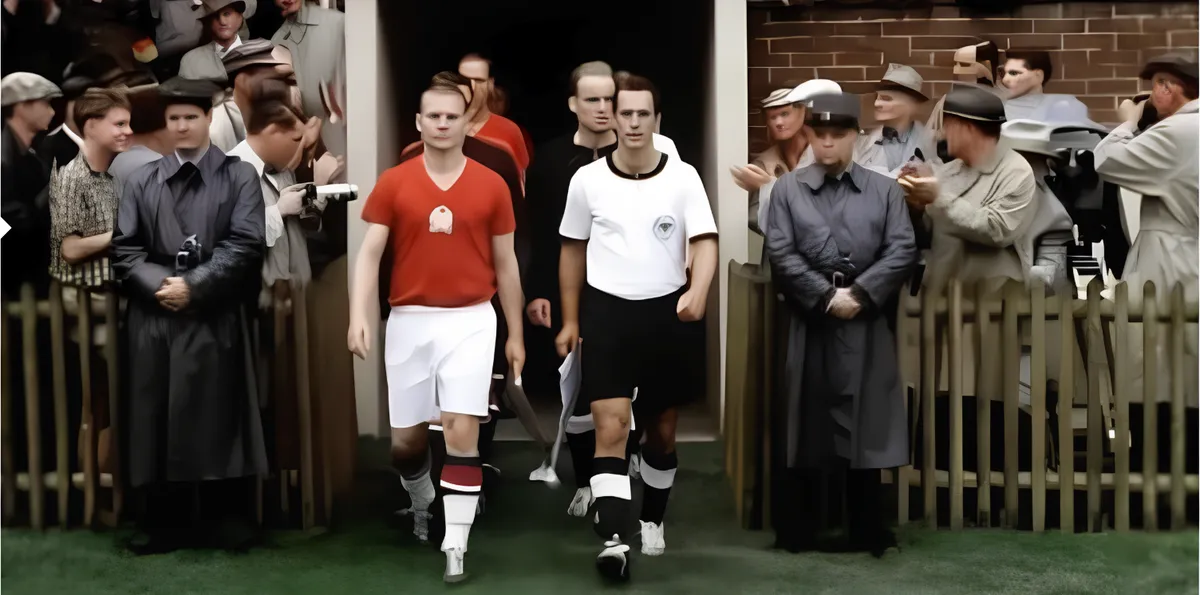
4 July 1954. Wankdorfstadion, Bern, Switzerland. Kickoff at 16:45.
Inside the ground, 60,000 spectators. Outside, every radio across Europe turned up to maximum volume.
Less than ten minutes into the game, Hungary led 2-0.
Everyone assumed the match was over. That Hungarian side was the first national team in football history to be systematically called a “Golden Generation”—an unbeaten run of 32 consecutive international matches, a world record at the time. A year earlier, they had thrashed England 6-3 at Wembley, ending England’s 90-year home unbeaten record.
West Germany? An amateur team from a defeated nation. Their goalkeeper, Toni Turek, worked in insurance. Their captain, Fritz Walter, had spent months in a Soviet POW camp and had been home only three years. Their manager, Sepp Herberger, was still coaching out of a 1930s tactical manual.
Between the tenth minute and the ninetieth, over the next eighty minutes, this amateur side pulled off a comeback that defied every mathematical model.
Hungary’s Golden Generation: The Team That Should Have Rewritten Football
What did the Hungarian squad look like in the summer of 1954?
Ferenc Puskás, 26, captain, number 10. Widely regarded as the best player in the world at the time. Street kids in Budapest had been imitating his left foot for a decade.
Sándor Kocsis, 24, number 9 striker. He would end this World Cup as its top scorer with 11 goals—a single-tournament record that stood for 36 years, until 1990.
Nándor Hidegkuti, 32, attacking midfielder. He is widely credited as the inventor of the false-9 in football history—dropping deep to receive the ball and opening space for Puskás and Kocsis to run into. The idea would later be adopted by Cruyff and refined by Messi, Benzema, and Kane.
József Bozsik, midfielder. Gyula Grosics, goalkeeper—one of the best of his era.
This team’s Elo rating reached 2166 in 1954—a number unmatched in international football until 2014, when the World Cup-winning Germany side finally broke it. Sixty years of ownership.
They were on a 32-match unbeaten streak. They played with tactics no one had seen before. They were favourites to win—not in the “very likely” sense, but in the “it’s already decided” sense.
That 8-3 in the Group Stage Was a Trap
In the group stage, Hungary beat West Germany 8-3.
Looking only at the scoreline, you would think the final was a formality.
But two details in that match determined how the final would end.
Detail one: Herberger deliberately threw the game.
West Germany’s manager Sepp Herberger looked at the group stage draw and ran a cold calculation—he knew even a loss to Hungary would still let West Germany advance via the playoff. So in that match, he deliberately fielded a reserve XI. Fritz Walter and the other key players never made the starting lineup.
The 8-3 scoreline was misleading. It was never a true test of the two sides’ best elevens.
Detail two: the targeted attack on Puskás.
With about 20 minutes left, West Germany’s centre-half Werner Liebrich produced a challenge that almost every football historian since has described as deliberate—he went straight through Puskás’s right ankle.
Puskás was forced off.
He missed the next two matches: the quarter-final against Brazil, the semi-final against Uruguay. Before the final, manager Gusztáv Sebes had him sign a declaration: “I am fully recovered.” Puskás signed. He was not fully recovered.
Herberger, while “throwing” the group-stage match, had performed a piece of precision surgery on Hungary’s talisman. Six years later Puskás himself would say, in an interview: “That wasn’t a game. That was an ambush.”
The Eve of the Final: Rain and a New Pair of Boots
Three hours before kickoff on 4 July, rain began to fall in Bern.
It did not stop. The final was played in the rain from start to finish.
This meant different things for the two sides. For Hungary, the mud disrupted their short-passing, quick-combination game. For West Germany, their captain Fritz Walter—weakened in heat because of malaria contracted during the war—was at his best in cold, wet conditions. “Fritz-Walter-Wetter” (Fritz Walter weather) became a German football idiom from that day on: rain that was on our side.
But the rain wasn’t what decided the final. Another piece of equipment was.
Before the tournament, Adi Dassler—founder of Adidas—had brought the West German squad a revolutionary new football boot: the studs could be unscrewed and replaced.
Every other team in the tournament wore fixed-stud boots—on a muddy pitch, there was nothing to do but slip and swear. The new Adidas boots let West Germany swap studs at halftime based on pitch conditions—short studs out, longer ones in, built for the mud.
In the West German dressing room at the break, all eleven players changed their studs in fifteen minutes. The Hungarians walked back onto the pitch in the same old-fashioned boots, now waterlogged and skidding.
Those boots turned Adidas—at the time a small four-year-old German company—into a global brand. Adidas’s annual revenue before 1954 was 1 million Deutsche Mark; by 1955, it had jumped to 2.4 million.
Minutes 6 to 18: Four Goals
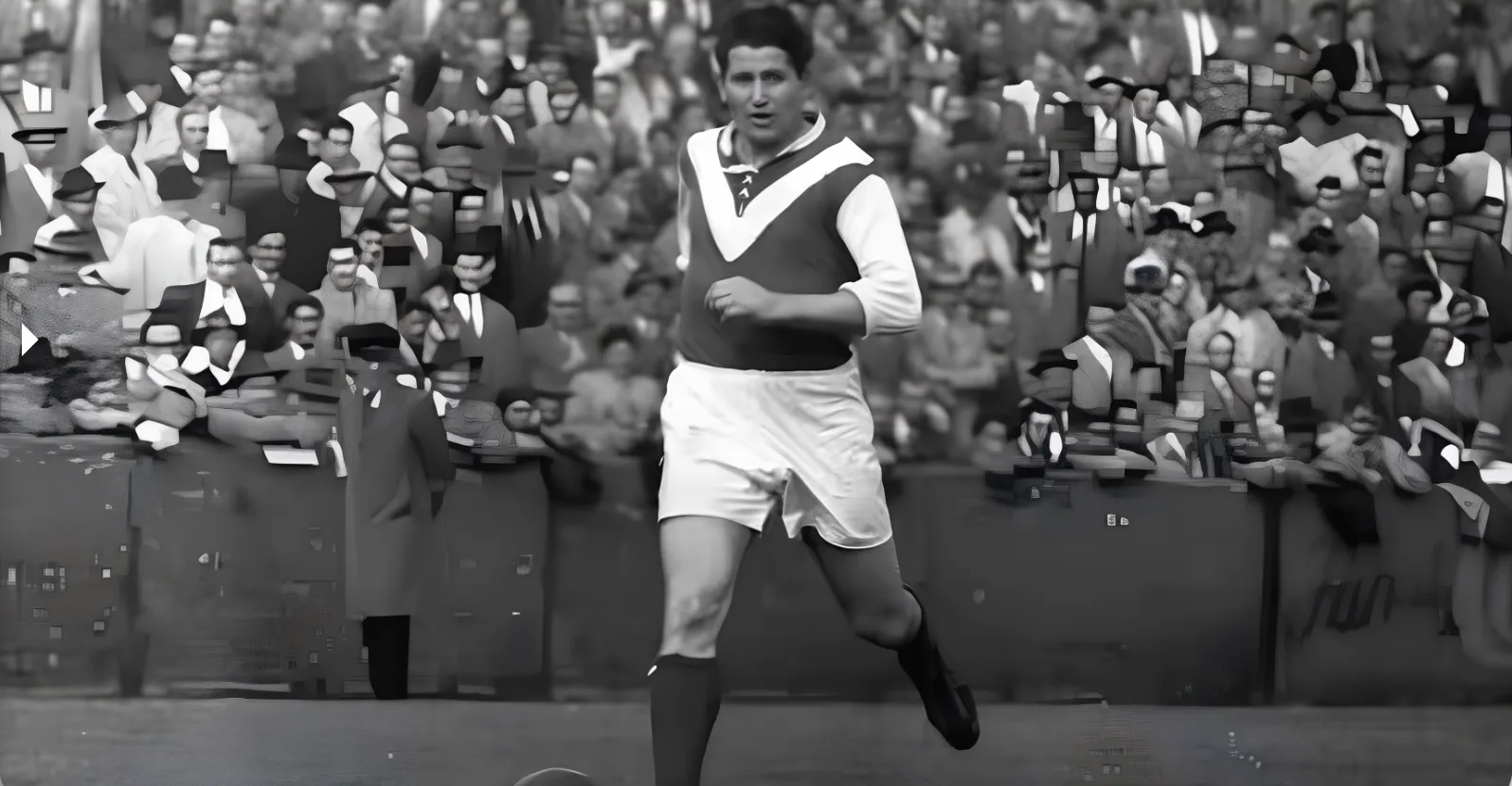
6th minute: Puskás received the ball and struck it; the shot deflected off a West German defender and into the net. Hungary 1-0.
8th minute: A miscommunication between West German keeper Turek and defender Kohlmeyer; Czibor pounced on the loose ball and tapped into an empty net. Hungary 2-0.
In the first eight minutes, the game looked over.
In the next ten minutes, it turned around.
10th minute: West Germany countered, Morlock stretched in the six-yard box and poked home. 2-1.
18th minute: Fritz Walter’s corner came in; Hungary’s keeper Grosics and Schäfer collided at the near post; Rahn pounced on the loose ball at the far post and scored. 2-2.
Eighteen minutes played. Four goals.
Any fan who watched that 2006 goal-swapping classic between Arsenal and Leeds knows that a game that starts like this is destined to keep scoring.
Except the 1954 final didn’t. For the next 72 minutes, no one scored—until the final six minutes.
The Game of Turek’s Life
From minute 20 to minute 83, Hungary attacked wave after wave.
During this stretch, something happened that actually changed the course of the match: West Germany’s keeper Toni Turek played the game of his life.
In the 24th minute, Hidegkuti unleashed a thunderous shot from the edge of the box. Turek flew to tip it away—a save later ranked by the German FA as one of the five greatest in World Cup history.
In the 26th minute, Puskás bore down one-on-one. Turek stood up and smothered him.
In the 47th minute, Kocsis met a cross with a header. Turek dived and got a fingertip.
In the 53rd minute, Czibor’s long-range drive rattled the crossbar.
In the 60th minute, Puskás clipped a ball into the box; Kocsis guided it with a first-time finish—and it hit the post.
Hungary hit the woodwork three times. Had any one of those gone in, the final would have become a rout.
None went in.
In the 60th minute, German radio commentator Herbert Zimmermann delivered a line that has echoed through German football history ever since:
“Turek, du bist ein Fußballgott!” “Turek, you are a football god!”
It remains one of the most famous lines ever spoken in German sports commentary.
Minute 84: Rahn Shoots
83rd minute. 2-2.
Everyone was bracing for extra time. Puskás was visibly limping. Fritz Walter was soaked through, hair plastered to his forehead.
Then came an otherwise ordinary attack.
Schäfer crossed from the left. The Hungarian defender tried to clear, but didn’t get it fully away. The ball fell to the feet of Helmut Rahn.
Rahn was 24, from Essen in the Ruhr. He played on the right wing. He was West Germany’s third-choice forward. In front of him stood one Hungarian defender.
Rahn shot with his left foot—his weaker foot.
The ball skimmed the turf, brushed keeper Grosics’s fingertips, and flew into the net.
West Germany 3-2.
Zimmermann’s commentary became a national treasure in the German Broadcast Archive:
“Schäfer nach innen geflankt—Kopfball—abgewehrt—Rahn müsste schießen—Rahn schießt—Tor! Tor! Tor! Tor! 3 zu 2 für Deutschland!” “Schäfer cuts it in—header—blocked—Rahn has to shoot—Rahn shoots—GOAL! GOAL! GOAL! GOAL! 3-2 for Germany!”
The recording was later pressed onto vinyl, printed on T-shirts, used in films. In 2003, Sönke Wortmann’s film Das Wunder von Bern used it as the emotional climax of its soundtrack. 6.4 million Germans saw that film in cinemas—roughly one in every thirteen Germans bought a ticket.
Minute 87: The Offside That Probably Wasn’t
Three minutes after Rahn’s goal, Hungary countered. Puskás received a pass inside the box and slotted home.
3-3.
English referee William Ling made no signal. Welsh linesman Griffiths raised his flag for offside.
The referee paused for nearly a full minute—consulting his linesmen, consulting his partner on the far side.
Finally, offside was confirmed. The goal was disallowed.
This call is one of the most controversial in 20th-century football.
In 2004, Germany’s NDR public broadcaster dug up unofficial footage from the archives of Swiss national television. The footage came from an amateur camera positioned in the northwest corner of the stadium. It showed that at the moment of touch, Puskás was at least a step behind the last West German defender. He was not offside.
NDR showed the footage to Horst Eckel and Hans Schäfer—two of the West German winners still alive in 2004. Eckel watched in silence for a long time before finally saying: “If that goal had counted, the conversation we’re having right now would be entirely different.”
Puskás himself, in a 1993 interview with British magazine FourFourTwo, said: “There’s one question I’ve never been able to ask out loud—if that goal had counted, would we have won? I don’t know. But I know it should have counted.”
Minute 90: The Whistle
No extra time. The final ended West Germany 3, Hungary 2.
West Germany lifted the Jules Rimet Trophy—their first World Cup.
What happened in the stands mattered more than what happened on the pitch.
West German fans began singing the German national anthem during the ceremony. They were not singing the third verse—“Einigkeit und Recht und Freiheit” (Unity, Justice, Freedom)—which the 1952 government decree had designated as the only appropriate verse for official occasions. They were singing the first verse: “Deutschland, Deutschland über alles”—Germany, Germany above all else.
The lyrics were written in 1841 and are not inherently problematic, but they had been weaponized during the Nazi era. Post-war West Germany had explicitly forbidden this verse at official functions.
And yet, on the afternoon of 4 July 1954, the West German fans in the Wankdorfstadion stands spontaneously sang the first verse.
International media headlines the next day mostly read: “Germany Still Hasn’t Learned.” Britain’s The Guardian ran with “A Dangerous Celebration.”
For ordinary Germans, though, this was not politics. This was the first time in the nine years since the war had ended that they publicly cried for their country.
An elderly worker who had listened on the radio in a Cologne pub told Germany’s ZDF years later: “I cried because I couldn’t remember the last time I could say out loud, ‘I am German.’ It was 8 p.m., 4 July 1954.”
What Came After Hungary: The Golden Generation Vanished
This World Cup was both the peak and the end of Hungary’s Golden Generation.
The Hungarian Revolution broke out in 1956. Soviet tanks rolled into Budapest. The three core players who happened to be abroad at the time—Puskás, Czibor, and Kocsis—chose not to return.
Puskás joined Real Madrid, where he helped win three European Cups (1957, 1958, 1959, 1960, 1966). Czibor and Kocsis joined Barcelona.
None of the three ever wore the Hungary shirt again.
At the 1958 World Cup, Hungary had only four players left from the 1954 final. They exited in the group stage. At Euro 1964, they finished third. Since then, Hungary has never again reached the final of a World Cup or European Championship.
At Euro 2024, Hungary won one group match and lost two. They have been seventy-six years without a major title.
Puskás died in 2006. On the wall of his home outside Budapest hung a single photograph—the Hungary squad in the dressing room before the match on 4 July 1954. Eleven men. All smiling.
No one ever photographed them walking out of the Wankdorfstadion.
On the Word “Miracle”
The 1954 final put “Das Wunder von Bern”—the Miracle of Bern—into everyday German.
But the word is a kind of shorthand.
What happened that day wasn’t really a miracle. It was a precise chain of cause and effect:
- Sepp Herberger threw the group-stage match, gathering intelligence and setting a trap;
- A deliberate foul by a West German defender forced Hungary’s greatest player to play the final on a bad ankle;
- Adi Dassler’s removable studs gave West Germany a precise physical advantage on a muddy pitch;
- Turek played the game of his life, keeping Hungary from ending the match early;
- A linesman’s flag erased a goal that probably should have stood.
This wasn’t a miracle. It was preparation, luck, and a rainstorm all firing together in the same ninety minutes.
But ordinary people don’t need those explanations. They need a simple word for what happened that day.
In German, they found one. Wunder. Miracle.
Seventy-Two Years Later
In June 2026, Germany will return to the World Cup—drawn into Group E against Curaçao, Côte d’Ivoire, and Ecuador. Their manager is Julian Nagelsmann. Their core is Musiala, Wirtz, and Havertz.
They won’t wear new removable-stud boots. They won’t face Hungary in the group stage (Hungary didn’t qualify). Their matches won’t be played in the rain—summer in the United States brings different worries, mostly heat.
But every German player, before boarding his flight, will walk past a wall at Munich Airport. On that wall is engraved the starting XI from 4 July 1954. Below it, a line cut into German football history:
“Das Wunder von Bern. Weil wir uns vorbereitet haben.” “The Miracle of Bern. Because we had prepared for it.”
Sources: Wikipedia entries on “1954 FIFA World Cup Final” and “1954 FIFA World Cup”; ESPN classic-match feature “West Germany 3-2 Hungary (1954 final)”; The Football History Boys, “1954 World Cup Final: The Miracle of Bern”; FIFA’s official “The Miracle of Bern” retrospective; archival material from Sönke Wortmann’s 2003 film Das Wunder von Bern; NDR’s 2004 offside reanalysis; ZDF’s 1994 40th-anniversary documentary; Puskás’s 1993 interview with FourFourTwo; Adidas corporate archive.