The number 38 writes most of the script. When Lionel Messi steps onto the pitch at the 2026 FIFA World Cup, he will become only the sixth player in history to appear at six separate World Cup tournaments, joining an exclusive club alongside Antonio Carbajal, Lothar Matthaus, Rafael Marquez, Gianluigi Buffon, and Cristiano Ronaldo. It is, by his own admission, the final chapter of a 20-year international career that has redefined what a single player can mean to a national team.
Messi has long made “rhythm” his sharpest tool — training loads are down, and the 72 hours before each match are now built entirely around his recovery. But to understand what Argentina stands to gain and lose in his final tournament, you have to look at the full arc of his World Cup story.
A World Cup odyssey: 2006 to 2022
Messi’s relationship with the World Cup has been one of football’s great emotional sagas. At Germany 2006, a fresh-faced 18-year-old came off the bench against Serbia and Montenegro to become Argentina’s youngest-ever World Cup goalscorer. He finished that tournament with one goal and one assist in three appearances before Argentina fell to the host nation on penalties in the quarterfinals.
South Africa 2010 brought higher expectations and a heavier fall. Under Diego Maradona’s chaotic coaching, Messi created 28 chances across four matches — the most by any player in the group stage, according to Opta — but failed to score. A 4-0 quarterfinal demolition by Germany left the squad in pieces and Messi visibly distraught.
Brazil 2014 was, at the time, his finest hour. Five goals and an assist across seven matches carried a defensively resolute Argentina side to the final, where a 1-0 extra-time loss to Germany denied him the trophy. Messi won the Golden Ball as the tournament’s best player, though even that felt hollow. “I would trade every personal award for the World Cup,” he said afterward. Per FIFA’s official statistics, Messi completed 456 passes in that tournament at an accuracy rate of 83.2%, while creating 23 chances — more than any other player.
Russia 2018 was the nadir. A dysfunctional squad under Jorge Sampaoli lurched from a 1-1 draw with Iceland to a 3-0 humiliation by Croatia. Messi’s body language told the story: slumped shoulders, head down, walking through matches. He managed just one goal — a brilliant strike against Nigeria — but covered an average of only 8.4 km per match, well below tournament average. Argentina scraped into the Round of 16 before a thrilling 4-3 loss to eventual champions France ended their campaign.
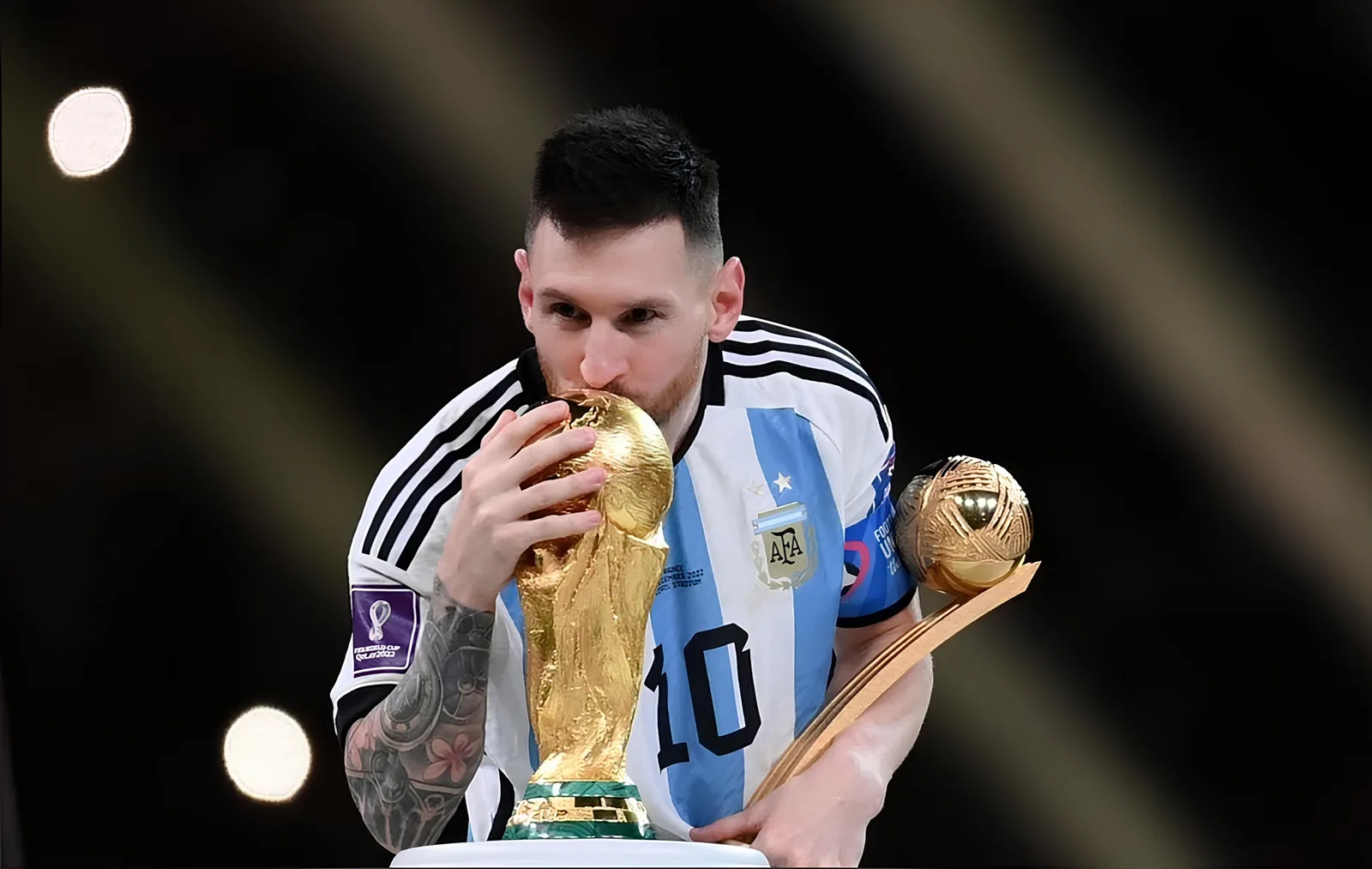
And then came Qatar 2022 — the redemption. Under Lionel Scaloni’s careful stewardship, Messi played every minute of every match en route to glory. Seven matches, seven goals, three assists. He covered an average of 9.1 km per game, according to FIFA’s tracking data, with 34 high-intensity sprints per match. The final against France — a 3-3 draw decided on penalties — is widely considered the greatest World Cup final ever played. Messi scored twice, including a sumptuous extra-time strike, before converting in the shootout. At 35, he had finally completed the set.
The physical reality at 38
Four years on, the numbers tell a more complex story. Messi’s move to Inter Miami in 2023 was widely viewed as a semi-retirement, but his competitive output has defied expectations. In the 2025 MLS season, he recorded 14 goals and 11 assists in 22 appearances. His pass completion rate remained at an elite 89.7%, per MLS Stats Centre data.
But the physical metrics reveal the trade-offs. Scaloni has confirmed Messi will not start all three group games. Friendly data from Argentina’s 2026 warm-up matches shows his sprint distance per 90 minutes is down 12% from 2022 levels, dropping from 216 meters of sprinting per match to approximately 190 meters. His total distance covered has declined from 9.1 km to 7.8 km per 90 minutes. However, his touches now come an average of six meters closer to the opponent’s box than they did in Qatar. Fewer runs, more threat per touch.
“We are managing the best player who has ever lived,” Scaloni told reporters in March 2026. “There is no manual for this. But I can tell you that when Leo is fresh, when he has had the right preparation, he is still the most dangerous player on any pitch in the world. The task is making sure he arrives at the right moments in the right condition.”
Touch maps from Argentina’s recent friendlies paint a fascinating picture. In 2022, Messi’s heat map showed activity across the entire right half-space, from the halfway line to the box. In 2026, his zone of influence has compressed into a lethal pocket between the edge of the area and the right channel — a space roughly 20 meters by 15 meters where he receives, turns, and creates. According to StatsBomb data, his expected assists per 90 minutes have actually increased from 0.42 in Qatar to 0.51 in recent international appearances, even as his total actions have declined.
Managing the minutes: Scaloni’s rotation blueprint
Scaloni’s plan is methodical. Based on Argentina’s warm-up schedule and comments from the coaching staff, the framework looks like this: Messi will start the opening group match — the stage demands it — but is expected to be substituted around the 60th minute. For the second group match, he is likely to begin on the bench entirely, entering only if the scoreline demands it. He will then start the third group match to build sharpness heading into the knockout rounds.
In the Round of 32 and Round of 16, Messi is expected to start but with a hard limit around 70 to 75 minutes. “If we get to the quarterfinals, then the leash comes off,” a source within the Argentina camp told reporters. “From that point, it is about winning. Full stop.”
The substitution patterns from friendlies support this. In six warm-up matches between January and April 2026, Messi started four, completed 90 minutes in none, and averaged 61 minutes per appearance. His impact, though, remained extraordinary: three goals and four assists in those 244 minutes, a goal involvement every 35 minutes.
Who picks up the creation?
When Messi is off the pitch, Argentina do not simply lose a player — they lose a gravitational center. The entire attacking structure must be recalibrated. Scaloni has been rehearsing the alternatives:
- Julian Alvarez drops from shadow striker into a false-9 role, taking responsibility for link-up play in the final third. Alvarez has developed considerably since 2022; his time at Atletico Madrid under Diego Simeone has sharpened his pressing and off-ball work. Per Opta data, he ranks in the top five percent of strikers in La Liga for progressive carries and pressures in the attacking third.
- Alexis Mac Allister takes over midfield progression, stepping into a more advanced number-8 role that allows him to carry the ball into the spaces Messi would normally occupy. At Liverpool, Mac Allister has averaged 6.2 progressive passes per 90 in the 2025-26 Premier League season, making him one of the most press-resistant midfielders in European football.
- Enzo Fernandez is held back for rhythm-changing moments, deployed as a second-half injection of energy and technical quality from a deeper position. His role at Chelsea has evolved into a box-to-box conductor, and Scaloni sees him as the player who can change the tempo of a match from the 60th minute onward.
- Alejandro Garnacho provides the direct running threat from the left flank that Messi no longer supplies. The Manchester United winger’s pace and willingness to take on defenders give Argentina a different kind of danger — less cerebral, more explosive.
Tactical analyst Marcelo Bielsa, in a recent interview with Argentine outlet Ole, observed: “The great challenge for Scaloni is not replacing Messi’s talent — that is impossible. It is replacing his authority. When Messi is on the pitch, the other ten players know what to do because they orient themselves around him. Without him, they must find a new compass.”
The emotional weight: legacy and the Maradona comparison
Messi’s farewell tour carries an emotional magnitude that transcends tactics. In Argentina, the debate over Messi versus Diego Maradona as the greatest ever has largely been settled since Qatar — Messi now holds both the World Cup and the complete statistical record that Maradona never matched. But a second consecutive World Cup would place Messi in a category entirely his own.
No player has won back-to-back World Cups as the undisputed talisman of his team since Pele in 1958 and 1962. Even Pele shared the stage with Garrincha and Vava. If Messi, at 38, can guide Argentina to a repeat, it would be the most extraordinary individual achievement in the history of the sport.
“He doesn’t need another World Cup for his legacy,” former Argentina international Pablo Aimar told FIFA.com. “But he wants it. And that is what makes him dangerous. He has nothing left to prove and everything left to give.”
The title window
Argentina’s group with the USA and Brazil feels comfortable on paper but carries hidden risks. The USA will have the crowd behind them as co-hosts, and Brazil’s rebuilt squad under Dorival Junior showed significant improvement in 2025 Copa America qualifying. The real test arrives in the Round of 16 and quarterfinals — France or Germany are the most likely collision course based on projected bracket positions.
If Argentina reach the semifinals, Messi will have played approximately 450 to 500 minutes across the tournament. That is roughly 200 fewer than his 690 minutes in Qatar. The question is whether his influence per minute can compensate for the reduced volume.
The data suggests it can — but only if Scaloni’s rotation plan holds and the supporting cast delivers. Messi’s 90-minute output deep into the knockouts is the single biggest question mark of the tournament. It is the difference between a storybook ending and an unfinished sentence, the margin between sporting immortality and a great player’s poignant farewell.
One way or another, this is the last time the world watches Messi at a World Cup. Every touch will carry the weight of finality. Every goal will echo into history. The last dance has begun.