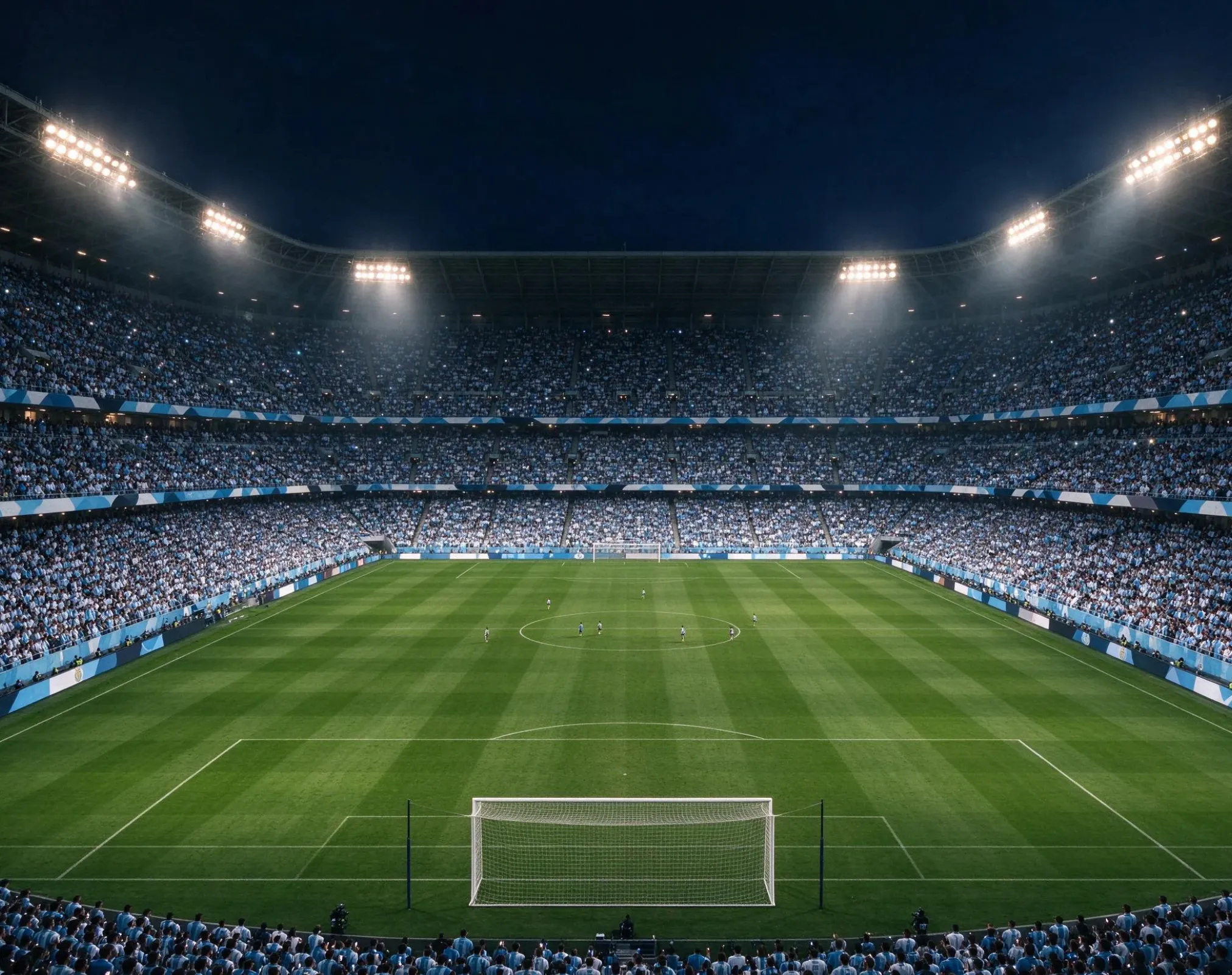

In December 2022, Lionel Messi lifted the World Cup under the Lusail night sky — the last piece of a legendary career. Four years on, La Albiceleste is transitioning. Argentina arrive at the 2026 FIFA World Cup as defending champions for the first time since 1990, when Diego Maradona’s side reached the final in Italy only to fall 1-0 to West Germany. The challenge before Lionel Scaloni’s squad is immense: no South American team has successfully defended the World Cup since Brazil won consecutive titles in 1958 and 1962 under the brilliance of Pele, Garrincha, and Didi.
That 64-year drought looms over everything Argentina do this summer. But if any squad from the continent has the depth, the mentality, and the tactical sophistication to break it, this is the one.
Copa America 2024: proof of concept
The 2024 Copa America served as a critical litmus test, and Argentina passed emphatically. Scaloni’s side won all six matches en route to the title, conceding just two goals in the entire tournament — the best defensive record in Copa America history for a champion, according to CONMEBOL’s official statistics. They outscored opponents 12-2, with Julian Alvarez (four goals) and Lautaro Martinez (three) leading the attack.
More telling than the results was the manner of victory. Argentina controlled an average of 58.3% possession per match, completed 89.1% of their passes, and allowed opponents an average of just 0.78 expected goals per game, per StatsBomb data. For context, that defensive expected goals figure was lower than any team recorded at the 2022 World Cup across a full tournament.
The semifinal against Colombia — a 2-0 win in which Argentina managed the game with ruthless precision after an early Alvarez goal — was perhaps the most instructive performance. Scaloni deployed a mid-block that invited Colombia onto the ball before springing rapid transitions through Mac Allister and Enzo Fernandez. It was a masterclass in controlled aggression.
The spine is still there — but aging
Rodrigo De Paul, Alexis Mac Allister, and Enzo Fernandez remain Scaloni’s preferred midfield trio — the engine behind a Copa America retention that showed European top-tier levels of control. This trio has now played 32 matches together for Argentina, winning 26, drawing four, and losing just two, per Transfermarkt records.
But the spine carries concerns that Scaloni cannot ignore.
In defense, the age profile is the most pressing issue. Nicolas Otamendi turned 38 in February 2026 and is now playing in the Portuguese league with Benfica. His reading of the game remains exceptional — he led all Copa America 2024 defenders in interceptions per 90 — but his recovery pace has declined measurably. According to Opta, his average sprint speed dropped from 30.2 km/h in Qatar to 28.6 km/h in the 2025-26 season.
Cristian Romero, by contrast, is in his prime at 28. His partnership with Otamendi has been central to Argentina’s success: they have conceded just 0.67 goals per match when starting together since the 2022 World Cup, per FIFA data. But Romero’s aggressive style — he averages 2.4 fouls per 90, among the highest for any center-back in the Premier League — carries yellow-card risk in a tournament format.
The wildcard is Lisandro Martinez. The Manchester United defender’s versatility — comfortable at center-back, left-back, and even as a holding midfielder — gives Scaloni options. Martinez’s ball-playing ability from the back (91.3% pass completion in the 2025-26 Premier League, per FBref) makes him the natural long-term replacement for Otamendi. Scaloni has been trialing a Romero-Martinez partnership in friendlies, and the early returns are encouraging: in three starts together, they have conceded zero goals.
In midfield, the trio of De Paul, Mac Allister, and Enzo Fernandez has earned comparisons to Spain’s Xavi-Iniesta-Busquets axis — high praise, but not entirely unwarranted. De Paul, now 32, functions as the relentless pressing trigger and emotional heartbeat. Mac Allister, refined by two seasons at Liverpool under Arne Slot, has evolved into one of the most complete midfielders in world football: his 7.3 progressive passes per 90 and 3.1 tackles and interceptions per 90 in the Premier League put him in the top five percent at his position, per FBref data.
Enzo Fernandez, still just 25, is the youngest and most dynamic of the three. His development at Chelsea has been uneven in club terms, but for Argentina, he has been consistently excellent — averaging 8.2 ball recoveries per match at the 2024 Copa America, the highest of any midfielder in the tournament, according to CONMEBOL statistics.
A new front line: life after peak Messi
The most significant tactical evolution from 2022 to 2026 is the redistribution of creative responsibility. In Qatar, Messi was responsible for 41% of Argentina’s chance creation in open play, per Opta. That figure has dropped to approximately 22% in 2025-26 international matches, with the slack picked up by a deeper and more versatile attacking unit.
Julian Alvarez has graduated from Messi’s apprentice to Argentina’s primary attacking threat. His time at Atletico Madrid under Diego Simeone has added a combative edge to his natural technical gifts. Alvarez’s 2025-26 La Liga numbers are formidable: 18 goals, 7 assists, and 5.3 shot-creating actions per 90 — figures that place him among the top strikers in European football.
Alejandro Garnacho is being trusted with the left-wing role that Angel Di Maria once owned. The Manchester United winger, still only 21, offers searing pace and an unpredictability that gives defenses a different problem than Messi. His 14 goals and 9 assists in the 2025-26 Premier League season have confirmed his readiness for the world stage.
Lautaro Martinez, at 28, provides the insurance policy. The Inter Milan striker’s finishing instincts are among the sharpest in world football — his 93 goals in his last three Serie A seasons speak for themselves. He and Alvarez have shown they can coexist in a front two when Scaloni shifts to a 4-4-2 diamond in certain tactical scenarios.
Scaloni’s tactical evolution: 2022 to 2026
Scaloni’s Argentina in Qatar operated primarily in a 4-3-3 that morphed into a 4-4-2 in defensive phases, with Messi exempt from pressing duties. The system was built on defensive solidity, quick transitions, and Messi’s genius in the final third.
The 2026 iteration is different. Without Messi as a guaranteed 90-minute starter, Scaloni has developed a more possession-oriented approach. The 4-3-3 remains the base shape, but the full-backs now invert — both Nahuel Molina on the right and Nicolas Tagliafico (or Martinez) on the left tuck into midfield when Argentina have the ball, creating a 2-3-5 attacking structure that overloads central areas.
“The team has matured,” Scaloni said in a press conference in February 2026. “In 2022, we needed to create space for one man. Now, we create space for the team. The principles are the same — control, aggression, intelligence — but the expression is more collective.”
Defensively, Argentina have become even more disciplined. Their PPDA (passes allowed per defensive action) in 2025-26 qualifiers and friendlies averaged 8.7, indicating an intense pressing approach that ranks among the most aggressive of any World Cup contender, per StatsBomb data.
Historical context: the weight of defending
The history of title defense at the World Cup is overwhelmingly discouraging. Of the eight nations that have attempted to defend the trophy since Brazil succeeded in 1962, only three have reached the final: West Germany in 1986, Brazil in 1998, and France in 2022. France came agonizingly close, losing to Argentina on penalties in Qatar after a Kylian Mbappe hat trick.
The most common fate for defending champions is early elimination. Spain were knocked out in the group stage in 2014. Germany suffered the same ignominy in 2018. Italy did not even qualify in 2018 or 2022. France’s run to the 2022 final was the exception, not the rule.
Argentina’s advantage is that Scaloni has kept the core group together while refreshing the edges. Of the 23 players who featured in Qatar, approximately 14 are expected to be in the 2026 squad — continuity that no other recent defending champion has matched.
Group outlook: no room for complacency
Argentina’s group features Brazil, the USA, and Japan — a draw that looks manageable on paper but is loaded with traps.
Brazil is always the defining rivalry. Argentina hold a 42-40 head-to-head advantage in 106 meetings, per RSSSF records, but recent history favors Scaloni’s side. Argentina have beaten Brazil in four of their last six encounters, including the 2021 Copa America final and the 2024 Copa America quarterfinal. However, Brazil’s rebuilt squad under Dorival Junior has shown marked improvement, with Endrick, Vinicius Junior, and Rodrygo forming a fearsome front three.
USA as co-hosts will have the crowd and the adrenaline of a home World Cup. The Americans have improved dramatically under Gregg Berhalter’s successor, with a squad built around Christian Pulisic, Weston McKennie, and a new generation of MLS and European-based talent. Argentina beat the USA 3-0 in the 2024 Copa America semifinal, but a World Cup on American soil is a different proposition entirely.
Japan has been consistently underestimated at recent World Cups and consistently overperformed. Their high-press, high-tempo style caused both Germany and Spain serious problems in Qatar, and if the opening match is played at altitude in Mexico City — at 2,240 meters above sea level — the physical demands could neutralize Argentina’s technical superiority.
Key weaknesses opponents will target
Argentina are not invulnerable. Analysts across Europe and South America have identified several pressure points:
Set-piece defense remains a concern. Argentina conceded from corners three times in the 2025 World Cup qualifying cycle, and Otamendi’s declining aerial ability compounds the problem. At the Copa America 2024, opponents generated 1.3 expected goals from set pieces against Argentina across the tournament — a figure that ranked in the bottom half of the eight quarterfinalists, per StatsBomb.
Transition defense when the full-backs invert is the system’s structural risk. If possession is lost in the build-up phase, the space behind the inverted full-backs can be exploited by fast wingers. Teams like France (Mbappe), England (Saka), and Brazil (Vinicius Jr.) have the personnel to punish this.
Depth at goalkeeper is an underrated concern. Emiliano Martinez remains world-class — his penalty-saving record is unmatched, and his distribution has improved markedly at Aston Villa — but the backup options lack tournament experience.
Despite these vulnerabilities, Argentina remain the consensus second favorite behind France in most pre-tournament rankings. Their blend of proven winners, emerging talent, and tactical flexibility makes them perhaps the most complete squad heading to North America.
The question is not whether Argentina have the quality to retain the trophy. It is whether they have the hunger — and whether history’s relentless tide against defending champions can finally be turned.